


Alternanthera dentata Seeds | Ruby Leaf
LATIN NAME: Alternanthera dentata
COMMON NAME: Ruby Leaf
Plant Profile
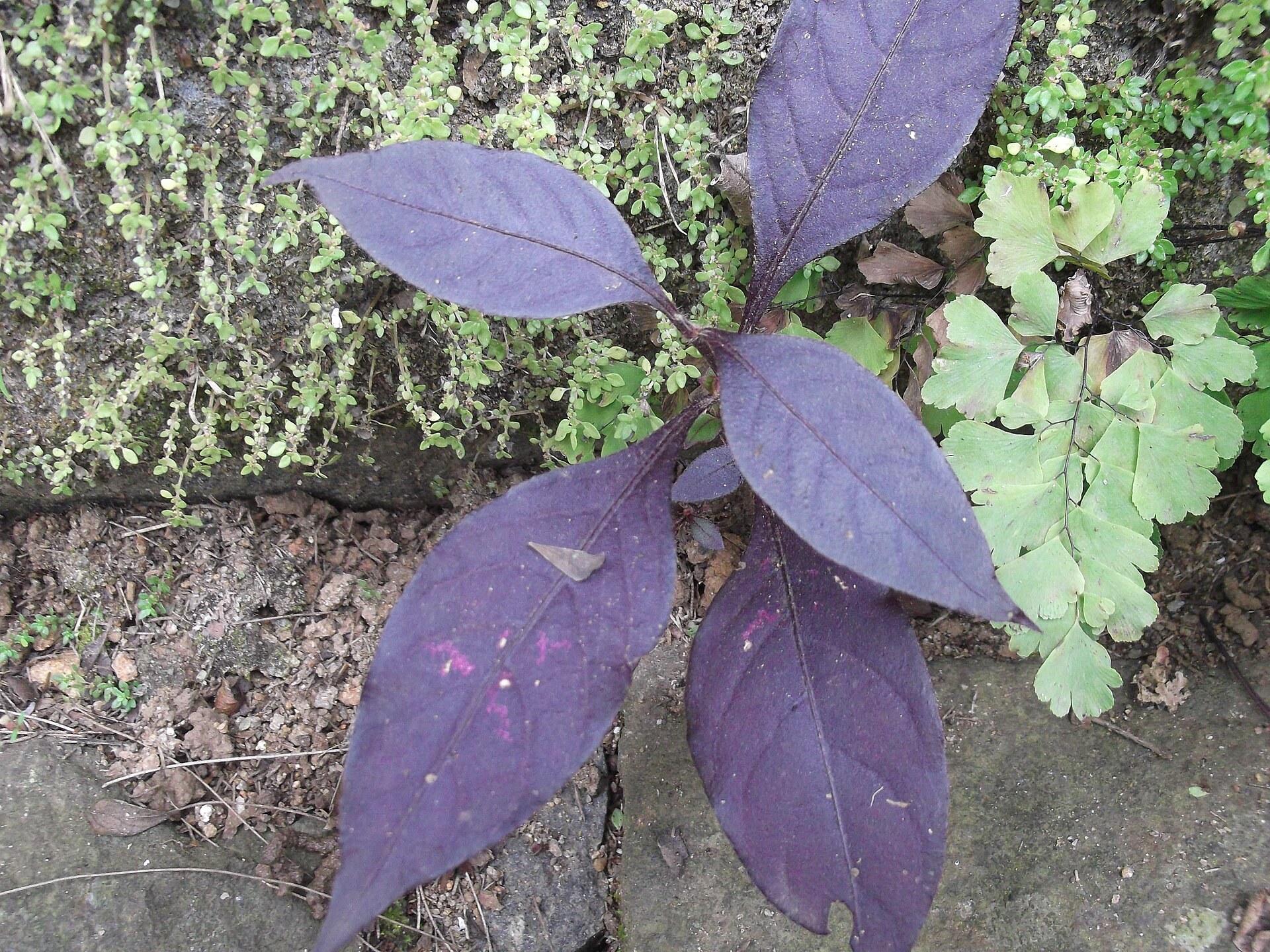
Ruby leaf is a fast-growing herbaceous groundcover of the amaranth family, 60 to 80 cm tall, with pointed burgundy foliage whose undersides carry a radiant ruby red. Its habit is compact, mounding and spreading, and the effect is a plant grown entirely for colour that no flower could hold for as long.
Its native range runs down the American tropics from southeastern Mexico through Guatemala, Nicaragua and Colombia to Ecuador, Peru, Brazil, Bolivia and northeastern Argentina. The naming has layers: first described as Telanthera brasiliana var. villosa in 1849 by Alfred Moquin-Tandon, it now circulates as Alternanthera dentata, described by Stuchlik and Robert Elias Fries in 1913.
It resembles its relative Alternanthera bettzickiana closely, and the two share some strikingly similar-looking cultivars, which keeps the seed racks and the botanists in polite disagreement. The flowers, when they come, are dark creamy pompoms in winter and early spring, a footnote to the foliage.
The popular cultivar Little Ruby is shorter and slightly less brownish in colour, with smaller leaves than the type. Between them the two forms cover most of the front-of-border and container work that bedding coleus once did, with better heat behaviour and no shade requirement. It sits among Halogeton arachnoideus, Atriplex hortensis and Salsola tragus, all Amaranthaceae.
Science & Biotechnology
The colour is anthocyanin business done well: burgundy upper surfaces and a red reverse that flashes when the wind turns a leaf, so the plant changes tone with the weather instead of blooming. Deeply pigmented foliage of this kind holds its colour in heat and sun where chlorophyll-only bedding burns out.
The family physiology backs it up. Amaranths are built for hot, bright conditions, and this species is explicitly noted for humidity tolerance and heat tolerance, thriving in conditions that collapse temperate foliage plants. Its one demand in return is drainage; the root run resists sitting water more than drought.
Propagation is famously easy. The plant roots from stem cuttings, and would root readily in plain water, which makes it a standard subject for propagation demonstrations and a fast turnover crop for nurseries. Seed-grown stock varies a little in depth of colour, which is the trade’s reason for keeping clones of the named forms.
Uses & Benefits
In the garden it is the contrast plant: suited for pots, usable as a low hedge, and deployed deliberately against lighter foliage, where the burgundy reads almost black at distance and the ruby reverse gives the bed a live edge. A single row reorganises a pastel border.
It does its best work where summer defeats ordinary bedding: humid, hot, bright. In temperate climates it is grown as a warm-season annual or lifted before frost, and it wants a somewhat shaded, frost-free location to overwinter, which in practice means a bright windowsill or a heated porch.
For containers it is close to ideal: mounding, self-branching, tolerant of cramped roots, and consistent in colour from spring to the first cold night. The maintenance list is short, water when dry, trim once mid-season to keep the mound tight, and never fertilise heavily enough to force green growth back. Fed hard, the foliage fades toward olive and the whole point of the plant walks off.
Growing from Seed
Sow in spring at warm temperatures, surface-sown or barely covered, since the seed is fine and wants light and steady moisture. Germination is quick in heat, and the seedlings show their colour from the first true leaves, which makes rogueing the pale ones easy while they are small.
Grow the seedlings bright and do not push them; the species colours best in full sun to partial shade and well-drained soil, and a shaded, overfed seedling stays green and leggy. Pinch once early to set the mounding habit, then plant out after frost 25 to 30 cm apart.
Through the season, water when the surface dries and trim once if the mound loosens. If a plant is worth keeping over winter, take cuttings in late summer; they root in water on a windowsill and carry the colour line through to next spring better than any seed lot.
Our Take
Ruby leaf is the annual for gardeners who have grown tired of waiting for flowers to earn their keep: from the first warm week to the last, it supplies the colour, the contrast and the structure, and it asks for heat rather than skill.
Sow it where the sun beats down and the soil never sits wet, and judge it in August when everything paler has surrendered. The flowers, if you notice them at all, arrive as a bonus. Take cuttings in early autumn and the colour carries through winter on a windowsill for free.
Related Reading
Continue exploring with these related plants: