


Cirsium arvense Seeds | Creeping Thistle
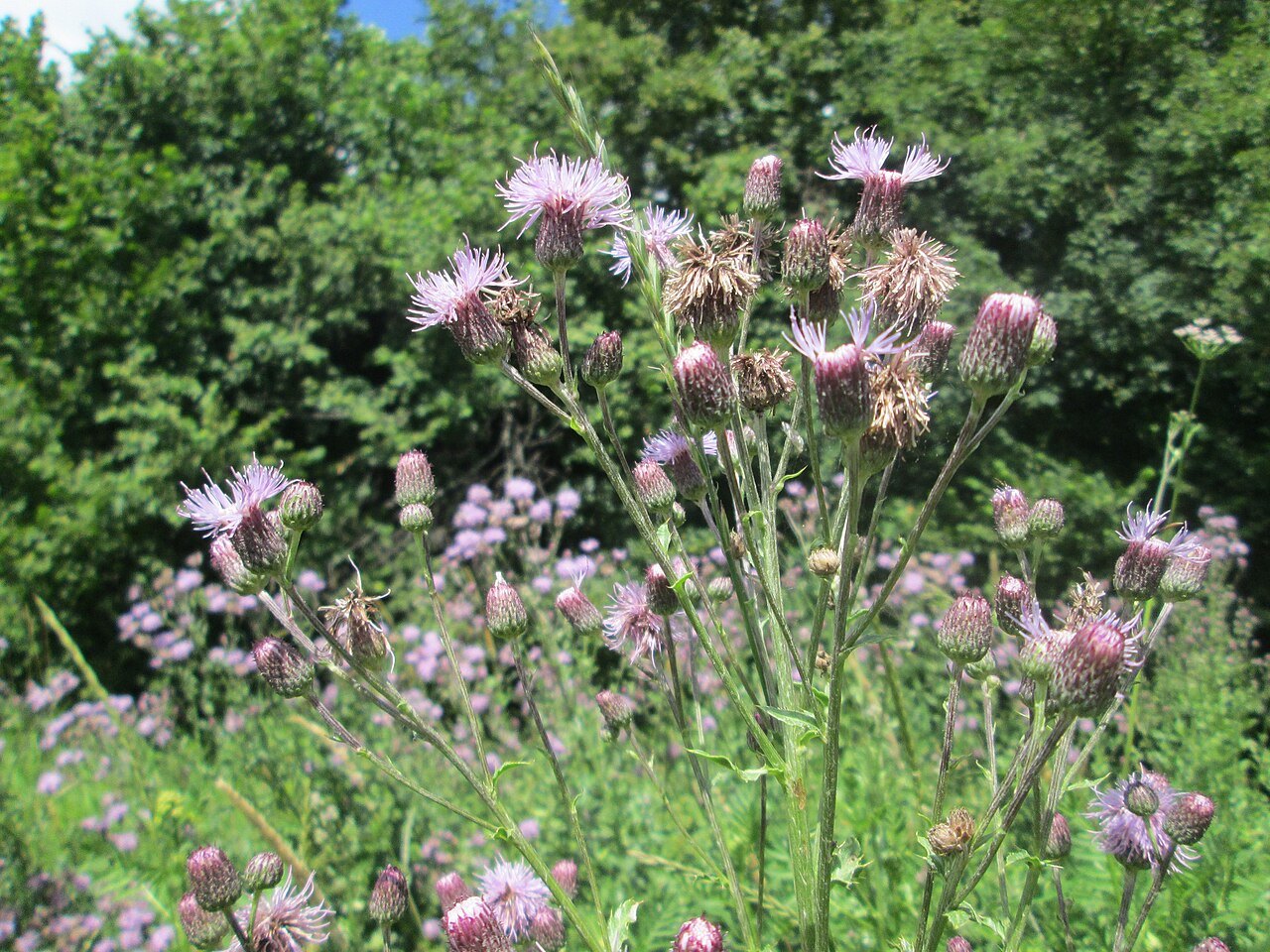
LATIN NAME: Cirsium arvense
COMMON NAME: Creeping Thistle
Plant Profile
Creeping thistle is native across Europe, western Asia and northern Africa, and it has followed agriculture almost everywhere else. It is a perennial, dying back to the root each winter and rebuilding a stem 0.3 to 1.2 m tall the following spring, armed along every leaf edge with spines fine enough to draw blood without warning.
The flower heads are purple, produced in loose clusters from June to September, and they are the part most people recognise. The rest of the plant is a network of brittle, branched roots that run horizontally through the topsoil and go down further than most people dig.
In North America it is called Canada thistle, which is simply wrong. The name was in use by the late eighteenth century, when settlers assumed the plant had arrived from the north, and it has stuck for two centuries despite the species being Eurasian. The older English name is creeping thistle, and the list of local names is longer than most plants manage: corn thistle, cursed thistle, perennial thistle, and in one nineteenth-century American source, lettuce from hell.
Science & Biotechnology
The root system is the reason the plant is so hard to be rid of. A single plant can occupy several metres of ground, with vertical roots reaching two metres and horizontal ones spreading wider. Every fragment of root longer than about a centimetre can produce a new shoot, so cultivation does not remove the plant, it multiplies it. This is why a rotavator is the worst tool you can use on an infested patch.
It is also dioecious, with male and female flowers on separate plants, which is unusual in the thistles. That means seed set requires cross-pollination, and the pollen is carried by bees and hoverflies rather than wind. The seed itself carries a pappus of feathery hairs and travels on the wind, though most of it lands within a few metres of the parent.
Photosynthetically it is a C3 plant, the older and less water-efficient of the two main pathways, which suits the temperate, moisture-retentive soils it evolved in. It is classed among the most serious agricultural weeds in the world, and it is legally regulated as a noxious weed in many jurisdictions, which tells you something about how well it competes.
Uses & Benefits
Set aside the field view for a moment and it is a first-rate bee plant. The flowering period is long, the heads are open and shallow, and a stand of thistle will hold more pollinators per square metre than most garden flowers. Beekeepers in parts of Europe value it, and thistle honey is a recognised light, mild variety.
The young stems can be peeled and eaten raw, and the root has a history of use in folk medicine as a diuretic. Neither is a reason to plant it in a vegetable garden, but both are worth knowing if you forage.
For wildlife it does more than feed insects. The seed is taken by finches, and several butterflies use it as a larval host. In a wild corner where it can be contained, it earns its space; in a border, it does not. The Asteraceae thread continues with Thymophylla tenuiloba, Rudbeckia amplexicaulis and Ursinia anthemoides.
Growing from Seed
Seed needs a cold period to germinate well. Sow in autumn, on the surface and lightly pressed in, and let winter do the work; germination the following spring is usually uneven, spread over several weeks. Fresh seed sown in spring without stratification will germinate, but at a lower percentage and with no predictability.
If you are raising it deliberately, sow into deep pots rather than a seed tray. The taproot goes down fast, and a plant left in a shallow tray will be checked for a season. Plant out while small, because established plants do not move. A patch that has been in grass for years will already have roots through the top 30 cm, and your first season is spent weakening them, not removing them.
Containment is the whole discipline. Sink a root barrier to 45 cm around the patch, or grow it in a large bottomless container, and remove flower heads before they set seed if you do not want it in the neighbourhood. Do not compost the roots: they survive a domestic heap.
Our Take
This is the one plant in this catalogue I would hesitate to sell anyone with a small garden. It is beautiful in flower, it feeds more insects than most things you could plant instead, and it will take over a bed within three seasons if you turn your back. For a wildflower strip against a boundary, with a mown path between it and the rest of the garden, it is genuinely worth having. For a mixed border, no.
Related Reading
Readers interested in Creeping Thistle frequently explore these as well: