


Centaurea dealbata Seeds | Persian Cornflower
LATIN NAME: Centaurea dealbata
COMMON NAME: Persian Cornflower
Plant Profile
Persian cornflower, whitewash cornflower: the second name is a translation of the epithet, and the epithet comes from the Latin dealbare, to whitewash. It refers to the underside of the leaf, which is covered in silver hairs dense enough to look painted on. The plant was described by Karl Koch in 1851, in volume 24 of Linnaea.
It is native to the northern Caucasus, Transcaucasia and Turkey, and it has been introduced to Austria, the Baltic states, Belgium, Czechoslovakia, Germany, Britain and Poland, mostly by way of gardens. In parts of the United States it has naturalised, and weed registers classify it as a casual alien: it escapes, but it does not invade.
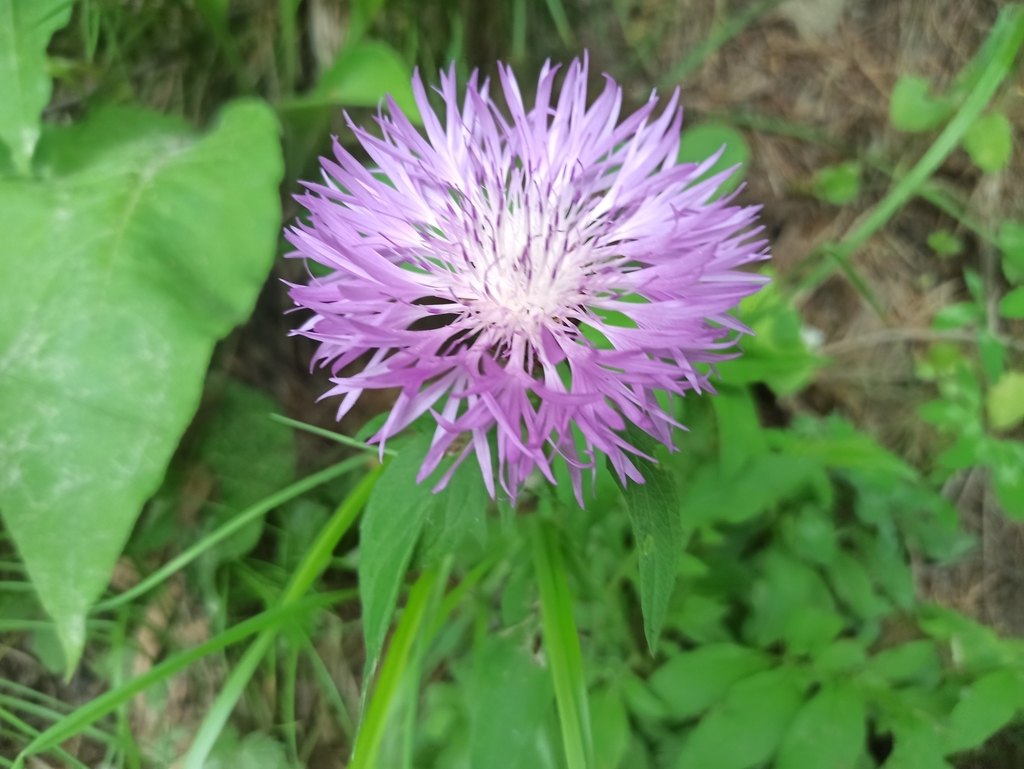
The head is a composite of rosy outer florets shading to cream at the centre of a 5 cm disc, surrounded by scaly bracts, on a slender peduncle 45 to 60 cm long. The flowering period is early summer, and the whole effect is softer than the annual cornflower and considerably larger.
Science & Biotechnology
The leaves are the interesting structure. Like those of Centaurea moschata they are divided, but the division here is regular, almost geometric, and the underside carries a dense indumentum of silver hairs. That layer does two jobs: it reflects light, which reduces heat load, and it traps a thin boundary of still air, which reduces water loss.
Silver foliage in a plant from the Caucasus is not decoration. The habitat is dry in summer and cold in winter, and a leaf that reflects rather than absorbs is a leaf that survives both. The same logic appears across the Mediterranean flora and it is worth reading as a signal: grey means sun and drainage, not shade and irrigation.
The genus has been split, and the plant now sits in Psephellus, a segregate of Centaurea distinguished on bract and appendage anatomy rather than on habit. The garden trade has been slow to follow, and both names will be in catalogues for years. For the grower the change means nothing except a moment of confusion at the seed rack. The Asteraceae thread continues with Centaurea scabiosa, Centaurea americana and Arctotis stoechadifolia.
Uses & Benefits
It is a border plant for the front or middle, where the silver foliage can be seen before and after the flowers. The leaves emerge early and hold through the season, and a clump that has finished flowering is still a plant worth looking at, which is more than can be said for most cornflowers.
The flowers attract butterflies and bees, and the plant self-seeds to a degree without becoming a nuisance. It is drought tolerant and widely adaptable, and it asks for little beyond sun and drainage. In a dry border it will outlast the delphiniums and the lupins that were planted with it.
The cultivar Steenbergii is the one usually sold, with larger heads and a stronger pink. Seed from it does not come true, and a packet of species seed gives a range of pink intensity and a range of silver in the leaf, which is either a defect or the point depending on what you wanted.
Growing from Seed
Sow in late winter or early spring at 16 to 18 °C, on the surface and barely covered. Most of the seed is up inside three weeks. The seed is large enough to handle and the seedlings are sturdy, which makes this one of the easier perennials to raise from a packet.
Prick out into individual pots and grow on cool and airy, hardening off before planting out in late spring or early autumn. Space at 40 cm. The plant resents wet feet more than cold, so plant it high on a slope or in gravel, with the crown just above the soil line.
Division every three or four years keeps the clump vigorous; lift in spring, cut the root ball into pieces with a spade, and replant the outer sections. The centre is woody and should go on the compost. Seed will not reproduce Steenbergii, so division is the only way to keep a particular form.
Our Take
It is a plant that has never had the attention it deserves, and the reason is probably the name. Persian cornflower sounds like something from a seed catalogue of 1900, and the plant itself is tough, silver and undemanding, which is not a fashionable combination.
Grow it for the leaves as much as the flowers. A clump at the front of a dry border, with the undersides turned up by the wind, is a better use of silver than most of the plants sold for it. The flowers are a bonus that arrives in June and is over by July.
Related Reading
Gardeners who grow Persian Cornflower often pair it with these related subjects: