


Tithonia rotundifolia Seeds | Mexican Sunflower
LATIN NAME: Tithonia rotundifolia
COMMON NAME: Mexican Sunflower
Plant Profile
Mexican sunflower is native from Mexico through Central America, and the size difference between wild and garden plants is worth stating plainly: up to 4 m in its native habitat, 0.8 to 1.5 m in a British or northern European border. It is a perennial where winters are frost-free, an annual everywhere colder than USDA zone 10, and it behaves like a completely different plant in the two situations.
The leaves are large and coarse, deltoid to lanceolate and occasionally lobed, up to 38 cm long and 30 cm wide, on petioles that can reach 40 cm. The upper surface is grey-green and the underside is hairy, so the plant looks dusty rather than glossy and why water runs off it in beads. The lower leaves are usually three-lobed.
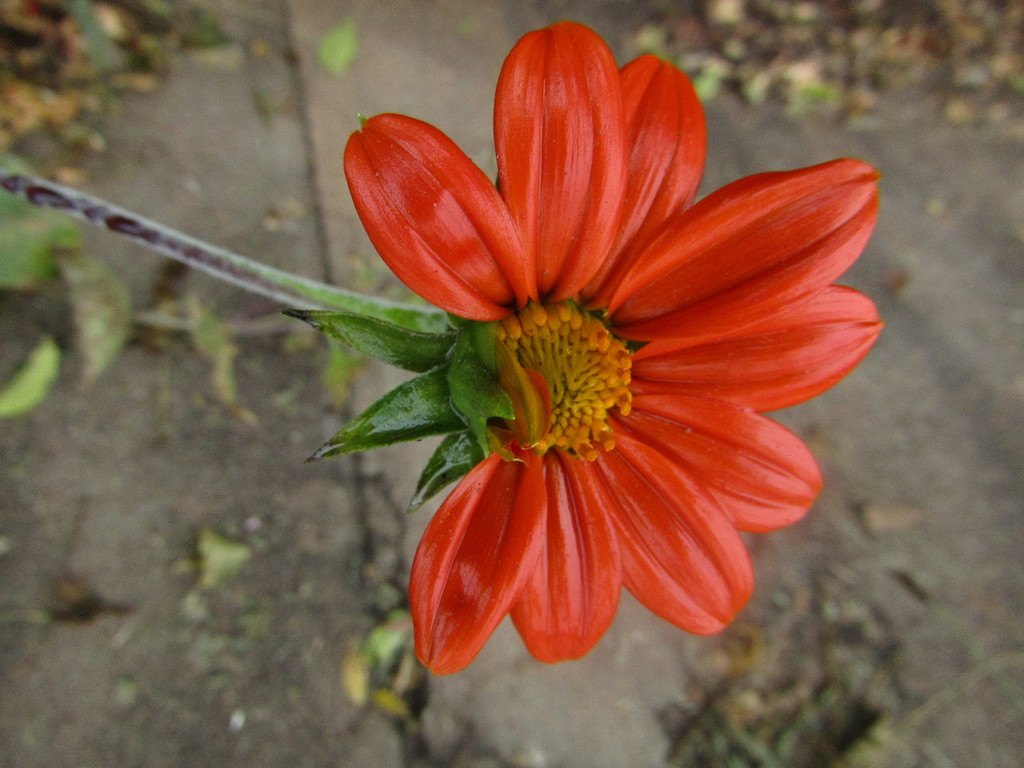
The heads are 5 to 8 cm across, rarely 10, with broad vermilion ray florets and a centre of golden disc florets. Philip Miller described the species in 1768 as Tagetes rotundifolia, filing it with the marigolds, and Hooker published it again in 1834 as Helianthus speciosus. S. F. Blake moved it to Tithonia in 1917. Other Asteraceae on the list: Anthemis tinctoria, Aster tataricus and Tragopogon pratensis.
Science & Biotechnology
The seed is a cypsela under a centimetre long, brown or black, with two unequal wings that are shed at maturity. Asymmetry of that kind usually means rotation: a falling seed that spins stays airborne longer and travels further from the parent, which is an advantage on the open roadside ground the plant colonises. The wings are the dispersal mechanism, not decoration.
Flowering is governed by day length. The plant begins in mid-summer as the days shorten and continues until frost, so early sowing does not produce significantly earlier flowers. It produces a bigger plant that flowers on the same calendar date, and a bigger plant is a taller one with more stem to snap. The response is the reason the species is a short-season ornamental in temperate gardens.
The stem is hollow and lignifies quickly from the base upward, which gives a rigid lower section and a soft upper one. Wind loading concentrates at the transition, and that is where the plant breaks. Breeding has selected for flower colour and compact habit, not for stem strength, so the fault has never been corrected in the garden strains.
Uses & Benefits
Its use is as a background plant, a screen of coarse leaves with orange heads in front of a hedge or a wall, at 30 to 50 cm spacing so the plants support each other. It wants poor to average, well-drained soil and shelter from wind. In rich soil it grows taller, flowers later and falls over sooner, which is the opposite of what most people expect from feeding.
For cutting, pick when the ray florets are fully expanded and sear the stem ends in hot water for ten seconds. The stems are hollow and full of milky sap, and without sealing they collapse within hours. Even handled well it lasts four or five days, which is shorter than a sunflower and longer than most people manage.
As a late-season nectar source it ranks among the best. Migrating monarch butterflies, hummingbirds and a wide range of bees work the heads through August and September, when the border has thinned out. Outside its native range it has naturalised in parts of Africa up to 1,580 m, and in India and Southeast Asia it turns up on roadsides and disturbed ground.
Growing from Seed
Sow indoors six to eight weeks before the last frost, 1 cm deep in individual cells rather than a communal tray. Germination takes seven to fourteen days at 21 to 24 °C. The seedlings are vigorous and fast, and they resent being held in a small pot: a plant that becomes root-bound before planting out never recovers its momentum.
Pot on early and keep the plants moving. Harden off over a week, then plant out once the soil has warmed and frost has passed, watering in well. A handful of compost in the planting hole is enough; more than that produces leaf at the expense of flower, and the stems get longer and weaker in proportion.
Pinch the growing tip once, about ten days after planting out, and the plant will branch into three or four stems instead of one. That single pinch is the difference between a plant that breaks at the first gale and one that bends. After that, water only in drought. The plant tolerates dry spells far better than it tolerates kindness.
Our Take
For six weeks in late summer there is nothing else in the border that orange, and that is the entire case for growing it. The colour is warm rather than red, so it sits beside magenta and purple without the clash you get from a scarlet zinnia, and it holds in low evening light when everything else has gone flat.
Plant it where a snapped stem does not matter: behind a hedge, against a warm wall, at the back of a border you walk past rather than through. Stake it if you must, but a staked tithonia looks like a plant in hospital. Better to accept the collapse in October, pull the whole thing out, and sow it again next spring.
Related Reading
If Mexican Sunflower appeals to you, these related plants are worth a look: