


Mimulus hybridus Seeds | Monkey Flower
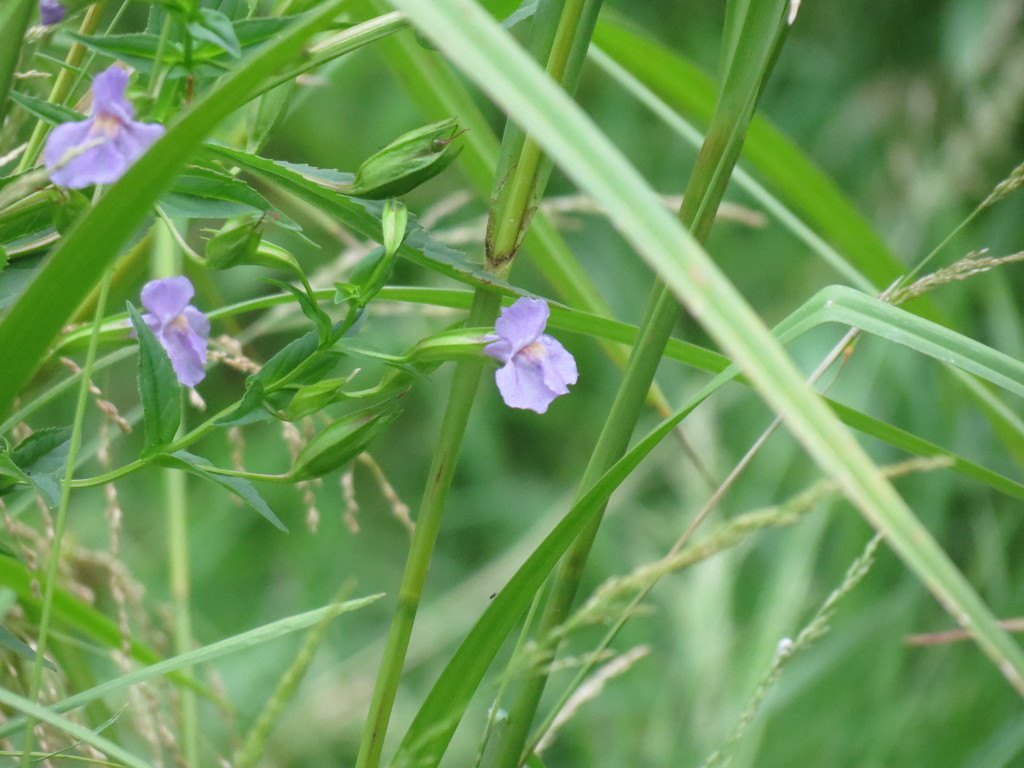
LATIN NAME: Mimulus hybridus
COMMON NAME: Monkey Flower
Plant Profile
Mimulus hybridus is the garden monkeyflower, a hybrid of two western North American species that has been in cultivation since the early nineteenth century. Modern botany places it in Erythranthe, as Erythranthe × hybrida, following a reorganisation of the family in 2012. The garden name has not changed, and neither has the plant.
It makes a bushy plant thirty to fifty centimetres high, with opposite, toothed leaves and a long succession of two-lipped flowers. The throat is closed by a lower lip that serves as a landing pad for bees, and the colour is usually yellow with red or brown blotches. Named forms run to red, orange, cream and near-white.
The parents are Mimulus luteus, the yellow monkeyflower of Chile, and Mimulus guttatus, the seep monkeyflower of western North America. Both are streamside plants, and the hybrid inherited their appetite for water. It will grow in a bog garden, at the edge of a pond, or in any soil that never dries out completely. Dry soil kills it faster than cold.
It was raised in Britain before 1820 and has been reselecting itself in gardens ever since. Because it self-sows freely and crosses easily, old gardens often hold populations that are neither the original hybrid nor either parent. That is a nuisance for the taxonomist and a pleasure for the gardener, who gets free plants in new colours.
Science & Biotechnology
The genus Mimulus in the old sense was a convenient box for hundreds of species on several continents, and the 2012 revision split it. New World species went to Erythranthe, and the name Mimulus was tied to a small group of Old World plants. The change rested on DNA and chromosome numbers, and horticulture has adopted it slowly.
Monkeyflowers are famous in evolutionary biology for two things. One is the evolution of copper tolerance in populations growing on mine spoil, which appears independently and quickly. The other is the genetics of flower shape, where a few genes control the width of the corolla and the position of the stamens. Both are studied in the wild relatives.
The flower is built for bumblebees, which push into the throat and are dusted on the back with pollen. The stigma closes on contact if it has already received pollen, which prevents a second visit from wasting it. That touch-sensitive stigma is easy to see with a pencil tip, and it is the party trick of the genus.
Uses & Benefits
It is a plant for damp places, and that limits where it can go. At the edge of a pond, in a bog garden, or in a bed that stays moist, it flowers from June to September and often longer. It is not drought-tolerant and it will not survive a hot dry border without constant watering. Given water, it is almost too easy.
The plant self-sows with enthusiasm, and a single clump can seed into every damp corner of a garden within three years. Seedlings appear in gravel, in moss, in the gutter of a greenhouse. If that is not wanted, deadhead before the capsules split. If it is, the plant will supply a meadow of monkeyflowers for the price of one packet.
It has no food use and no reliable medicinal use, though the genus has a history in folk medicine as a poultice for minor wounds. The plant is not notably toxic. Its value is ornamental and, in the classroom, pedagogical: the touch-sensitive stigma and the easy crosses make it a good teaching plant for a school garden. Close allies on the list: Linaria vulgaris, Penstemon strictus and Penstemon digitalis.
Growing from Seed
Sow in late winter on the surface of a moist mix at eighteen to twenty degrees, and do not cover the seed, which is dust-fine and needs light. Germination takes two to three weeks. Water from below to avoid washing the seed away. A gram holds many thousands, so a packet goes a long way and can be sown thinly.
Prick out in small clumps rather than singly, because the seedlings are fragile, and grow them cool and wet. Plant out after the last frost at twenty-five centimetres apart, in soil that holds moisture. Water well and mulch. Pinch the tips once to make a bushier plant, and deadhead through summer if self-sowing is unwanted.
Cuttings taken in late summer root in water in a week, and they are the way to keep a named colour true. Overwinter them in a cool, bright place, not a warm one. In mild gardens the plant overwinters as a rosette and regrows in March; in cold ones it behaves as an annual and the seedlings replace it.
Our Take
The monkeyflower rewards neglect in the right place and punishes it in the wrong one. Put it where the ground is wet and it will seed into a colony; put it in a dry border and it will be dead by August. The name on the packet is out of date and the plant is not, which is a fair summary of garden botany.
Sow it near water, let it seed, and pull out what you do not want. It is cheap, cheerful and genuinely useful at the muddy edge of a pond where little else will grow. That is a narrow brief, and it fills it better than anything else in this catalogue.
Related Reading
If Monkey Flower appeals to you, these related plants are worth a look: