


Cuphea hookeriana Seeds | Hooker’s Cuphea
LATIN NAME: Cuphea hookeriana
COMMON NAME: Hooker’s Cuphea
Plant Profile
Hooker’s Cuphea earns its common name from flowers the size of match heads, but it earns its place by refusal to stop. Cuphea hookeriana is a sticky-haired, many-branched plant of twenty to forty centimetres from Mexico and Central America, in bloom almost without pause whenever temperatures stay above ten degrees.
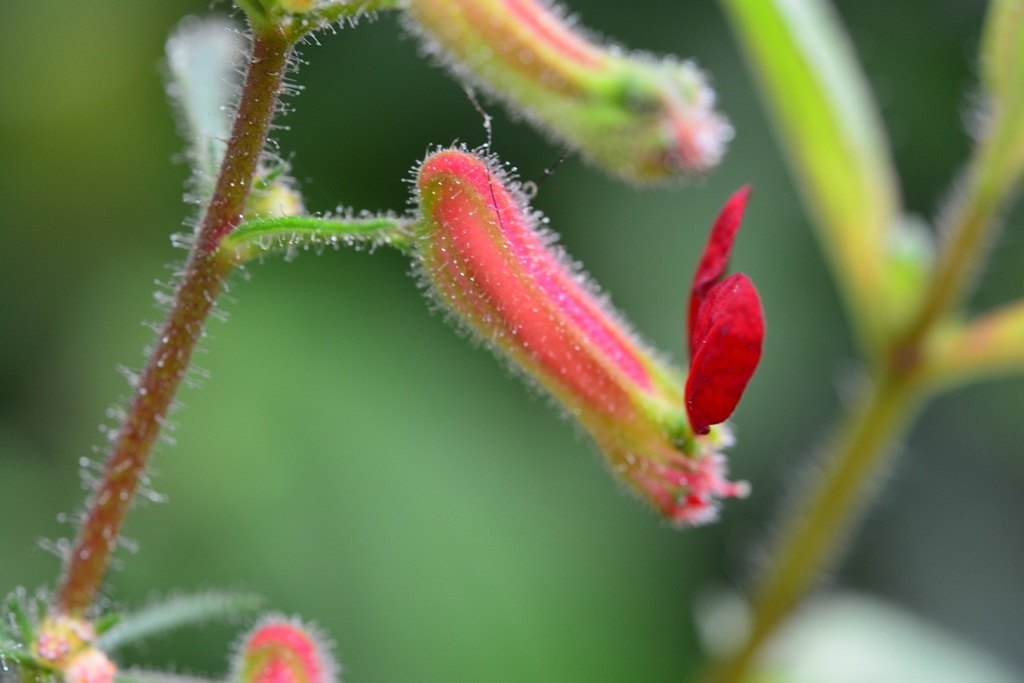
The flowers are narrow tubes, white to pale mauve on the outside with purple petal flares inside the throat, each lasting two or three days and replaced by the next along the leaf axils. Stems and leaves are covered in glandular hair that leaves fingers sticky after handling. In bloom the plant hums quietly with small bees all day.
Walpers named it in the 1840s for William Hooker, director at Kew, and it has drifted through catalogues since as cigar flower or match plant. Mexico to Nicaragua is its native span, and it has slipped into gardens across Java, Fiji and even Beijing’s parks as an unassuming bedding subject.
Within Mexico it records from nearly every state, from Baja California Sur to Chiapas, on roadsides, field edges and dry scrub. That breadth explains the plant’s tolerance: it takes heat, poor soil and erratic water in stride, and fails only where frost or permanent damp gets a grip. Its nearest neighbours on the list are Clarkia amoena, Oenothera lindheimeri and Oenothera longissima.
Science & Biotechnology
The genus matters far beyond the border bed. Cuphea flowers store oil rather than nectar in specialized elaiophores, and the seeds concentrate medium-chain fatty acids of the kind industry normally extracts from coconut and palm kernels. Mexican cupheas are the only temperate-climate source of such chains, which has driven decades of agronomic work. Breeding lines combined Mexican species to push seed oil above thirty percent capric acid.
Oil flowers need oil bees, and pollination research on the genus shows specialized bees that scrape the elaiophores with combs on their forelegs, then carry the grease in hollow hind-leg hairs to feed their larvae. In gardens honeybees settle for pollen and the plant self-pollinates enough to set seed regardless.
Public observation records trace its bloom calendar in southern latitudes: counts peak from October to January, a reminder that in its native climate the cool season is the growing season. In temperate gardens the pattern inverts and flowering runs from early summer to frost without a break.
Uses & Benefits
As a garden plant it is an edger and a filler, low, dense and permanently in flower, content in heat that stops other annuals. It suits rock pockets, borders of a sunny walk, and pots where its continuous small colour reads better than one dramatic flush.
Its real service is to pollinators. The tubes fit small native bees, and the sticky foliage shelters nothing, so a bed of it functions as a season-long nectar-and-oil station. Butterfly keepers also report it among the few annuals that holds through the hottest weeks of a southern summer.
No part of the plant is used in the kitchen and the sticky hair makes it unattractive to chew, so it is safe around children in the ordinary sense. The limitation is cold: it is a tender perennial, and where frost bites it must be grown as an annual from spring seed.
Growing from Seed
Sow on the surface at twenty to twenty-two degrees, barely covered, eight weeks before the last frost; germination takes one to two weeks and is improved by a week in the fridge before sowing. Grow seedlings warm and harden off gently; young plants resent cold nights.
Plant out after frost in full sun, twenty-five centimetres apart, in any well-drained soil. Water weekly the first month, then only in drought. Growth is fast, flowering within ten weeks of sowing. Pinch once for bushiness. It carries no significant pests; the occasional aphid is the whole list, and whitefly only under glass.
Seed matures in the small capsules along the stems and shakes out when the plant is dry, so harvest by shaking stems into a bag on a still afternoon. A succession of sowings from early spring keeps young plants replacing old, since a two-year-old clump thins at the base.
Our Take
Our take: hooker’s Cuphea is the definition of dependable rather than spectacular. It will never headline a catalogue photograph, but through the hottest weeks it is the plant still standing and still feeding bees, and it asks for a seed packet and nothing more. For gardeners in hot, dry regions, that combination is rare enough to plan around.
The honest verdict: grow it for continuity, not for portraits. Its tubes are small, its colour modest, its foliage sticky. What it offers instead is a living demonstration that in the flower bed, as in chemistry, the quiet continuous performers are the ones industry ends up studying.
Related Reading
More species in the same orbit as Hooker’s Cuphea: