


Layia platyglossa Seeds | Tidy Tips
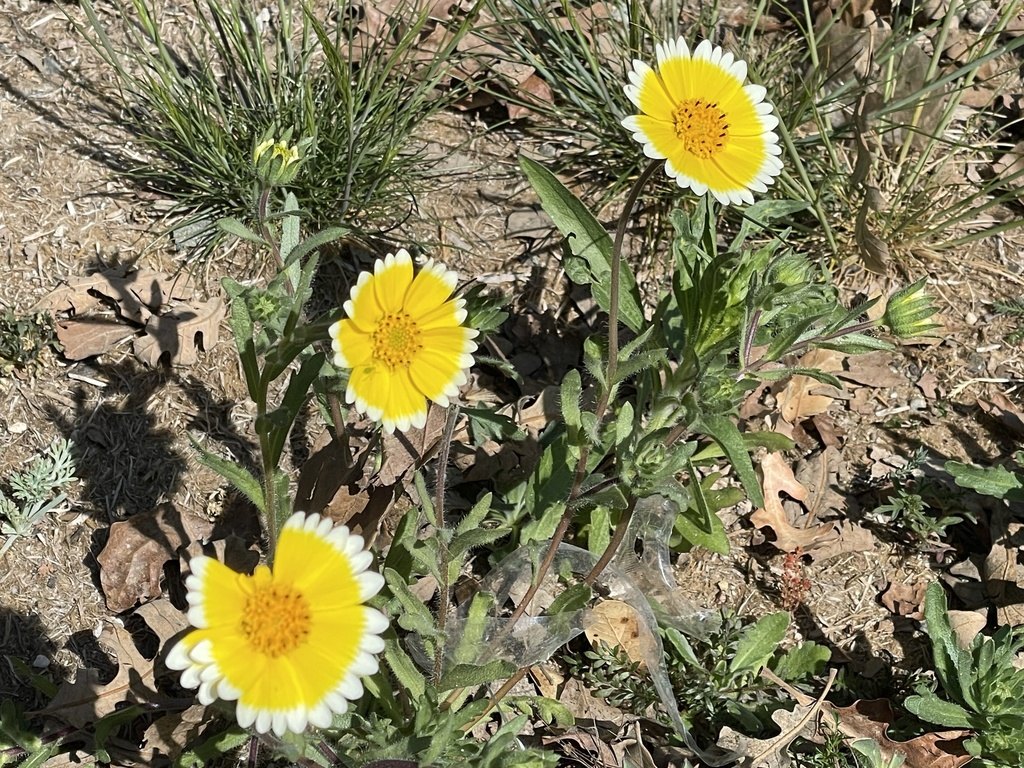
LATIN NAME: Layia platyglossa
COMMON NAME: Tidy Tips
Plant Profile
Tidy tips is a small annual, 10 to 30 cm high and about as wide, with narrow rough-hairy leaves and a taproot that goes down further than the top growth suggests. The lower leaves are lobed or toothed, the upper ones entire, and the whole plant is glandular and slightly sticky to the touch.
The flower heads are the reason it is grown: five to eighteen ray florets, bright golden yellow with a sharply defined white tip, around a centre of many yellow disc florets. That white fringe is unusual and it gives the flower a painted, almost hand-finished look. The bracts are rounded at the tip and the involucre is 6 to 12 mm high.
It is native to low-elevation dry country in California, from the coast to the Mojave, and into Arizona and Utah, as well as Baja California and Guadalupe Island. Before European settlement it grew in solid stands at low elevations, in valley grassland, on hillsides and in openings in chaparral.
Science & Biotechnology
It is a spring annual of the California floristic province, flowering from March to June and completing its life before the summer drought. The seed germinates with winter rain, the plant grows through the cool season, and by June it is dead and the seed is on the ground. Everything about its cultivation follows from that timetable.
The heads are indeterminate and zygomorphic, borne on peduncles, with florets that can be bisexual, pistillate, functionally staminate or neuter, sometimes on the same head. That mixture is common in the tribe and it means a head is not a single flower but a small economy of different ones.
Pollination is by insects, and the plant is one of the species that makes up the California spring wildflower displays, along with the poppies and the lupins. Those displays are less reliable than the tourist boards suggest: they depend on rain in November and December, and a dry winter produces a green hillside and no flowers.
Uses & Benefits
It is a meadow annual for a dry sunny place, and it is at its best in a matrix with other California annuals rather than on its own. Sow it with clarkia, nemophila and eschscholzia and let them compete; the mixture hides the gaps and the flowering is longer than any one species manages.
The white tip makes it a good front-of-border plant, because it reads at a distance where a plain yellow daisy would not. It is also useful in a pot, where the taproot is restricted and the plant stays compact, though it will not tolerate drying out while it is in flower.
It is a poor cut flower. The stems are short, the heads are small, and they close in the evening and in dull weather. Leave it where it grows and look at it there, which is what a wildflower display is for. Closest relatives on the list are Anthemis arvensis, Aster novi-belgii and Ageratum conyzoides.
Growing from Seed
Sow in autumn, where the plants are to flower, and do not sow in spring in a climate with a dry summer: the seed needs winter rain and cool growth, and spring sowing produces a plant that bolts and dies before it is worth looking at. This is the single thing that decides success.
Scatter on bare, raked ground, barely cover, and keep damp until germination, which takes one to three weeks at 10 to 15 °C. Do not water heavily after that; the seedlings rot at the collar in a wet February, and a light hand with the can is half the skill. Thin to 20 cm; the plants branch and need the room. They do not transplant because of the taproot, so sow direct or use deep modules and plant young.
Let the last flowers set seed and do not clear the ground until it has shed. The seed bank is short-lived compared with a poppy’s, so a bed that is dug over in summer will lose it. Leave the patch alone, and it will come back for two or three years before it needs resowing.
Our Take
It is a pretty thing with a short season, and it is worth growing for the six weeks when the tips are white against the yellow. In a meadow mix it holds its own; on its own it looks like a gap with flowers in it.
The requirement is a Mediterranean winter, or a cold frame and a sharp eye. Gardeners in wet climates who try it in spring are always disappointed, and the disappointment is not the plant’s fault. Sow it in October and it will do what the pictures show.
Related Reading
Readers interested in Tidy Tips frequently explore these as well: