


Linaria vulgaris Seeds | Common Toadflax
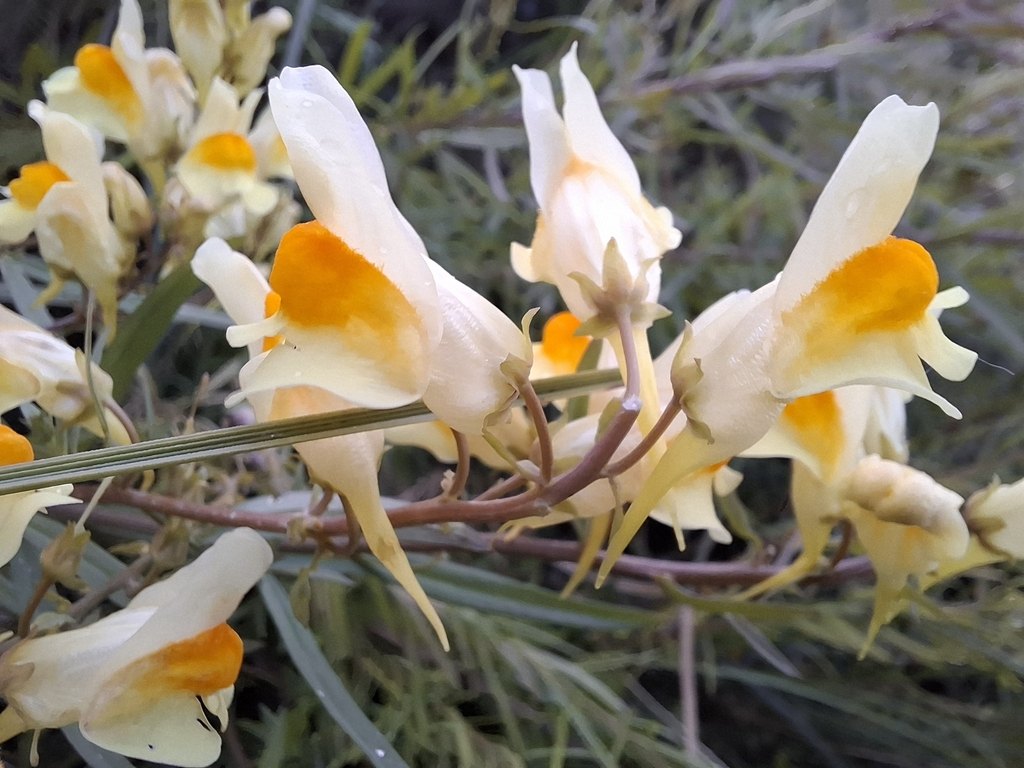
LATIN NAME: Linaria vulgaris
COMMON NAME: Common Toadflax
Plant Profile
Common toadflax is a perennial of roadsides, railway banks and waste ground, 15 to 90 cm tall, with stems that start upright and fall outward as the flowers weigh them down. The leaves are threadlike, 2 to 8 cm long and only 1 to 5 mm wide, blue-green with a waxy bloom that sheds water.
The flowers are snapdragons in miniature, 25 to 33 mm long, pale yellow with an orange stain on the lower lip, carried in dense spikes from midsummer into autumn. Each one is closed by the lower lip, which presses up against the upper like a thumb on a purse. The whole spike faces one way, which gives the plant its old name.
Behind the flowers sits an oblong capsule, 5 to 11 mm long, holding numerous flat seeds. Below ground the plant runs: a short crown sends out roots that travel, and a patch that looks like three separate plants is usually one. That is the reason it survives ploughing, and the reason it is so hard to be rid of.
Science & Biotechnology
Because the flower is shut, only a heavy insect can get in. Bumblebees force the lips apart and are dusted on the back with pollen; honeybees are mostly too light to manage it. Short-tongued bees cheat, biting a hole at the base of the spur and taking nectar without touching the anthers at all, which costs the plant a pollination.
Now and then a plant makes regular, five-spurred flowers instead of the usual mask. Linnaeus put these in a genus of their own, Peloria, and Darwin later argued that such forms are reversions to an ancestral symmetry rather than new creations. The argument mattered to the history of evolutionary theory, and it started with this roadside weed.
Its status as a British native was settled by seeds rather than by records. They turn up in Hoxnian interglacial deposits at Clacton and in Weichselian strata across Essex, Surrey and north Wales, which is a long way before anyone wrote a flora. The plant was here before the roads were, and it has followed them since. The other Plantaginaceae in the catalogue are Linaria bipartita, Penstemon strictus and Penstemon digitalis.
Uses & Benefits
Cut-flower growers value it because the spikes last. Picked when the lowest flowers are open and the rest are still in bud, they hold for a week in water and dry acceptably for winter work. The colour is a soft butter yellow that is surprisingly hard to find among hardy perennials, so the plant is still sold.
Children squeeze the flowers at the base and the lips open, and that is the whole of its folk reputation. Beyond it there is a long history of use in herbal medicine as a diuretic and a laxative, and a yellow dye was taken from the flowering tops. The plant is also mildly toxic, so the medicine is history rather than advice.
For wildlife it is a host rather than a nectar station. The toadflax pug moth feeds on it exclusively, and a dozen other moths use it. In North America, where it arrived as a garden plant, the same species is classed as a noxious weed and has been fought with introduced beetles that feed on the seed heads.
Growing from Seed
Seed needs cold and light. Sow on the surface in autumn, leave the pot outside through winter, and expect germination in spring as the soil warms. Dry-stored seed sown warm in March will mostly sit and then rot. If you must sow in spring, give the packet four weeks in the refrigerator first.
Think hard before planting it in a border. The roots travel under paths and come up in the middle of neighbours, and digging makes it worse, because every severed piece grows. Sink a bottomless bucket, or grow it in a pot standing on gravel, and treat the patch as permanent once it is established.
Full sun and sharp drainage suit it. It grows on sand, chalk and rubble, and it resents rich soil, which produces soft growth and few flowers. Cut the first flush over after flowering and a second, shorter spike follows. Left alone it seeds into walls and gravel, where it looks better than it ever does in a bed.
Our Take
This is a plant to admire at the verge rather than install in the garden, unless you have a gravel bank and no neighbours within root distance. As a wildflower it ranks among the best: long-flowering, neat in form, and host to insects that have almost nothing else to eat in a sprayed landscape.
If you do grow it, grow it for the smell of a summer lane and the snap of the flower between finger and thumb. Those two things are what people remember about it, and neither of them survives a photograph, which is probably why the plant is loved by those who know it and ignored by everyone else.
Related Reading
Gardeners who grow Common Toadflax often pair it with these related subjects: