


Glandularia hybrida Seeds | Garden Verbena
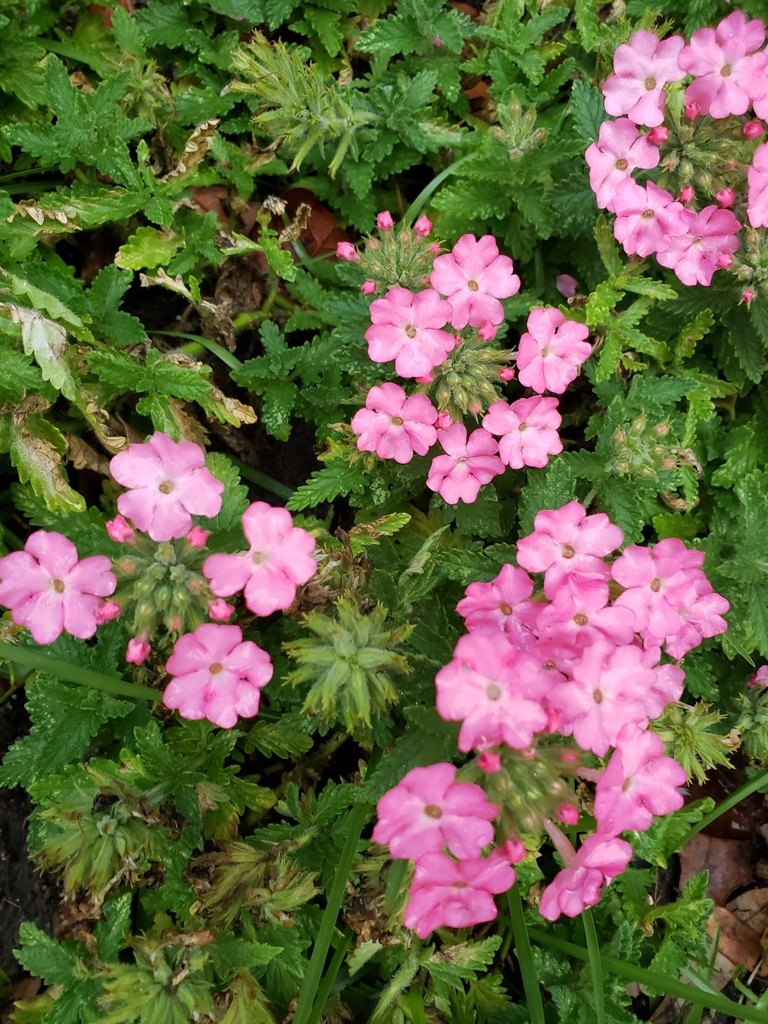
LATIN NAME: Glandularia hybrida
COMMON NAME: Garden Verbena
Plant Profile
Garden verbena is a hybrid of two South American species, Glandularia incisa and Glandularia peruviana, and it has been in cultivation so long that its wild parents are rarely seen in the trade. It was first described as a Verbena hybrid in 1867. Both parents come from the grasslands of southern South America.
The genus Glandularia was separated from Verbena on the basis of chromosome number, pollen morphology and the shape of the inflorescence, and most of the South American verbenas now sit in it. The garden hybrid followed its parents into the new genus. The separation is now supported by molecular data as well as morphology.
The plant is a low, spreading perennial with square stems, opposite leaves that are deeply cut and rough to the touch, and dense spikes of small five-lobed flowers. The colour range runs from white through pink, red, purple and blue, often with a pale eye. The leaves are aromatic when crushed and are usually avoided by deer and rabbits.
It grows fast in heat and flowers from late spring until frost, so it is planted in bedding schemes, hanging baskets and window boxes across the temperate world. It is not hardy below about minus five degrees. It is a plant of warm climates and it sulks in cold, wet summers, so it is treated as an annual.
Science & Biotechnology
The flowers are borne in a spike that elongates as the flowering season goes on, so that the oldest flowers are at the base and the newest at the tip. Each flower has four stamens in two pairs, one pair long and one short. The spike is technically a thyrse, with the flowers in opposite pairs.
The long-tongued bees and butterflies that visit are guided by a nectar reward at the base of a narrow tube, and the flower shape excludes insects too small to reach it. The result is a short list of effective pollinators. The tube length is the filter that decides which visitors can reach the nectar.
Powdery mildew is the plant’s great weakness in humid summers, and it disfigures the leaves long before it kills anything. Breeding in the last thirty years has produced lines with better resistance and a more compact habit. Good air movement does more against mildew than any spray.
Uses & Benefits
The plant is used almost entirely as a bedding and container subject, where its speed and its long season justify the cost of replacing it each year. It trails well over the edge of a basket and it takes heat without sulking. Baskets need more water than borders, and much less fertilizer than most people give them.
In warm climates it behaves as a short-lived perennial and can be cut back hard in late summer to force a second flush. The stems root where they touch the ground, which makes propagation almost too easy. The trailing stems can reach a metre in a long warm season.
There is no medicinal or culinary use. The genus name refers to the glandular hairs on the calyx, which give the plant a slightly sticky feel and a resinous smell when handled. There is no reason to grow it for anything but the flowers. Related entries here include Glandularia canadensis, Glandularia tenera and Campsis radicans.
Growing from Seed
Sow indoors in late winter at twenty to twenty-two degrees, barely covering the seed, and germination takes two to three weeks. Named cultivars must be raised from cuttings, because seedlings vary in colour and habit. Old seed germinates poorly, so buy fresh each year.
Take cuttings in late summer from shoots without flowers and overwinter them under glass at five to ten degrees. That is how the trade keeps its named forms, and how a gardener keeps a favourite from one year to the next. Cuttings root in two weeks in a warm, shaded frame.
Plant out after the last frost in full sun and any reasonable soil, and water until the roots are down. Pinch the young plants once to make them branch, and deadhead through the season to keep the flowers coming. A fortnightly liquid feed keeps containers going through summer.
Our Take
Garden verbena is one of those plants that does a simple thing extremely well: it flowers, continuously, in strong colours, for six months, with almost no help. That is enough, and it has been enough for a century and a half. The colours are clear and the scent is faint but real.
Treat it as an annual and it will not disappoint. Treat it as a perennial and you will be disappointed in most climates. Choose a named cultivar if colour matters, and a seed strain if cost does. Either way, plant it late, water it well, and deadhead it often.
Related Reading
Readers interested in Garden Verbena frequently explore these as well: