


Aglaia odorata seed
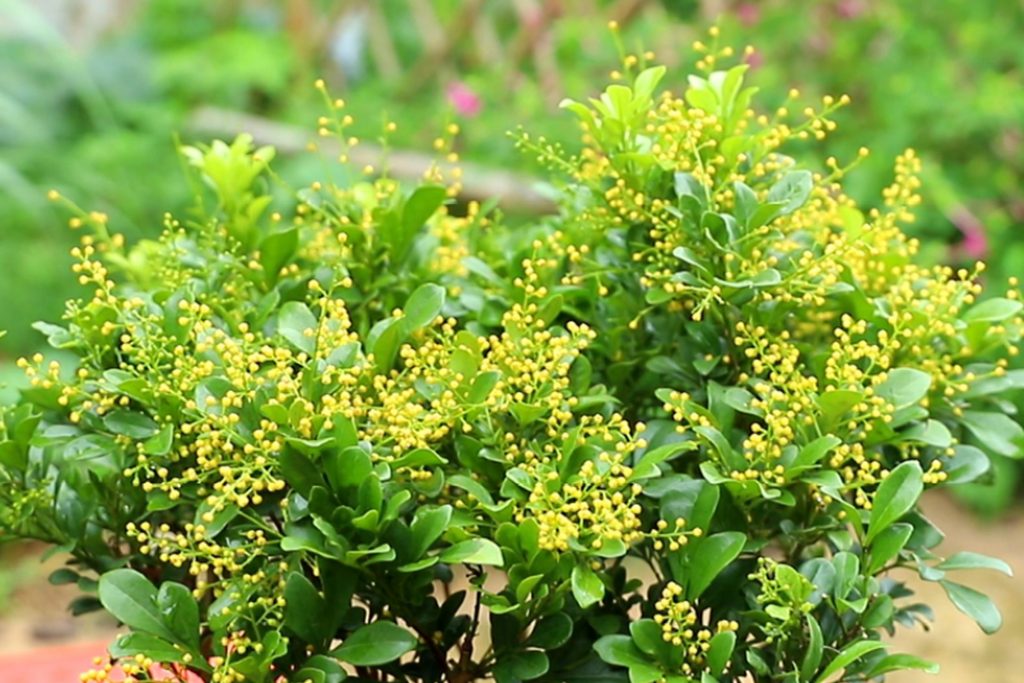
LATIN NAME: AGLAIA ODORATA
COMMON NAME: Chinese Perfume Plant, Mock Lemon
The Aglaia odorata, or Chinese perfume plant, is one of the most fragrant and useful of the warm-climate shrubs, and its glossy, dark-green, compound leaves and its tiny, yellow, rice-grain-like, intensely fragrant flowers have made it a favourite of the warm gardens and the houseplant collections across the regions of the East and the southeast Asia. It grows as a dense, evergreen shrub or a small tree of the mahogany family, reaching up to five metres or more, with the smooth, grey bark and the dense, branching habit bearing alternate, glossy, dark-green, compound leaves with the oval leaflets, and bearing, through the warm months, the tiny, yellow, rice-grain-like flowers in the branching clusters which fill the air with a sweet, intense fragrance, followed by the small, orange-red berries. It is a species of the flowering shrub, native to the warm regions of the East and the southeast Asia, while it has been cultivated for its fragrant flowers for a very long time, and it is known as the Chinese perfume plant or the mock lemon.
Scientific Research & Plant Biotechnology
The Chinese perfume plant has a real and distinguished place in research. It has been studied in the chemistry and the natural-products science, since the Aglaia odorata is rich in the fragrant essential oils and the bioactive compounds, and the researchers have examined the flowers, the leaves, their constituents and their composition, while the study of the fragrant plants and their chemistry has drawn attention in the international natural-products press. The plant has also been studied in the horticulture and the ornamental-plant science, since the Chinese perfume plant is a popular, fragrant shrub for the warm garden and the house, and the researchers have examined its cultivation, its propagation and its value in the landscape, while the study of the fragrant shrubs has been of continuing interest. The species has also been studied in the ethnobotany, since the fragrant flowers have been used in the traditions for the perfumery and the tea, and the researchers have examined its uses and its cultural significance, while the tiny, yellow, fragrant flowers and the glossy leaves of the Chinese perfume plant have been of interest to the botanists and the gardeners. For a shrub of such fragrance, the Aglaia odorata has a rich and distinguished record of research.
Ecological & Economic Value & Wide Applications
To grow the Chinese Perfume Plant from seed, the Chinese perfume plant is a dense, evergreen shrub of the warm regions, bearing the glossy, dark-green, compound leaves and the tiny, yellow, fragrant flowers through the warm months. Its fragrant flowers are a magnet for the bees and the other pollinators, and its dense, evergreen habit gives a fine presence in the warm garden and the courtyard, while its fragrant flowers fill the air with a sweet scent. Its economic value is real: the Chinese perfume plant is prized as a fragrant, ornamental shrub for the warm garden and the house, and its value has drawn attention in the international horticultural and natural-products press, while the intensely fragrant flowers and the easy cultivation have made it a favourite of the warm gardens and the houseplant collections, and the shrub is a fine addition to the warm garden, the courtyard and the houseplant collection. To raise the Chinese perfume plant, sow the seeds in pots of moist, open soil in a warm, bright place, keep them gently watered, and grow the little shrubs on in the warmth.
sow the seeds in pots of moist, open soil in a warm, bright place, keep the young aglaia gently watered, and grow the little shrubs on in the warmth.
This plant with seemingly inconspicuous flowers has Undoubtedly the most amazing fragrance in the whole flora kingdom. After bringing it inside the house for a few hours the smell manages to stay long after its gone and you will be catching whiffs of its fragrance for days to come. A good, if slow growing, hedge plant. When trimmed regularly, the plant forms a dense, neat hedge. Very amenable to trimming, it is used for topiary in Asia.
Facts:
· Three oldest Aglaia Odorata trees planted by scholars in the year 1546 AD in Zhaoqing, Guangdong, China have been known for surviving 475 years and are still blooming regularly. · Aglaia Odorata tree rarely shed its leaves, even matured trees do not have many falling leaves, leaving a clean space around the tree. · Aglaia Odorata tree has many other names, including Chinese Perfume Plant, Chinese Perfume Tree, Chinese Rice Flower, Mock Lemon, Mock Lime, etc. · Aglaia Odorata tree is a slow grower: young trees can grow a few dozen centimetre in height per year, larger trees will grow more slowly. The tree can live hundreds of years in life span. It can be grown in ground and in pot, outdoor or indoor, or as a bonsai.
Medicinal uses:
·The genus Aglaia is the only source of the group of about 50 known representatives of compounds that bear a unique cyclopenta[b]tetrahydrobenzofuran skeleton. These compounds are more commonly called rocaglate or rocaglamide derivatives, or flavaglines, and most have been found to have potent insecticidal properties, antifungal, antiviral, antibacterial or anthelmintic bioactivity. Several of them exhibit pronounced cytotoxic activity against a range of human cancers. Since the first representative in this group was only discovered in 1982, this is one of the few recent examples of a completely new class of plant secondary metabolites of biological promise (see B. G. Wang et al., Biochem. Syst. Ecol. 32: 1223-1226. 2004; L.W. Chaidir et al., J. Nat. Prod. 64: 1216-1220. 2001)
· The roots are boiled with water to make a drink to increase appetite. In the Philippines, the roots and leaves can be used as a tonic. · The roots and the leaves are considered anticonvulsive, aromatic, febrifuge, pectoral, stimulant and tonic. A water infusion of the roots and leaves has been used as heart stimulant and febrifuge · The dried flowers are used to cure mouth ulcers and reduce fever. · In China, the dried branches and leaves are boiled in water and used to reduce pain from rheumatic joints, injuries from falls, superficial infections and toxic swelling. · An infusion of the leaves is taken as a tonic for treating excessive menses and venereal diseases.
Edible uses:
· Tender young leaves – cooked and eaten as a vegetable · The flowers are dried and used for scenting tea. The flowers are exquisitely scented, somewhat like vanilla but with spicy undertones.
Agroforestry Uses:
· A good, if slow growing, hedge plant. When trimmed regularly, the plant forms a dense, neat hedge. Very amenable to trimming, it is used for topiary in Asia. · The plant possesses natural antifungal, antiviral, insecticidal properties. Flower pellets show potential as an organic herbicide for the control of barnyard grass weed. Organic extracts of the twigs and leaves yielded eight insecticidal cyclopentatetrahydrobenzofuran rocaglamide derivatives. The isolated rocaglamide derivatives exhibited strong insecticidal activity towards neonate larvae of the polyphagous pest insect Spodophera littoralis when incorporated into artificial diet
Other uses:
· The flowers are used to scent clothes, are added to potpourris and also used in making joss sticks. The dried flowers retain their perfume almost indefinitely.
Aglaia odorata is a small tree that retains its green leaves throughout the year, and can reach a height of 2 to 5 meters. It is multiple branched and its leaves are 5 to 12 centimeters long. It has small golden yellow raceme oval-shaped flowers with 6 petals. The fruit is red, about one centimeter long and egg-shaped, containing one to two seeds
Chinese perfume tree (Aglaia odorata) is a small evergreen tree in the mahogany family. It is an ornamental plant in American gardens, typically growing to 10 feet (3 m.) or under and producing intensely fragrant sprays of unusual yellow flowers. If you want to start growing Chinese perfume trees, read on for information on these lovely plants and for tips on Chinese perfume tree care. Chinese Perfume Tree Facts Chinese perfume trees, also called Aglaia odorata plants, are native to low regions of China. They also grow in Taiwan, Indonesia, Cambodia, Laos, Thailand, and Vietnam. The plant’s genus name comes from Greek mythology. Aglaia was the name of one of the three Graces. In the wild, Aglaia ordorata plants can grow to 20 feet (6 m.) high. They grow in thickets or sparse forests. In the United States, they grow only in cultivation and are often planted for their fragrant blossoms. You’ll find some interesting Chinese perfume tree facts when you read about those blossoms. The tiny yellow flowers—each about the size and shape of a grain of rice—grow in panicles about 2 to 4 inches (5-10 m.) long. They are shaped like tiny balls but do not open when the flowers bloom. The scent exuded by Chinese perfume tree flowers is sweet and lemony. It is stronger during the day than at night. Growing Chinese Perfume Trees If you are growing Chinese perfume trees, you need to know that an individual tree will bear either male or female flowers. Both types of flowers are fragrant, but only a pollinated female flower produces the fruit, a small berry with one seed inside. Chinese perfume tree care begins with planting the tree in an appropriate location. The trees are only hardy in U.S. Department of Agriculture plant hardiness zones 10 through 11. In cooler regions, you can grow Aglaia odorata plants in containers and move them indoors when temperatures drop. The trees will need well-draining soil and a location with full or partial sun. Plant them in a location with some shade if your region is hot in the summer. Container plants brought inside should be located next to sunny windows. They’ll need moderate but regular irrigation. The soil must dry out between watering times.
Indoor / Outdoor Growing:
This plant can be grown both indoors or outdoors. If you have a garden and live in the USDA Hardiness Zone of 9 or 10, your Chinese Perfume Plant can thrive outdoors.
It can grow up to ten feet – pretty impressive for an ornamental plant!
While the plant thrives on light, it can grow in the shade and sunlight, so you don’t need to be concerned about its exposure or lack of it. If your environment isn’t suitable for growing the plant outdoors, or you are looking for a pleasant plant to keep in the house, you can grow it in a pot indoors where it can reach up to four feet tall.
Just remember not to expose the plant to temperatures below 2°C/ 35°F.
Watering and Soil Needs:
The Chinese Perfume Plant should be watered liberally about once a week, but make sure the pot drains well.
The plant prefers dryer soil, so make sure the soil doesn’t retain an excessive amount of water. If your plant is in a container, make sure there are drainage holes for the surplus water to drain out.
Wait until the soil is dried out before watering the plant, and then saturate the ground until the water seeps out of the pot’s drainage holes.
In between waterings, use a mister to lightly spray the leaves with some water.
Fertilize the soil once a month to replenish its nutrients, but don’t use full strength. The plant is delicate and can get poisoned from too much of it. Ideally, the pH level of its soil should be between 6.0 – 7.5. A cactus mix is an excellent soil to use.
Temperature Needs and Ideal Climate:
Outdoors, the Chinese Perfume Plant should be kept in temperatures above 15°C / 60°F. If the outdoor temperatures drop below that in your area, you can grow the plant in a container indoors.
Indoors, the plant can survive temperatures as low as 2°C / 35°F. Never expose your plant to temperatures lower than that.
The plant grows well under many sunlight conditions including in the shade or under full sun exposure.