


Quercus vulcanica Seeds | Vulcan Oak
LATIN NAME: Quercus vulcanica
COMMON NAME: Vulcan Oak
Plant Profile
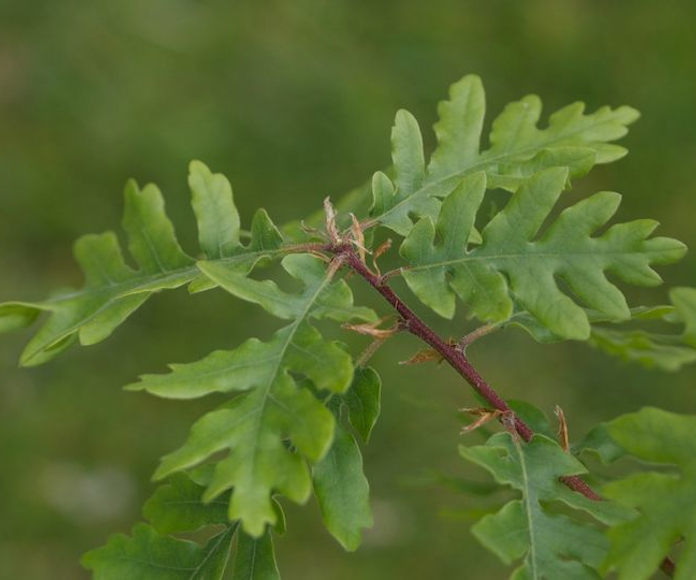
The Vulcan oak is a Turkish endemic, confined to a handful of mountains in the western Taurus and found nowhere else on earth. It grows between about 1,200 and 1,800 metres on limestone and volcanic slopes around Isparta, Konya and Afyon, usually mixed with black pine and juniper on ground that is snow-covered for four months and bone dry in August. The tree reaches fifteen to twenty-five metres with a broad, rounded crown and a trunk that stays smooth and grey for many years before breaking into thin plates. The leaves are leathery, deep-lobed and blue-green beneath, and they turn a dull bronze rather than a bright colour in autumn. Acorns ripen in the first year, in a cup with downy scales, and are eaten by jays, squirrels and wild boar as soon as they fall. The species was described from specimens collected on the Anatolian plateau in the 1840s, and its timber has been cut for charcoal and tool handles ever since.
Science & Biotechnology
Quercus vulcanica is a white oak of the section Quercus, which means its acorns mature in a single season and its leaves lack the bristle tips of the red oaks. It is a narrow endemic with a total range of a few thousand square kilometres, and the populations are fragmented by valleys and ridges into stands that exchange little pollen. That history shows in the genetics: stands differ from one another more than one would expect for a wind-pollinated tree, and some are small enough to lose diversity through drift. The species hybridises with the more widespread Q. frainetto and Q. cerris where they meet, and hybrid swarms complicate the mapping of its true range. Its thick, ridged bark and deep root system make it resistant to surface fire, and the tree resprouts from the stump after cutting, which is how many stands have survived centuries of charcoal burning. Regeneration from seed is poor wherever goats and sheep are kept, because the acorns are eaten before they can root.
Uses & Benefits
The wood is hard, dense and difficult to split, and it has been used for tool handles, wagon parts, flooring and, above all, charcoal, which is why old-growth stands are so scarce. The bark is rich in tannins and was used for tanning leather in the region. Acorns are bitter and were never a staple, but they are fed to pigs in good years, and the cupules are collected for tanning in some villages. The tree is planted in Turkish forestry trials as a drought-hardy oak for dry limestone slopes, and it has some value in erosion control where nothing else will hold. In gardens outside Turkey it is a collector’s tree: slow, long-lived, tolerant of drought and poor soil, and handsome in a quiet way. It is not a tree for a small plot, and it is hard to buy true to name, since seed is collected from a handful of stands.
Growing from Seed
Collect acorns as soon as they fall and sow them at once, since they lose viability within weeks if allowed to dry; if you must store them, keep them in damp sand at four degrees and sow by February. Sow two centimetres deep in a deep pot, because the radicle goes down fast, and protect the pot from mice and jays. Germination is usually in spring, and the shoot may not appear until May. Grow the seedling in the same pot for a season, then plant out into a sunny site with deep, well-drained soil; the tree tolerates limestone but not waterlogging. Water for the first two summers and mulch widely, keeping mulch clear of the trunk. Stake only if the site is windy. Little pruning is needed beyond removing a double leader in the first years, and the tree is best left alone after that.
Our Take
A rare Turkish oak with a broad crown and a taste for limestone. Slow, tough, and almost impossible to find true to name.
Related Reading
Readers interested in Vulcan Oak frequently explore these as well: