


Sarcostigma kleinii Seeds | Klein’s Sarcostigma
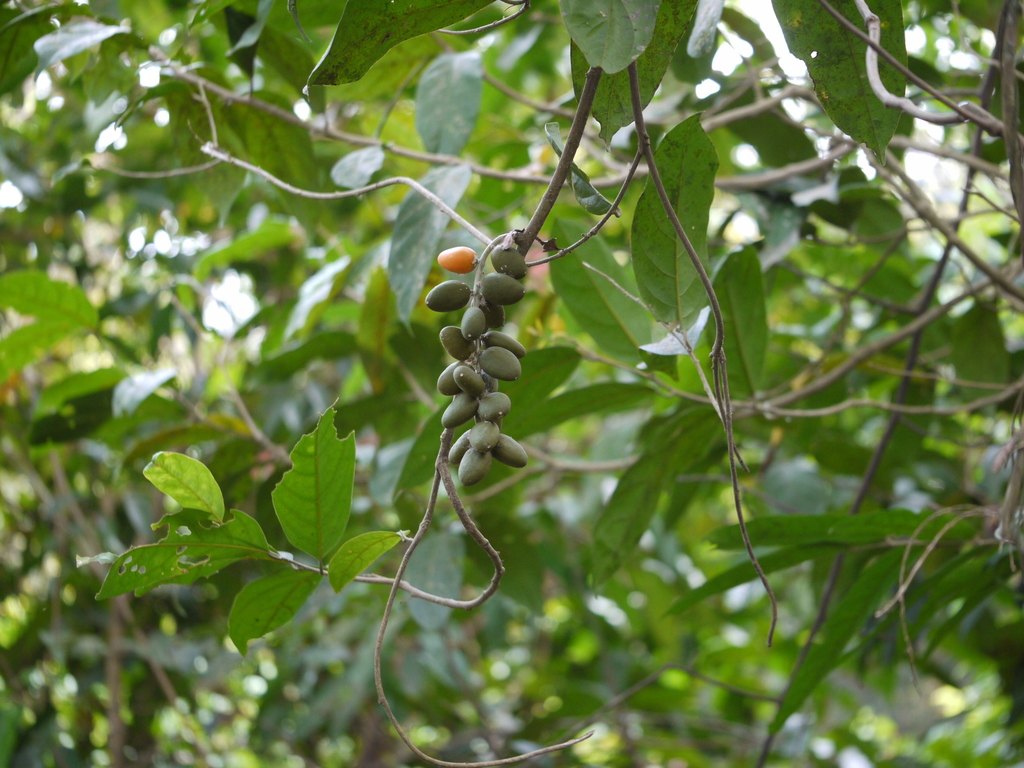
LATIN NAME: Sarcostigma kleinii
COMMON NAME: Klein’s Sarcostigma
Plant Profile
Sarcostigma kleinii is a large woody climber of the Indian and Southeast Asian forest, with a thick, fluted stem, leathery leaves and a cluster of fruit that turns from green to orange and then black. It ranks among the biggest lianas of the Western Ghats, and a mature stem can be as thick as a man’s thigh.
The genus name means fleshy stigma, and it refers to a structure in the flower that is easy to see under a lens and almost impossible to see with the naked eye. The epithet honours Klein, a botanist of the early nineteenth century, and the species was described by Wight and Arnott from Indian material.
Its range covers southern India, the Andaman and Nicobar Islands, Myanmar, Vietnam, peninsular Malaysia, Borneo and Java. It grows in evergreen and semi-evergreen forest, often along streams, and it climbs into the canopy and flowers there, so it is more often seen as a stem than as a flower.
The family is the old Icacinaceae, now much reduced, and the lianas in it share a set of characters: alternate leaves, small flowers with a disc, and a drupe with a single stone. Sarcostigma is one of the largest of the Asian genera, and it ranks among the least studied.
Science & Biotechnology
The liana habit is a hydraulic problem. A stem that climbs to the canopy must move water thirty metres or more, and it does so with wide vessels and a large sapwood area. The fluted, irregular stem of an old plant is a response to the mechanical strain of hanging in the canopy rather than standing on its own.
The flowers are small and greenish, with five petals, five stamens and a lobed disc, and they are pollinated by small insects. The fruit is a drupe with a fleshy layer over a hard stone, and birds and monkeys take it; the seed passes through them and arrives at a new gap in the forest.
The family’s chemical interest is camptothecin, which several genera accumulate, and the discovery that unrelated groups make the same compound has turned the Icacinaceae into a case study. Sarcostigma has been screened, and the results are not the reason it is interesting: its interest is structural and ecological.
Uses & Benefits
The stem yields a strong fibre, and in India it has been used for cordage and for rough cloth. The plant also stores water in its tissues, and cut stems are a source of drinking water in an emergency, a fact that appears in several colonial-era accounts of the Western Ghats.
In local medicine the bark and root are used for skin complaints and for fevers, and the plant appears in several regional pharmacopoeias. The documentation is thin, and the plant is not a major drug. It ranks among the many forest lianas that have a place in local practice and no place in the international trade.
Ecologically it is a structural species: a big liana connects the canopy, provides ladders for small animals and holds a gap together while the trees close. Removing it changes the architecture of a forest patch, so logging that takes the big stems is more damaging than it looks. Icacinaceae is well covered here, with Nothapodytes pittosporoides, Iodes cirrhosa and Natsiatum herpeticum alongside.
Growing from Seed
Seed is the usual route, sown fresh at warm temperatures, with germination over several weeks and a low percentage. Cuttings of half-ripe wood can be rooted in a humid bed, and they are the practical method for anyone who wants to try the plant.
It needs a large space, a strong support and a frost-free climate, and it will take several years to reach flowering size. Plant in deep, well-drained soil in light shade, water through the dry season, and give it something substantial to climb.
Prune to control size rather than to shape, because the plant’s habit is to run. The stems are heavy and the support must be built for a mature plant, not a seedling. In a cool climate it is a conservatory subject, and a very large one at that.
Our Take
This is a plant that is more impressive as a stem than as a flower, which is unusual and worth saying. A big liana in a forest is a piece of infrastructure, and this species is one of the substantial ones, with a trunk that looks like something out of a different order of plant life.
Grow it if you have the climate and the frame, and go and see it in a forest if you do not. Either way it is a plant that changes how you look at a canopy, and at the things that hold one together.
Related Reading
Gardeners who grow Klein’s sarcostigma often pair it with these related subjects: