


Iodes cirrhosa Seeds | Tendrilled Iodes
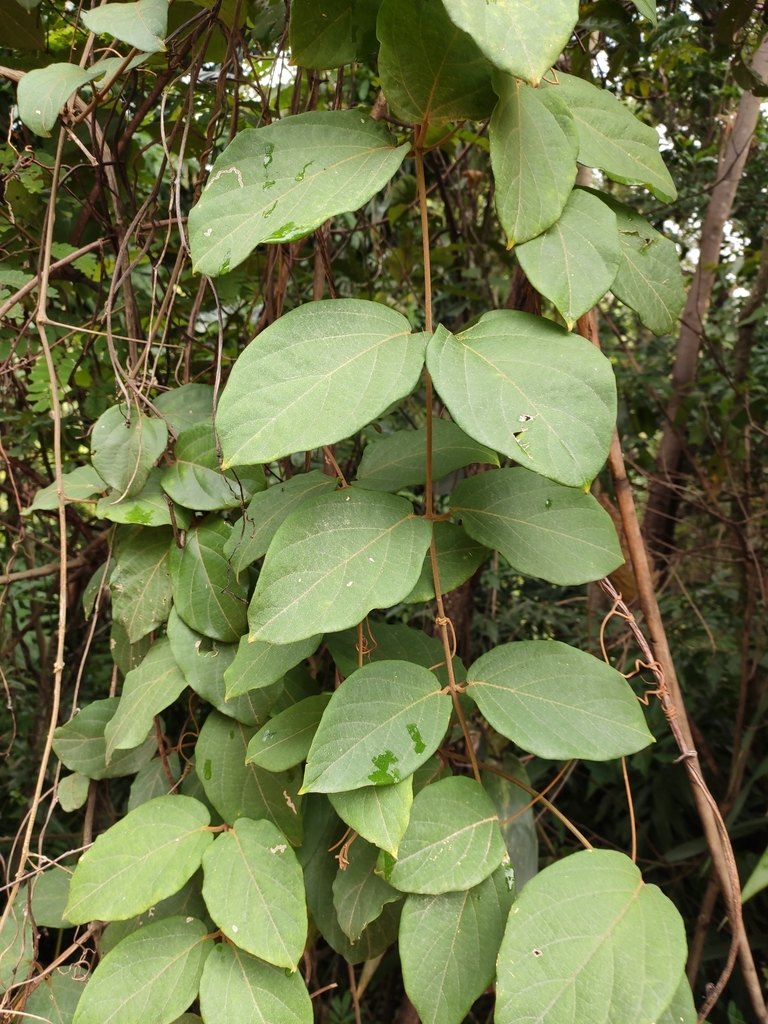
LATIN NAME: Iodes cirrhosa
COMMON NAME: Tendrilled Iodes
Plant Profile
Iodes cirrhosa is a woody climber of the old Icacinaceae, with opposite leaves, small greenish flowers in axillary cymes, and a cluster of egg-shaped fruit that turns from green to purple-black as it ripens. It is a plant of the forest edge and the thicket, and it climbs by tendrils rather than by twining.
The tendrils are the distinguishing habit. Most of the family twine their stems around a support; this species sends out slender, coiled tendrils from the leaf axils, and they grip a branch or a stem and pull the shoot upward. The epithet refers to them, and they are the first thing to look for.
Its range runs from southern Guangxi and Yunnan through northeastern India, Myanmar, Thailand, Laos and Vietnam into Malaysia, Sumatra, Borneo, Java, Sulawesi and the Philippines. It grows in disturbed forest, secondary growth and thickets, often along roads and rivers, and it is never a plant of the deep shade.
The genus name comes from the Greek for violet and for form, a reference to the colour of the fruit or the flowers, and it holds a few dozen species in the Old World tropics. The family has been through a revolution: the old Icacinaceae was a catch-all, and DNA work has moved most of its genera elsewhere.
Science & Biotechnology
The flowers are small, dioecious or polygamous, with five petals that are hairy on the inside, five stamens, and a disc at the base of the ovary. They are pollinated by small insects and they are not built for display; the plant’s investment is in the fruit, which is a drupe with a single stone.
The drupe is the family’s signature: a fleshy or leathery outer layer over a hard, often ridged stone, and the stone holds a seed with copious endosperm. Birds and monkeys take the fruit, and the seed passes through them, which is how a climber of forest edges moves between fragments of forest.
The family’s chemistry has attracted attention for other reasons. Several Icacinaceae accumulate camptothecin, the alkaloid that became irinotecan, and the discovery that unrelated genera make the same compound has turned the group into a case study in convergent biosynthesis. This species has not been reported as a source, and it should not be treated as one.
Uses & Benefits
The stems are fibrous and have been used for cordage in the villages where the plant grows, and the whole plant is used in local medicine for skin complaints, usually as a wash. Neither use is documented in detail, and the plant’s main role in the economy is as a component of the thicket.
In the garden it is a curiosity for a warm climate, grown for the foliage and the fruit rather than for flowers. The leaves are glossy and the habit is light, and a plant on a strong trellis makes a dense screen in two or three seasons. It is not in the ordinary trade and is likely to remain a collector’s plant.
Ecologically it is a pioneer of edges and gaps, one of the first woody climbers to arrive after a disturbance, and it contributes to the structure that later species use. In a restoration planting it would be a reasonable addition, though it is rarely used that way. It sits among Iodes hookeriana, Sarcostigma kleinii and Pyrenacantha volubilis, all Icacinaceae.
Growing from Seed
Seed germinates without much trouble if it is fresh, at warm temperatures and in a humus-rich mix, and the seedlings need a support almost at once. Cuttings of half-ripened wood root in a humid bed, and they are the quicker route to a flowering plant if you can get material.
Plant in light shade or sun in a deep, well-drained soil, with a trellis, a fence or a tree to climb. Water through the first dry season and then only in drought, and cut back the excess growth in late winter to keep the plant within bounds.
The plant is tender and will be cut to the ground by frost, though it may resprout from the base in a mild winter. In a cool climate it is a conservatory climber, and it needs a large pot and a strong frame. It is not a plant for a small garden or a cold one.
Our Take
This is a plant for the person who likes the overlooked corners of a flora, and it rewards that interest with a neat habit and a good fruit. It will never be a garden fixture, and it does not need to be; there is room for plants that are simply interesting.
Grow it where it is warm enough, on a strong support, and watch for the tendrils before you decide what it is. The family around it has been renamed out of existence; the plant has carried on regardless, which is the usual arrangement.
Related Reading
Readers interested in Tendrilled iodes frequently explore these as well: