


Apodytes dimidiata Seeds | White Pear
LATIN NAME: Apodytes dimidiata
COMMON NAME: White Pear
Plant Profile
White pear is an evergreen tree of the Metteniusaceae, native to eastern and southern Africa, Madagascar and the Indian Ocean islands, and it grows from five metres in the open to twenty in deep forest. The crown is dense and rounded, and the leaves are glossy, dark green and elliptical, hanging in flat sprays that catch the light like a camellia. The bark is pale grey and smooth, and the young stems are often reddish.
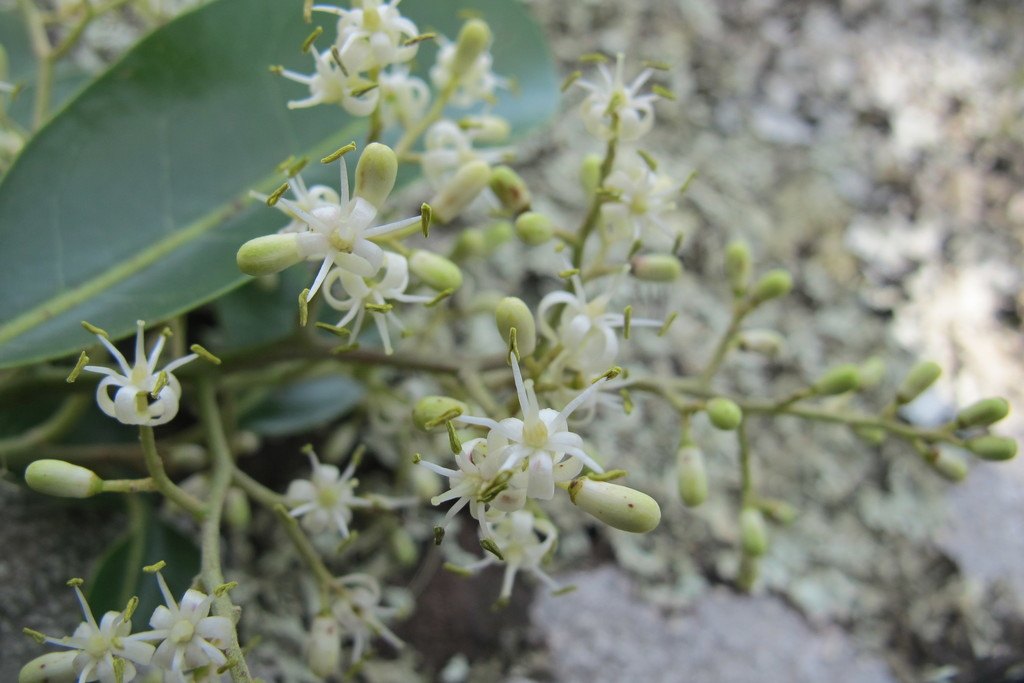
The flowers are small, white and strongly fragrant, in loose terminal panicles, and the scent is usually described as fresh coconut. They open in spring and are followed by the fruit, which is the most distinctive thing about the tree: a black, asymmetric drupe with a scarlet, kidney-shaped appendage at one end, hanging in clusters.
That appendage is the point. It is an aril, rich in fat and colour, designed to be seen by a bird and swallowed whole, and the seed passes through the gut and comes up somewhere else. A fruiting white pear in autumn is one of the loudest trees in an African garden. Allied plants on the list: Natsiatum herpeticum, Sarcostigma kleinii and Pyrenacantha volubilis.
Science & Biotechnology
The family placement of Apodytes was uncertain for a century. It sat in the Icacinaceae, a family that was used as a cupboard for genera nobody could place, and molecular work in the 2000s pulled that cupboard apart. Apodytes and a handful of relatives now sit in the Metteniusaceae, a small family of about ten genera with a scattered tropical distribution.
The wood is the reason for the English name. It is pale, fine-grained, hard and close-textured, and a cabinetmaker who had worked European pear would recognise it immediately. In southern Africa it is used for furniture, turnery and implements, and the tree is cut for it wherever it is common enough.
The species is variable across its range, and the plants of the coastal forest are not quite the plants of the Drakensberg edge. Growth habit, leaf size and fruiting time all shift with altitude and rainfall, so the tree is described as adaptable rather than as uniform.
Uses & Benefits
It is a superb garden tree: neat, glossy, fast enough to be worth planting, and bird-attracting out of all proportion to its size. In southern Africa it is used widely as a hedge and a screen, because it takes clipping well and regrows from hard cutting.
The bark and leaves have traditional medicinal uses, and the tree is a component of indigenous forest restoration planting, where its fruit is what brings the seed-dispersing birds back into a new block. Plant a white pear and the bulbuls arrive, and with them the seeds of everything else.
It is also one of the better small shade trees for a courtyard, because the crown is dense and the roots are not aggressive. It will grow in a large pot for years, which is more than most forest trees will do.
It also makes a good container plant for a patio, where the glossy leaves and the scent are close enough to be appreciated. In a cold climate it can be grown in a large pot and moved under cover for the winter, and it will flower at two metres in a way that a forest tree in a border never does.
Growing from Seed
Collect the fruit when it is black and the aril is bright, clean the aril off and sow at once. The seed is short-lived and loses viability quickly if it dries, so do not buy it from a packet that has been on a shelf. Germination is usually in four to eight weeks in warmth, and it is uneven.
Sow in a free-draining mix under light shade, and prick out when the first true leaves are firm. The seedling is fast once it is going, and it can be planted out at 30 cm with a good chance of success if the roots are not disturbed.
Give it shelter from cold wind and a position in sun or half shade. It takes light frost once established but not hard frost, and it wants a soil that is moist in summer and well drained in winter. Prune it young for shape, and clip hedges after flowering so the fruit can set.
Our Take
White pear does three jobs at once and does all of them well: an evergreen screen, a small shade tree and a bird feeder that happens to be a tree. There are not many plants that can be recommended for a suburban garden without qualification. If you garden in a frost-free or nearly frost-free climate, this is one of the best small evergreens you can plant.
Related Reading
Continue exploring with these related plants: