


Miquelia kleinii Seeds | Klein’s Miquelia
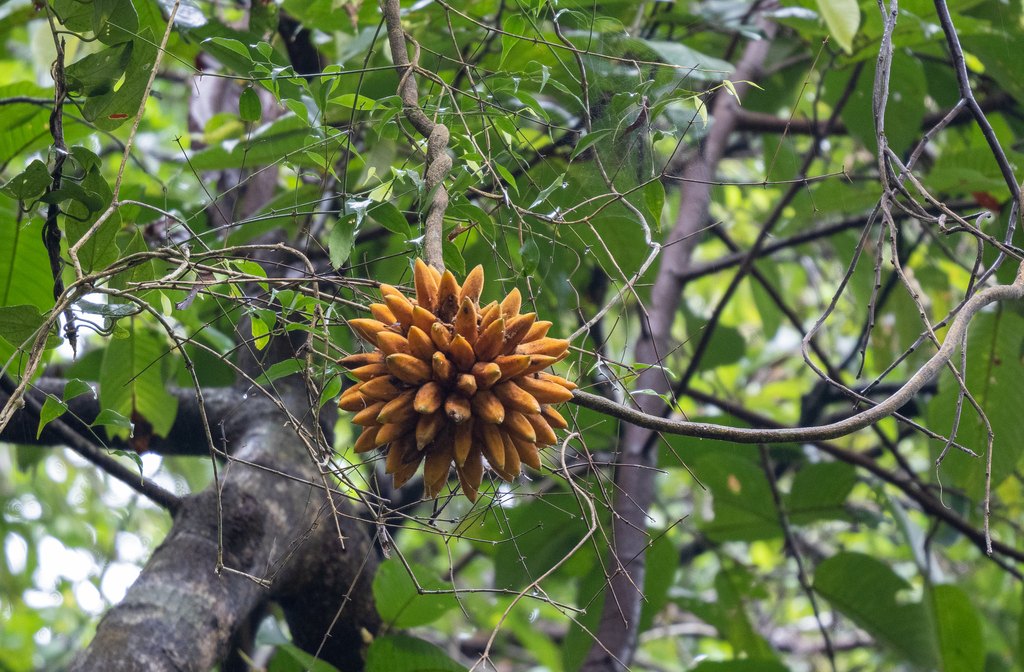
LATIN NAME: Miquelia kleinii
COMMON NAME: Klein’s Miquelia
Plant Profile
Miquelia kleinii is a woody climber of the humid forests of northeastern India, recorded from Assam, Meghalaya and Arunachal Pradesh, and extending along the eastern Himalaya wherever the foothill forest remains intact. It grows in the warm, wet belt below the hill stations, in country that receives some of the heaviest rain in Asia. Rainfall there exceeds two thousand millimetres in a normal year.
The species was described by Carl Meissner, the Swiss-born botanist who worked through the Proteaceae and the Thymelaeaceae for Candolle’s great compendium and who also handled a long list of Indian material sent to European herbaria. His name is attached to plants across several families. He described it from material that had passed through several hands.
The epithet honours a correspondent rather than a collector of this particular plant, a habit that was common in nineteenth-century botany, when a name might be given in thanks for a shipment of specimens from an entirely different region. The honouree’s connection with this particular plant remains unclear.
The plant is a robust twiner with alternate, entire leaves and small greenish flowers in axillary clusters, followed by dark drupes. It is not showy at any stage, and its interest lies in the family it belongs to. The flowers are small enough that most visitors never notice them at all.
Science & Biotechnology
Icacinaceae has attracted pharmacological attention out of proportion to its size, because several of its genera make alkaloids and because one of them, Camptotheca, gave the world camptothecin. The family is now known to be chemically varied rather than uniform in any useful sense. The same search produced several compounds that went no further than the bench.
Miquelia has been screened as part of that search, and the genus is among those reported to contain indole alkaloids of the type found across the lamiids. The reports are preliminary and largely from the 1970s and 1980s, and the compounds have not become drugs.
The climbing stems show the wide, solitary vessels and abundant parenchyma that mark many tropical lianas, an anatomy built for moving large volumes of water through a long, narrow column of tissue with very little mechanical support. Lianas make up a large share of the stem count in such forests. Icacinaceae is well covered here, with Miquelia dentata, Sarcostigma kleinii and Pyrenacantha volubilis alongside.
Uses & Benefits
Local use is modest. The stems yield a fibre that has been twisted into rough cord, and the plant appears in regional lists of minor medicinal plants, usually as a bitter decoction for stomach complaints and for intermittent fever in the wet months. The fibre is coarse and is used where strength matters more than fineness.
These records should be treated with caution. The family contains species with real toxicity, and a plant that has never been properly studied is a poor candidate for experiment by anyone who is not working under a permit and a supervisor.
Horticulturally it is a plant of botanical gardens in the humid tropics, grown for the collection rather than for display. It wants heat, moisture and something to climb, and it gives back green stems and small flowers. A plant that gives nothing back but interest is still worth its space.
Growing from Seed
Fresh seed germinates more readily than stored seed, which loses viability quickly in dry air. Clean the drupes, sow them barely covered in a mix of leaf mould and grit, and keep the whole thing under high humidity at twenty-five degrees or more. Stored seed should be kept cool and moist rather than dry.
The seedlings are slow for the first six months, making a thin stem and a surprisingly deep root. Repot before the roots circle the base of the pot, and give the young plant a rough pole or a length of netting to take hold of. The root will reach the bottom of a shallow pot within one season.
Established plants in the tropics grow steadily rather than fast, and they flower best where the roots are shaded and the top of the plant reaches into brighter light. In cool climates the species is not a realistic subject outside a heated glasshouse. Cool nights slow it down without killing it outright.
Our Take
There is a category of plant that exists in gardens mainly as a name on a label, and this is one of them. It has no flower worth a photograph and no habit worth a border, and yet the family it belongs to has produced one of the most important anticancer drugs of the twentieth century.
Growing it is an act of curiosity, and curiosity is a reasonable motive for keeping a plant that gives nothing back but interest. Curiosity is a reasonable motive, and it is the only one this plant offers. It is a plant to grow once and remember, which is enough.
Related Reading
Continue exploring with these related plants: