


Lagurus ovatus Seeds | Hare’s Tail Grass
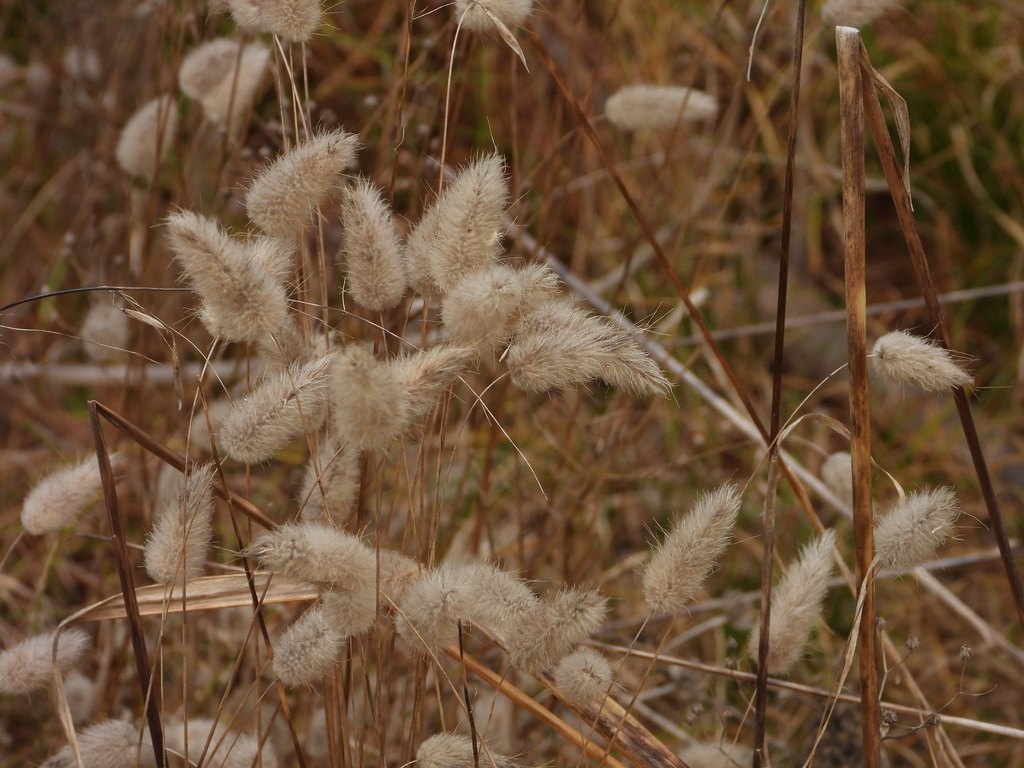
LATIN NAME: Lagurus ovatus
COMMON NAME: Hare’s Tail Grass
Plant Profile
Lagurus ovatus is an annual grass of the Mediterranean basin, from Madeira and the Canaries east to the Crimea and Saudi Arabia, growing in sand, on dunes and along roadsides. It reaches twenty to forty centimetres, with narrow, softly hairy leaves and a dense, egg-shaped head that looks like a rabbit’s tail.
The head runs one to seven centimetres long and up to two wide; the spikelets inside it are seven to ten millimetres, each ending in an awn of eight to twenty. Green at first, it turns buff as it ripens. The softness comes from those awns, and a row of the plants in a border looks like a line of small animals.
The epithet ovatus names the egg shape of the head, and the genus name says hare’s tail in Greek. Softness to the touch is rare among ornamental grasses, most of which bristle; florists notice it first and children second. Linnaeus described the species in 1753 and it has kept both names since. The same family turns up again in Elymus trachycaulus, Setaria faberi and Axonopus compressus.
Science & Biotechnology
Lagurus holds a single species. The others once placed here have gone: Lagurus cylindricus became Imperata cylindrica, and two more were moved to Cymbopogon. The genus is monotypic, a Mediterranean annual in the Poeae, and the hare’s tail is the whole of it. Chromosome counts give 2n = 14.
The bristles are sterile lemmas that have lost their flowers and become long, soft awns. They catch the wind and help the seed travel, and they help it work into the soil once it lands. Few ornamental grasses feel soft to the hand, and that softness is a by-product of dispersal rather than a design for gardeners.
In its native range it germinates with the autumn rains and flowers before the summer drought. Outside it, the plant has naturalised in Australia, New Zealand, the Azores, Ireland and southern England, and it grows on sand in Jersey and Guernsey. Garden sowings are usually made in spring, which shifts the season later without changing the requirements.
Uses & Benefits
It is used at the front of a border, in a gravel garden, in a meadow mix and in a cutting garden, where its heads are one of the best annual fillers for fresh and dried arrangements. The stems are stiff enough to hold the heads upright, and the heads last for months if they are cut before the seed shatters and dried in the dark.
In a container it works as a filler between flowering plants, where its pale heads lighten the composition and its soft texture contrasts with harder leaves. It is also one of the best plants for a child’s garden, since it is easy to grow, quick to flower and pleasant to touch, which is more than can be said for most grasses.
No part of it is edible, and none of it is prescribed. In its native range it is a plant of disturbed sandy ground and dunes, and it ranks among the species that stabilises sand, so it is sometimes sown in coastal restoration. In a garden it has no such role, and it is grown for ornament alone.
Growing from Seed
Sow direct in early spring, or indoors four to six weeks before the last frost at 15 to 20 °C. Cover it lightly and keep the surface damp for a fortnight, which is all the time it needs. The seed is chunky enough to handle and comes up dependably.
Thin to 15 cm apart, or plant out at that spacing. The plant tolerates poor, sandy soil and needs no feeding; rich soil produces soft growth that flops and fewer heads. Keep it watered until it is established, and after that only in a real drought.
For drying, cut the heads when they are fully formed but still green, and hang them upside down in a dark, airy room for two weeks. For the border, leave them standing into autumn; they will hold their shape through light frost and provide seed for the next year if a few are left on the plant.
Our Take
Hare’s tail grass is one of the most charming annuals in the catalogue, and one of the easiest. It is soft, quick, generous and useful, and it costs almost nothing to grow. A row of it in front of a border, with the heads moving in the wind, is worth more than a bed of expensive annuals. Sow it thickly, cut it for drying, and let a few heads go to seed. It will come back, and the children will notice it before you do.
Related Reading
More species in the same orbit as Hare’s Tail Grass: