


Setaria faberi Seeds | Giant Foxtail
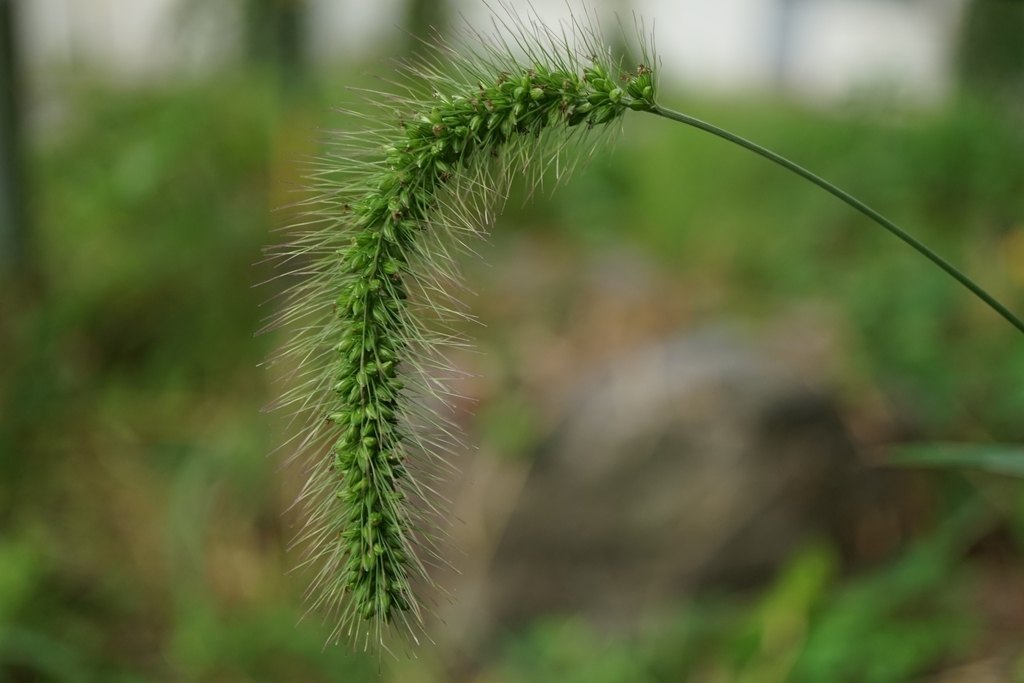
LATIN NAME: Setaria faberi
COMMON NAME: Giant Foxtail
Plant Profile
Giant foxtail is a summer annual of the Poaceae from eastern Asia, where it grows in field margins and disturbed ground from China to Japan and is mostly ignored. In North America it ranks among the worst weeds of maize and soya, and it has been since the middle of the last century. It arrived without fanfare, in contaminated seed and in straw, and it found a continent of maize waiting for it.
It reaches two metres in a good season, with broad, flat leaves that carry fine hairs on the upper surface and a dense, bristly panicle ten to fifteen centimetres long that nods over as the seed ripens. The bristles give the genus its name, and they are stiff enough to catch in wool and in the weave of a trouser leg. A field of it in August looks like a field of small green caterpillars hung out to dry.
There are no rhizomes and no stolons anywhere in the plant. It is an annual that relies entirely on seed, and that single fact is both what makes it manageable and what makes it relentless. Every plant you leave is a seed bank you will be fighting for years, and every plant you miss in a hedge bottom is next season’s infestation.
Science & Biotechnology
Setaria sits in the Panicoideae, one of the C4 grass lineages, and it runs the NADP-malic enzyme variant of the pathway. The C4 machinery is why the plant keeps growing through the heat of July, long after the cool-season grasses of the same field have headed and dried off. It is also why the weed competes so hard with maize for water, and why a late flush can hurt a crop that looked clean in June.
The genus also contains a crop. Foxtail millet, Setaria italica, was domesticated from green foxtail, S. viridis, in northern China about eight thousand years ago, and it is still grown across semi-arid Asia on land too dry for maize. Giant foxtail is a close relative of both, and the resemblance in the head is obvious once you have seen them side by side. The difference is that one was selected for a thousand generations and the other was not selected at all.
One plant sheds several thousand seeds, and the seed bank is not as long-lived as the reputation of foxtails suggests: much of it dies within three or four years if no new seed is added. That is cold comfort in continuous maize, where new seed arrives every autumn. It is the reason rotation and a stale seedbed still work better than any single herbicide, and the reason the oldest advice is still the best.
Uses & Benefits
It has almost no deliberate use. Young plants are grazed before the heads form, and the forage value is low. The seed is eaten by birds and small mammals, which is part of why it travels along hedgerows and field margins so effectively and turns up in places nobody planted it.
In its native Asia it is a minor forage and a famine grain, ground with other cereals in poor years. It has never been bred and is not cultivated on any scale, which is a strange thing to say about a plant that grows two metres tall on ground nobody fertilised.
For a seed merchant the entry is a caution rather than a product. Giant foxtail turns up in cheap bird mixtures and in uncertified grass seed, and once it is in a field it is very hard to get out. Certified seed and a clean harvester are cheaper than the alternative, and the arithmetic is not close. Closest relatives on the list are Setaria viridis, Achnatherum extremiorientale and Lagurus.
Growing from Seed
It germinates late, from mid-spring, and it wants compacted soil, nitrogen and phosphorus, and a pH above neutral. Those are the conditions of a maize field, so the two are so often found together, and why the weed has followed the crop into Europe and into the warm parts of Asia. A compacted headland is its favourite place in the world.
In a garden it appears in newly spread topsoil and in compost that did not heat enough. Pull it before the head emerges; after that, every plant you leave is several thousand seeds and a problem for the next five years.
ALS-inhibitor resistance is now documented in several Setaria species, giant foxtail among them. In arable systems the answer is rotation and a stale seedbed rather than a stronger chemical, and that answer has been correct since before the chemicals existed.
Our Take
It is a fine grass to look at, if you can look at it without thinking about yield loss. The nodding head has a grace that the crop it infests does not. That is not a reason to let it seed, and no one who has hand-rogued a maize field has ever been sentimental about it for long.
Related Reading
Gardeners who grow Giant Foxtail often pair it with these related subjects: