


Achnatherum extremiorientale Seeds | Chinese Needlegrass
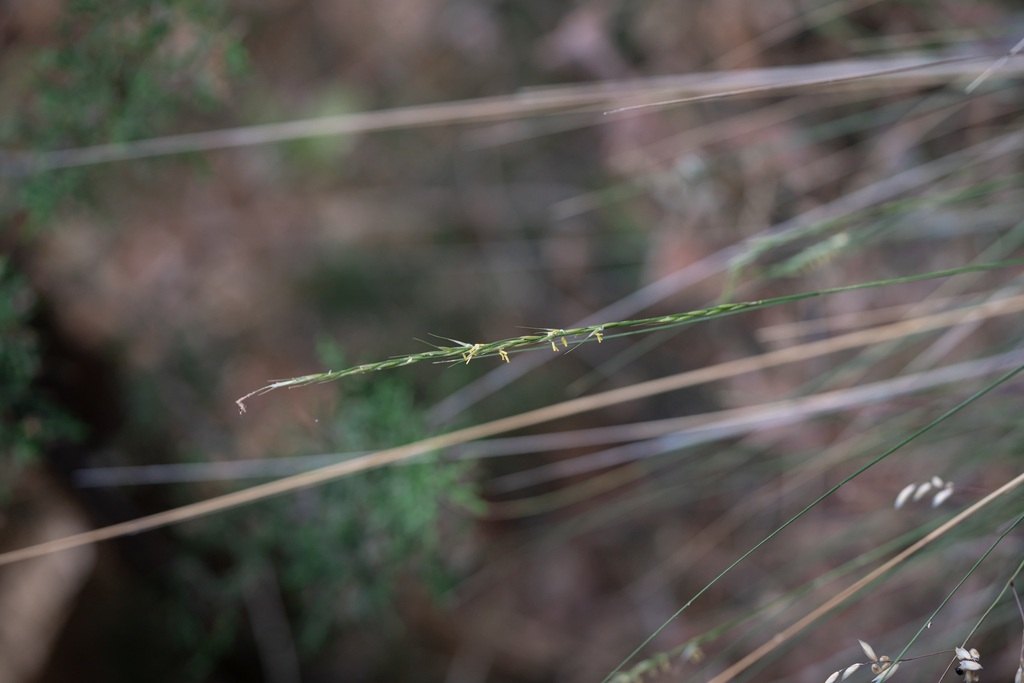
LATIN NAME: Achnatherum extremiorientale
COMMON NAME: Chinese Needlegrass
Plant Profile
Achnatherum extremiorientale is a tufted perennial grass of the north Chinese hills, with narrow arching leaves, a loose panicle of one-flowered spikelets, and a long twisted awn on every seed. It is now usually treated as Achnatherum pekinense, the name Ohwi gave the plant in 1941, and both names are still in the literature.
The clump is dense and upright, forty to a hundred centimetres tall, with flat leaves that roll at the edges in dry weather and a panicle that opens in August and turns from green to straw through September. It is a grass of mountain meadows, forest edges and rocky slopes.
Its range covers northern China, Inner Mongolia, Manchuria, Korea, Japan, Sakhalin and the Russian Far East, and in China it is a familiar species of the hills around Beijing, which is what the newer epithet refers to. Keng described it as A. extremiorientale in the 1930s, from material at the eastern end of the range.
The genus name combines the Greek for chaff and for awn, and the plant is a member of the tribe Stipeae, the needlegrasses, a group defined by the one-flowered spikelet and the long, often twisted awn. The tribe has been split and renamed repeatedly, and Achnatherum itself has lost species to Eriocoma and Ptilagrostis. The other Poaceae in the catalogue are Achnatherum splendens, Melinis nerviglumis and Beckmannia syzigachne.
Science & Biotechnology
The awn is a hygroscopic machine. Its two halves swell differently as humidity changes, so the awn twists and untwists with every shift in the weather, and the seed works its way into the soil like a screw being turned. The mechanism is one of the classic examples of a self-burying seed.
The spikelet holds a single floret, and the lemma carries the awn from its tip. Flowering is unremarkable: the grass is wind-pollinated, the anthers hang out on long filaments, and the feathery stigmas catch the pollen. Seed set is often good, and the seed is heavy enough to fall near the parent.
Photosynthetically it is a C3 grass of cool, open habitats, so it belongs to the mountains and the northern steppe rather than to the hot grasslands further south. Its growth starts late, in May, and the plant is at its peak in the cool, wet weeks of late summer.
Uses & Benefits
It is a forage grass of moderate value, grazed when young and refused when the awns harden, and in China it ranks among the native species used in the reseeding of degraded mountain pasture. It is not a ley grass, and it will not stand heavy continuous grazing.
In the garden it is an ornamental grass for the middle of a border or a gravel planting, where the loose panicle catches light and the winter skeleton holds up. It is drought-tolerant once established, and it does not self-sow into a nuisance the way some members of the tribe do.
The awns are the problem for anyone who works with the seed. They work their way into clothing, fleece and skin, and a hay crop cut late is a crop full of them. Cutting before the awns harden is the standard advice, and it is advice worth taking.
Growing from Seed
Seed needs no pretreatment and germinates in two to three weeks at fifteen to twenty degrees. Sow in spring on the surface, press it in and keep it moist; the seedlings are slow for the first month and then grow away quickly once they have three leaves.
Plant out in full sun in any well-drained soil, and give it a metre of space if you want the clump to open properly. It tolerates drought, poor soil and wind, and it resents wet feet in winter more than cold. Cut it back in late winter, before the new growth starts.
Division every few years keeps the clump tight and stops the centre from dying out. The plant is long-lived and slow to spread, and it will hold a position for a decade without attention. It ranks among the few grasses here that looks better in its second year than its first.
Our Take
This is a grass with a good silhouette and no fuss, and it deserves to be better known outside China. The panicle is loose and mobile, the autumn colour is a clean straw, and the winter skeleton stands through snow without collapsing, which is more than most grasses manage.
Grow it for the movement and the winter structure, and cut it before the awns ripen if you plan to use the hay. The taxonomy has changed twice in a century; the plant itself has not changed at all, and it does not care what the label says.
Related Reading
If Chinese Needlegrass appeals to you, these related plants are worth a look: