


Achnatherum splendens Seeds | Chee Grass
LATIN NAME: Achnatherum splendens
COMMON NAME: Chee Grass
Plant Profile
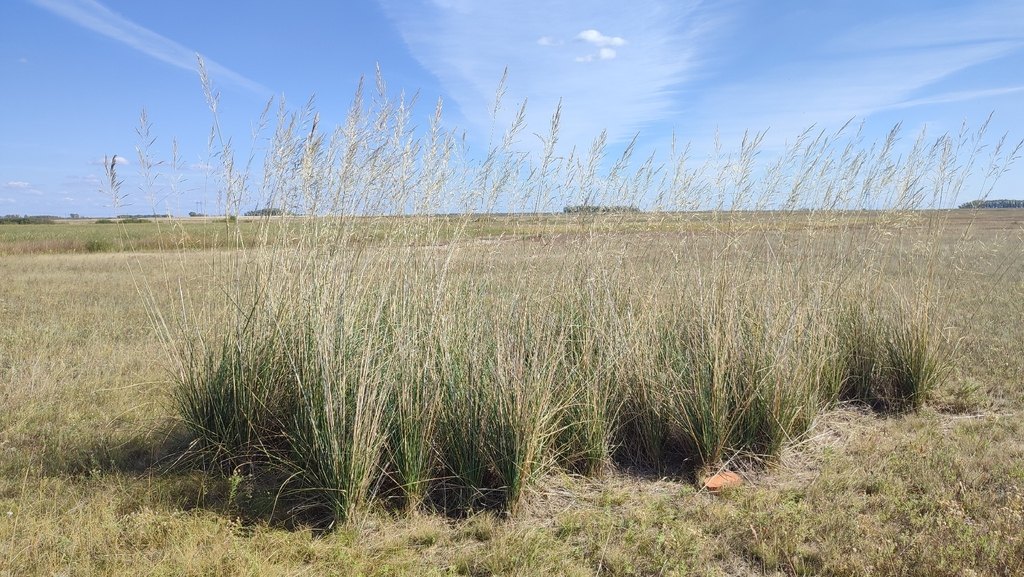
Chee grass is architecture before it is a plant. Achnatherum splendens, a giant bunchgrass of the Central Asian steppe, builds hemispherical tussocks one to two metres tall and across, a fountain of fine, rolled leaves topped in summer by large, open, silvery panicles that move with the least wind.
Each tussock grows outward from a dense base of old leaf sheaths, and the oldest clumps on the Mongolian and Chinese steppes are measured in decades, islands of vegetation in bare ground that the grass itself creates, shedding litter and lifting dust into its own shadow. Herders call the stands chee, and whole landscapes carry the name: the jiji grasslands of Inner Mongolia and Xinjiang are map features.
Botanically it has travelled. Described from Siberian material in the 1820s and long placed in Achnatherum, molecular work of recent years moved it and its close relatives into a rebuilt genus, Neotrinia, a split the major checklists now accept. Seed trade and old floras still say Achnatherum splendens, and both names describe the same giant tussock.
Its range is the dry belt of Asia: Siberia and Mongolia, and across northern and western China from Inner Mongolia through Gansu and Qinghai to Tibet and Xinjiang, on saline steppe, sandy flats and abandoned ground between three hundred and four thousand metres of elevation.
Science & Biotechnology
The tussock is a machine for ruling steppe hydrology. Its dense base intercepts wind-blown seed and dust, builds a mound of its own litter, and sheds rain outward, so the soil beneath turns saline and bare while the clump itself sits moister than the plain around it. Ecologists treat chee stands as ecosystem engineers that reorganise a steppe into islands and corridors.
For herders that structure is infrastructure. Stands break the wind, trap drifting snow, shelter livestock in winter, and their coarse leaves are cut for rope, matting and paper; the pulp industry in northern China has drawn on wild chee stands for over a century. Field records peak from June to September, matching the panicle season across the huge range.
Physiologically it is a steppe generalist with deep reach: roots run metres down, the rolled inrolling of the leaf blade is classic drought gear, and the plant tolerates the saline soils that end most grasses. Recent genetic work on Chinese populations underpins breeding for forage and restoration, because natural stands degrade under overcutting while demand for the fibre persists.
Uses & Benefits
In temperate gardens it is a statement grass on the scale of pampas, hardy far beyond it, taking winters deep into minus thirty. A single clump anchors a dry border; a row makes a windbreak three seasons a year; the winter skeleton of pale stems and seed heads lasts until spring cleanup.
Its practical services travel with it: erosion control on sandy and saline ground, shelter belts, and a structural grass for low-input landscapes where irrigation is a rumour. PFAF rates it hardy to zone 6 and lists no hazards, no edibility and a traditional place in steppe craft, rope and paper, that remains a working use in Inner Mongolia.
The honest limitations are scale and patience. A tussock needs a metre of ground and a few years to arrive, and it is a plant of presence rather than detail: from a distance it is silver movement, up close it is coarse leaves and old sheaths. Small gardens should admire it elsewhere. Elsewhere in Poaceae, the list holds Achnatherum extremiorientale, Lagurus ovatus and Hordeum jubatum.
Growing from Seed
Sow in spring, in deep cells or in place, covering lightly; germination runs one to three weeks at eighteen to twenty-two degrees with no pretreatment. Seedlings grass along for a season and explode in the second. Transplant young, spacing one metre minimum, because the clump’s final diameter is not negotiable.
Full sun, any soil that drains, no feeding and no watering after the first year, drought being its native condition. Cut the old foliage to the crown in late winter. Pests and diseases do not register on the list; the only management is keeping its bare-circle habit from swallowing small neighbours.
For seed, cut panicles when the glumes begin to shed and dry them in paper; each panicle yields a scatter of elongated seeds with their twisted awns, which need no removal. Viability holds several years cool and dry. In suitable ground a single clump self-sows a ring of seedlings within a few seasons.
Our Take
Our take: chee grass is the steppe sold in a packet. Nothing else in the temperate grass palette combines this hardiness, this scale and this history of use, and a mature clump in winter wind is worth every square metre it occupies.
The honest deal is simple: give it a metre of nothing, walk away, and in the third year you own a landmark. Growers wanting fast or fine should look elsewhere; growers with dry land to tame and a long view have found their plant.
Related Reading
Gardeners who grow Chee Grass often pair it with these related subjects: