


Elymus sibiricus Seeds | Siberian Wildrye
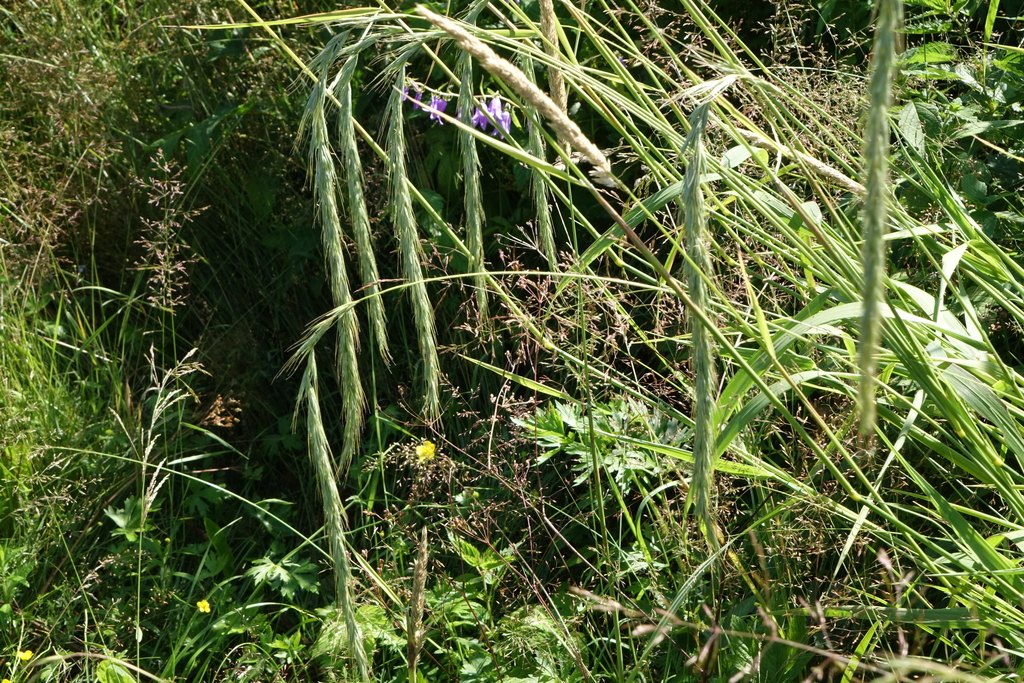
LATIN NAME: Elymus sibiricus
COMMON NAME: Siberian Wildrye
Plant Profile
Elymus sibiricus was named by Linnaeus himself in 1753, one of those early species that came with the first wave of herbarium material from the Russian empire. It is a tufted perennial rye grass of the vast northern belt, running from Belarus and the Altai through Mongolia, Siberia and the whole of northern China out to Alaska and British Columbia.
The plant builds loose clumps fifty to one hundred and twenty centimetres tall with flat grey-green blades, and carries the spikes that give it its character: nodding heads ten to eighteen centimetres long, two or three spikelets per node, each flower drawn out into an awn of fifteen to twenty-five millimetres that catches light all through late summer.
Flowering runs from July into September according to field records, later at altitude, and on the Qinghai-Tibet plateau the species is the backbone of seeded hay meadows between three and four thousand metres, where it is known as lao mang mai, the old-awn rye, and has been sown by herders for generations.
Its ecological range is as striking as its latitudinal one: alpine meadow, steppe, forest edge, road verge and riverside gravel, wherever disturbance opens a gap in the cool northern belt. Few forage grasses of any continent cover as much ground without cultivation’s help.
Science & Biotechnology
Genetically the species is a tetraploid carrying the St and H genomes, the signature combination of the wheatgrass and wildrye alliance, and that ancestry has made it a working subject for genome studies. Recent chromosome-scale reference sequences for the species have given breeders markers to work with in a grass that resisted genomic tools for years.
Its reproductive biology is unusually tidy. The anthers shed most of their pollen inside the closed floret, so the species sets seed essentially by self-pollination, outcrossing being a rare event. That selfing habit produces uniform offspring from any seed lot, convenient for breeding, at the cost of low genetic recombination in wild populations.
The crop’s one real defect is mechanical rather than biological: the spikes shatter as the seed ripens, joints of the head dropping to the ground with their seed still attached. Seed growers therefore harvest early and dry the crop off the field, and the shattering habit itself has become a target of breeding work in its own right. It shares the family with Elymus repens, Elymus trachycaulus and Buchloe dactyloides.
Uses & Benefits
As forage it is the plateau standard. The hay cuts at heading with moderate protein and good digestibility, cures easily in dry mountain air, and the sward tolerates grazing after establishment. Chinese breeding programmes have registered a series of cultivars from collected plateau ecotypes, selected for seed yield, standing power and altitude performance.
In restoration the grass is the first name on the list for reseeding degraded alpine grassland on the plateau, where overgrazing and rodent damage have opened ground that erodes fast. Its seed is cheap, its establishment reliable and its root system binds loose mountain soils within a couple of seasons.
Wildlife value comes in winter, when the persistent spikes feed granivorous birds and the tussocks shelter small animals above the snow. In a garden setting the nodding spikes earn the plant a place in naturalistic grass schemes, though gardeners should expect it to look its best high and cool rather than in low, humid summers.
Growing from Seed
Germination is straightforward and needs no cold treatment, a shallow physiological dormancy clearing within weeks of harvest. Sow in spring or late summer a centimetre or two deep, at seeding rates in the order of fifteen to twenty-five kilograms per hectare for swards, and keep the seedbed moist through the first month.
The establishment year is all root: plants may look unimpressive by autumn, but the crowns survive winter firmly. Light grazing or a first hay cut comes in the second season, and a mature sward carries through drought better than most perennials of the same meadows, thinning only where shading closes overhead.
For a seed crop the trick is timing. Swath or cut the heads as the first joints begin to drop, well before the stand looks fully ripe, and finish drying under cover. Leave it a week too long and a large share of the crop lies on the ground attached to shed spike sections.
Our Take
The species is a reminder that the most valuable plants are often the least ornamental in the catalogue sense. A nodding spike and a wide cold range have made it a pillar of high-altitude agriculture from the Altai to the Tibetan plateau.
Sow in spring or late summer an inch deep and let the crown do its quiet first-year work. Cut hay at heading, harvest seed early because the spikes shatter fast, and the sward will hold for years on thin mountain ground.
Related Reading
Gardeners who grow Siberian wildrye often pair it with these related subjects: