


Calamagrostis epigejos Seeds | Wood Small-reed
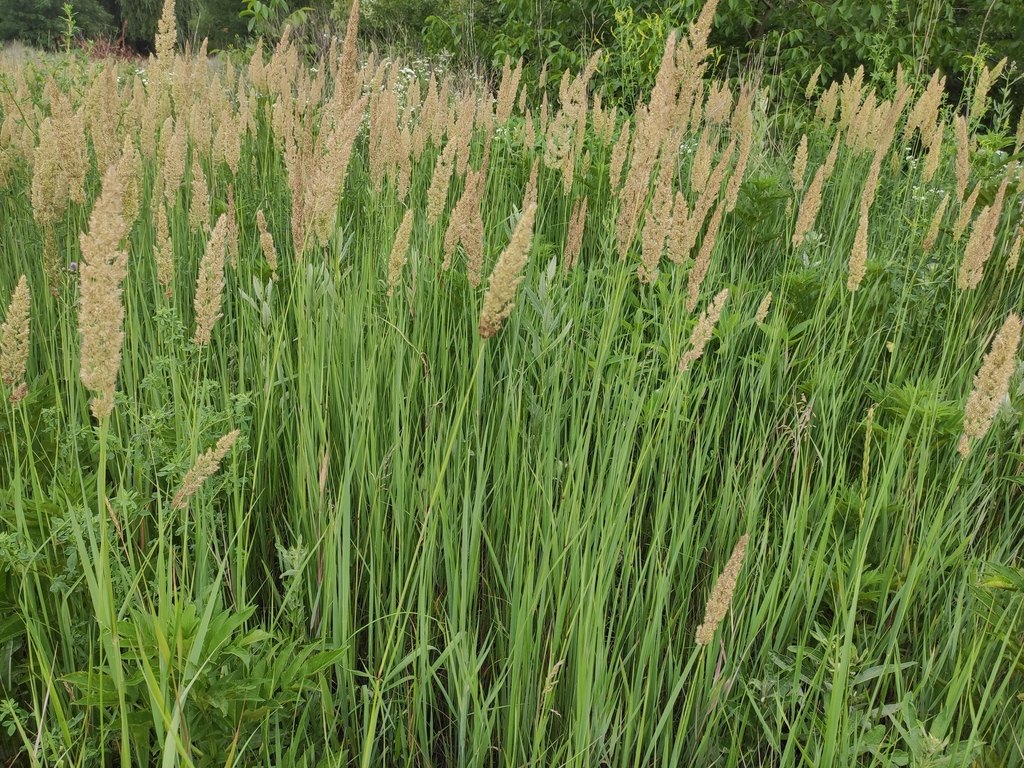
LATIN NAME: Calamagrostis epigejos
COMMON NAME: Wood Small-reed
Plant Profile
Wood small-reed, also called bushgrass, is a perennial grass of temperate Eurasia and Africa, from average-moisture ground to salt marsh and wet habitats. It builds itself on lengthy rhizomes, the underground runners that make it both a colonist in the wild and, in a garden bed, a plant with opinions about territory.
The culms stand erect at 60 to 200 cm, and the leaf blades run to 70 cm long and 3 to 14 mm wide, occasionally to 20. The ligule, 4 to 12 mm, is acute and lacerate, the sort of character a botanist checks with a lens and a gardener ignores until the grass is in the wrong place.
The flowering apparatus is the ornament: a large, erect, rich brown panicle, oblong to almost lanceolate, 15 to 30 cm long, dense and narrow, with spikelets of 4.5 to 7 mm. The glumes are scaberulous and lanceolate, the lemma half their length, with awns of 1 to 2.5 mm attached near the lemma’s middle.
Its distribution spans France and Great Britain to Japan, and a distinct variety occupies southern and eastern Africa. It is cultivated as an ornamental grass for gardens, usually with the warning attached, because the rhizomes that make it self-sufficient in a wet meadow do not respect a border line. Other Poaceae on the list: Agrostis nebulosa, Koeleria and Lagurus ovatus.
Science & Biotechnology
The rhizome strategy is the biology worth understanding. Each running stem can push up new culms a metre from the parent, so a single plant becomes a close-packed colony in a few seasons, which is how the species holds wet ditches, roadside verges and derelict ground against competition. Salt tolerance extends that reach into marshes.
The technical characters separate it from lookalikes cleanly: the prolonged rhachilla, the awn positioned near the middle of the lemma, and the tall lacerate ligule. Brown-panicked grasses are easy to confuse at a glance, and this one is identified as much by what it does underground as by the spikelet details.
Ecologically it is a mid-succession aggressor: it moves into moist disturbed ground, builds a dense sward, and shades out finer grasses and forbs. That makes it valuable on raw ground and unwelcome on nature reserves, where its spread is managed by cutting and, in several European countries, watched carefully.
Uses & Benefits
As an ornamental its virtues are height, toughness and winter presence: the brown panicles dry on the stem and stand through winter, catching frost and low sun, in positions where most showy grasses would sulk. Large schemes, screens and wet-soil plantings are its natural assignments.
It earns a place in wildlife planting for the same reasons it earns warnings: dense swards shelter ground-nesting birds and small mammals, and the seed heads feed finches through the cold months. On restored wet ground it does structural work that decorative clump grasses cannot.
The honest guidance is positional: give it a wet basin, a bastion bed or a big margin where its colony is the design, and it is a superb plant; put it beside choice perennials and the relationship ends badly within three years. Root barriers exist and are worth installing on the first day.
Growing from Seed
Sow in spring on the surface of moist compost, pressing the seed in without covering it deeply, and keep it evenly wet. Germination is straightforward in warmth, and the seedlings are grass-typical: thin threads at first, then sudden runners. Pot on before the roots meet the tray edge.
Plant out into moist to wet soil in full sun or light shade, spacing generously, a metre or more, because the colony will fill the space itself. Water the first season; after that the rhizomes do the work and the plant survives drought, flooding and salt spray with equal indifference.
Establishment management is simple: cut the whole stand to the ground in late winter, once, every year. Do not attempt to divide and contain it by trimming during the season, and do not plant it in fine ground unless the boundary is hardscape. It is a grass to be given a kingdom, not a corner.
Our Take
Wood small-reed is the honest workhorse at the rough end of grass growing: two metres of brown architecture on wet, cold, salty ground, for the price of one seed packet and one firm boundary decision. Few plants deliver this much winter presence with this little attention, and none of them also fix a ditch bank.
Make the boundary decision first, with edging and a metre to spare, and then enjoy a grass that never needs you again. The failures with this species are all failures of placement, and all of them avoidable on the planting day.
Related Reading
Continue exploring with these related plants: