


Bromus rubens Seeds | Foxtail Brome
LATIN NAME: Bromus rubens
COMMON NAME: Foxtail Brome
Plant Profile
Foxtail brome is a winter annual, solitary or tufted, with erect or ascending culms 20 to 70 cm high and downy leaf sheaths. It has no auricles, the ligule is glabrous and 1.5 to 2 mm long, and the flat blades run 4 to 20 cm long and 1 to 5 mm wide. The whole plant is softer than its reputation suggests.
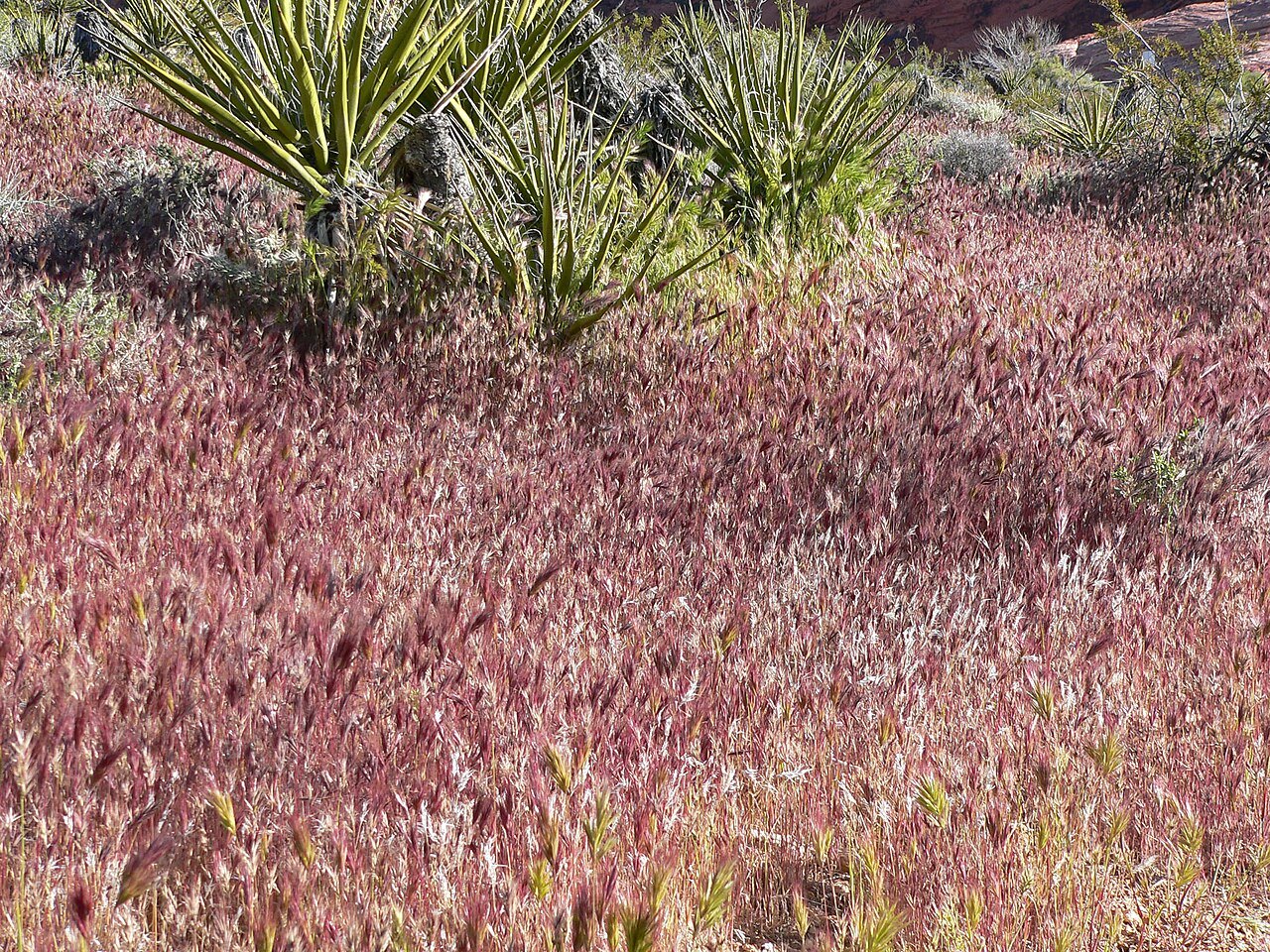
The panicle is erect and ellipsoid, 3 to 12 cm long, with short branches that ascend and spread slightly but never droop, carrying one or two spikelets each. The spikelets are 4 to 6 cm long, longer than the branches that hold them, and carry seven to eleven florets. They run from green to a distinct purplish red, which is where the name comes from.
The lemmas are 1.5 to 2 cm, five to seven veined, hairier at the edges, with awns of about the same length that curve slightly. The anthers are tiny, half a millimetre to one, and the caryopsis can reach 11 mm, which is large for a grass of this size and part of why the plant is so good at what it does. It has 28 chromosomes at the diploid stage.
Science & Biotechnology
It is now treated as a subspecies of Bromus madritensis, so the name in the trade and the name in the database disagree: Bromus madritensis subsp. rubens is the accepted combination, Bromus rubens is what the seed catalogues and the weed literature still print. The two subspecies differ in panicle density and hairiness, and not by much else.
Its season is the opposite of a prairie grass. It emerges in early winter and sits dormant until spring rain and rising temperature start it growing; it flowers until May, when water stress shuts it down. Populations expand in wet years and can be wiped out entirely in a long drought, so the plant is a boom-and-bust species rather than a permanent sward.
It also changes the ground it grows on. The litter and the competition alter soil conditions and the availability of nitrogen, so that the community after a brome invasion is not the one that was there before. That is the quiet part of weed ecology, and it is the part that matters most in the long run.
Uses & Benefits
In the American west it is a fire plant, and a bad one. The dry standing straw carries flames across ground that would otherwise be bare between shrubs, and it has made the fire cycle in parts of the Mojave and the Great Basin faster and more frequent than the native species can tolerate. Red brome in spring means black ground in June.
It is grazed when it is young and before the awns harden, and after that stock will not touch it. The forage value is brief and the awns work into wool and into the mouths of animals, so it is not sown deliberately in any pasture I can find.
In a garden it is a weed of dry gravel and poor ground, and it is worth recognising early: a tuft of soft green grass in February that turns red in April and dies in May, leaving a mat of straw. Pull it before the seed sets, and the patch stays clear for the year. The rest of the Poaceae here runs to Bromus hordeaceus, Eragrostis pilosa and Calamagrostis epigejos.
Growing from Seed
It germinates with the first autumn rain, at 10 to 15 °C, on the surface of bare ground. There is no need to sow it, and no reason to; the seed bank does the work. If it is being grown for study, scatter on sterile compost in autumn and leave the tray outside through winter.
Control is by removal before seed set, which in practice means late March or early April, when the panicles have emerged but the spikelets are still green. Pulling is more effective than mowing, because a mown plant will tiller and set seed at 5 cm.
Do not compost the plants once the awns have formed. Bag them, and do not move hay or straw from an infested site to a clean one, which is how it travels. The seed is short-lived in the soil compared with most weeds, so two clean years will usually clear a patch.
Our Take
There is no garden case for this grass, and no ornamental use that survives an honest look at it. It is a weed with a pretty colour, and the colour is the warning rather than the attraction: red brome means the fuel is dry and the fire is coming.
Worth knowing, because it is spreading, and because a gardener who can recognise it in February can remove it in March and save themselves a summer of pulling straw out of the gravel. Everything else about it belongs to the fire ecologists.
Related Reading
Readers interested in Foxtail Brome frequently explore these as well: