


Acacia decurrens Seeds | Green Wattle
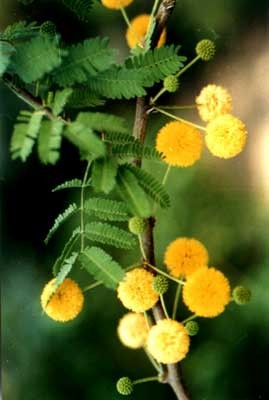
LATIN NAME: Acacia decurrens
COMMON NAME: Green Wattle, Sydney Green Wattle
Plant Profile
The most distinctive thing about Acacia decurrens is not its flower but its leaf. Like other wattles it has abandoned true leaves in favour of phyllodes, and in this species the phyllode base runs down the stem in a narrow wing, which is exactly what the name decurrens describes. The blade is narrow, lance-shaped and usually grey-green, carrying the faint parallel veins that mark the Mimosoideae. A young plant shows a brief stage of true pinnate leaves before the phyllodes take over, a small reminder of the family it grew from. Gardeners who meet the tree only in bloom often miss this detail, yet it is the surest field mark.
It is easily confused with Acacia mearnsii, the black wattle of commerce, but the decurrent leaf base and the brighter yellow, more conical flower heads set it apart. Silver wattle carries grey foliage and a softer profile; decurrens is greener and tighter in habit. The flat, slightly curved pods that follow the bloom are another field mark, narrowing toward the tip and holding several hard, oblong seeds. Where the two grow together the flower timing also helps, decurrens blooming a little earlier in the warm season.
Long before it was a garden tree, A. decurrens was a tanning resource. The bark stores a high load of condensed tannins, and colonial tanners stripped it for the leather yards of Sydney and Melbourne. The wattle-bark trade shaped whole regional economies, and the common names Tan Wattle and Wattle Bark both point back to that use. The wood, pale and close-grained, is marketed under the misleading names Golden Teak and Brazilian Teak, though it is no teak at all and shares none of that genus’s oily heartwood.
Science & Biotechnology
Modern phytochemistry explains the old tanning value. The bark is rich in proanthocyanidins, chains of flavan-3-ol units, alongside gallic acid derivatives and a suite of flavonoid glycosides built on quercetin and kaempferol. The phyllodes carry these compounds too, which is why wattle foliage resists most browsers. Research lines have screened A. decurrens extracts for antioxidant and antimicrobial activity, consistent with the condensed-tannin load. The chemistry is the reason the bark, not the leaf, was the commercial prize.
Because seed-grown wattles vary widely, breeders have turned to micropropagation. Shoot-tip culture on a cytokinin-balanced medium produces uniform lines, and somatic embryogenesis has been demonstrated for several Acacia species, giving clean stock for plantation forestry. For the home grower this matters less, but it is how commercial wattle and tannin clones are now held true to type rather than drifting from seed.
Uses & Benefits
Beyond tanning, the pale timber is valued for woodturning, inlay and light furniture, where its even grain takes a clean finish. The flowers feed bees that produce a distinctly flavoured black wattle honey, prized in local markets. As a nitrogen-fixing pioneer it also earns its place in revegetation and mine-site restoration, rebuilding soil where little else will start, which is why land managers favour it on disturbed ground.
The nectar flow arrives in late winter and early spring, and apiaries are moved beneath the bloom to capture it. The resulting honey is dark, aromatic and slow to candy, a useful counterpart to the lighter eucalypt honeys. A single mature tree can shade a hive for the whole flow, and the bee lines are a quiet part of the rural economy.
Growing from Seed
In the wild the species spans the tablelands and coast of south-eastern Australia, from Tasmania north through Victoria and New South Wales. It favours moist valleys and the edges of sclerophyll forest, yet it tolerates the dry spells that define the Australian summer. The tree grows fast and reaches a slender eight to twelve metres in cultivation, carrying an open, spreading crown once established. It is frost-tolerant once mature but the seedlings are tender, so a sheltered first season pays off.
The seed coat is hard and impermeable, so sow only after scarification. Nick the coat with a file or pour near-boiling water over the seed and let it cool, then sow into a free-draining seed mix. Set the seed just below the surface and keep the medium warm and lightly moist. Seedlings emerge through the warmth of the season; thin them once they stand with their first true leaves, and move them to individual pots when they reach about fifteen centimetres.
Plant out in full sun and well-drained soil, spacing trees three to four metres apart where a hedge or screen is intended. A dusting of rhizobial inoculant at sowing helps the roots nodulate and fix nitrogen. Water through the first dry season, then the tree largely fends for itself and asks only for light and drainage.
Our Take
I keep A. decurrens for the brief, electric-yellow bloom and for the way it banks soil on a bare bank. If you want a faster tannin crop, black wattle is the heavier producer, and black locust makes a tough nitrogen-fixing neighbour in colder ground. Scarify well, sow in warmth, and the run-down leaf will tell you at a glance that you grew the right wattle.
Related Reading
Readers interested in Green Wattle frequently explore these as well: