


Iodes hookeriana Seeds | Hooker’s Iodes
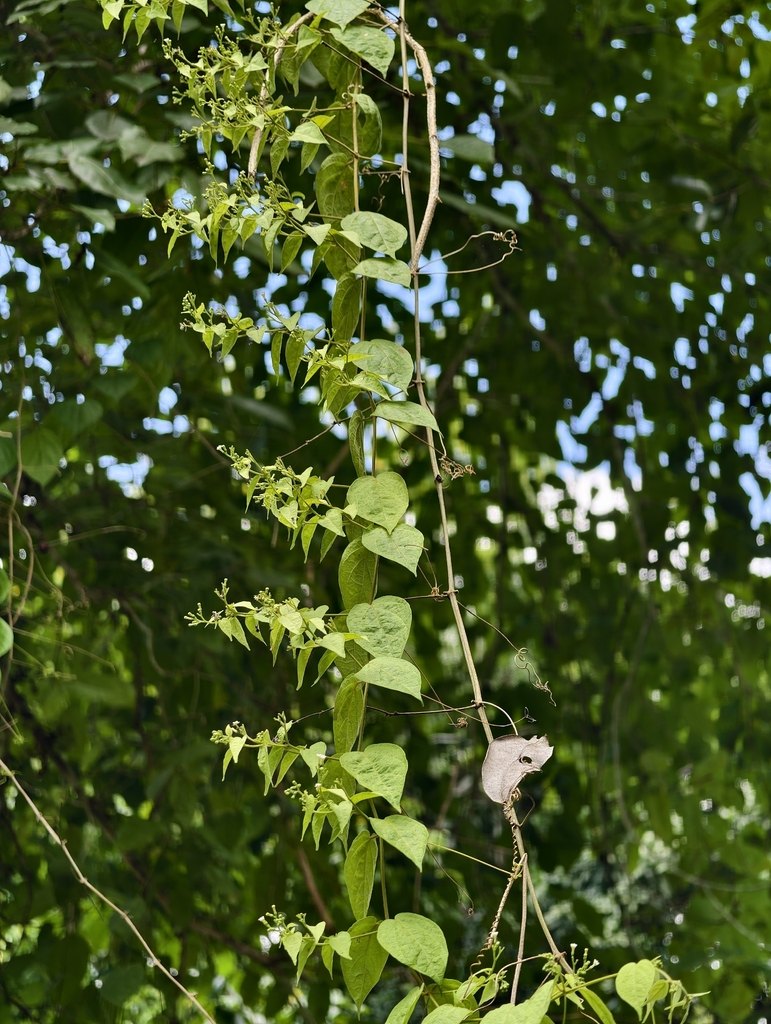
LATIN NAME: Iodes hookeriana
COMMON NAME: Hooker’s Iodes
Plant Profile
Iodes hookeriana is a woody liana of the warm forests of northeastern India, Bangladesh, Myanmar, Sumatra, the Malay Peninsula and Borneo. It climbs by tendrils rather than by twining, a habit unusual in its family and one that lets it cross gaps between trunks without needing a continuous support. Its stems are dark and slender, wandering widely through the understorey.
The species was described by Henri Baillon, the French botanist who produced the monumental Histoire des Plantes and who described an immense number of tropical plants from the Paris herbarium. His work on the Icacinaceae remains a starting point for the family. Baillon worked from the Paris collections for most of his long career.
Hermann Sleumer moved the plant into Mappianthus in his 1940 revision, and the combination Mappianthus hookerianus is accepted in current databases, though the older name persists in nursery lists and in much of the regional literature. The transfer has been accepted by most subsequent authors.
The epithet honours Joseph Dalton Hooker, who collected in Sikkim and whose Himalayan journals established the botanical geography of the eastern Himalaya for the next century. Hooker’s Sikkim collections were the first serious survey of that flora. Hooker’s own account of the Sikkim forests mentions climbers of this kind.
Science & Biotechnology
Tendril-climbing lianas face a different mechanical problem from twiners: the tendril must find and hold a support, then stiffen enough to carry the weight of the growing shoot. The tissue that does this work is a short, specialised section of stem rather than a modified leaf. A tendril must also be able to let go when the support fails.
The family’s classification has changed repeatedly. Icacinaceae in the old sense was a large assemblage, and molecular phylogenetics has moved genera into Metteniusaceae and other families, leaving a much smaller core that includes Iodes and Mappianthus. The older family name is still used in much horticultural writing.
The fruit is a compressed drupe, often with a ridged or winged stone, and the seeds carry a small embryo in abundant endosperm. Dispersal in the genus is mainly by birds, which take the fruit in the canopy and drop the stones below. The stone is often ridged in a pattern that helps identification.
Uses & Benefits
The stems are fibrous and have been used for rough cordage in the hill districts, and the plant appears in local pharmacopoeias as a bitter tonic, usually prepared from the root. None of this has been validated and none of it should be tried at home. The root is dug in the dry season, when the top growth has died back.
In Malesia the fruit is sometimes eaten by children, though the pulp is thin and the stone large. It is famine food rather than a crop, and it is not collected for market anywhere in its range. The pulp is sweet but thin, and the stone is usually spat out.
Horticulturally the plant is a tropical curiosity, grown in a few collections for its dark stems and its small greenish flowers. It has no ornamental trade and no cultivar names, and it is unlikely to acquire either. No garden in the temperate zone has flowered it, so far as I know. It sits among Iodes cirrhosa, Nothapodytes pittosporoides and Natsiatum herpeticum, all Icacinaceae.
Growing from Seed
Clean the stones from the pulp and sow them fresh, since viability falls quickly. A mix of coir, leaf mould and grit, kept at high humidity and twenty-five degrees, gives the best results, and germination is erratic over two to four months. A tendril that finds support coils within a few hours.
The seedling makes a slender stem and a network of fine roots, and it must be given a support early, because a tendril that finds nothing to grip will abort and the plant will sulk for weeks. Provide netting or a brushwood pole. Mist and shade matter more than heat for this species.
Outdoors the species needs a frost-free, humid climate and shade at the root. In temperate gardens it is a glasshouse plant at best, and even there it rarely thrives without constant humidity. The plant needs a host structure before it needs feeding.
Our Take
The appeal here is the tendril, which is a different solution to the same problem that every liana faces and which gives the plant a looser, more exploratory habit than the tight spiral of a twiner. Watching a tendril search is a small lesson in plant behaviour. The tendril is the whole argument, and it is a good one.
It is not a plant for a border, and it does not pretend to be one. It is a plant for a warm glasshouse and a curious owner. It rewards patience with behaviour rather than with display. That is the whole of its case, and it holds.
Related Reading
More species in the same orbit as Hooker’s iodes: