


Salvia pratensis Seeds | Meadow Sage
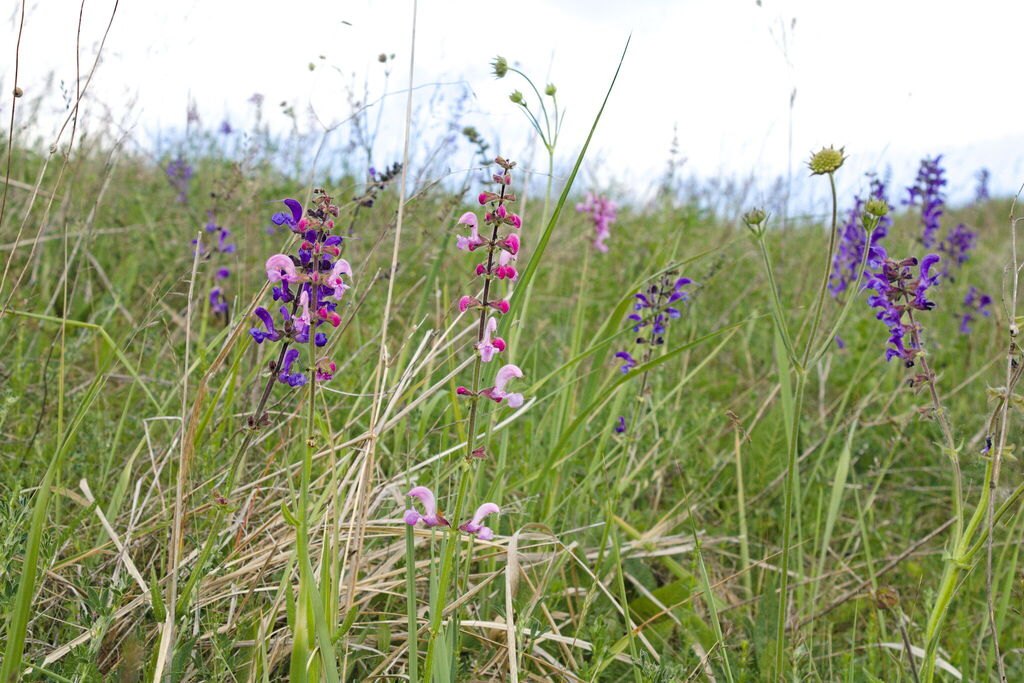
LATIN NAME: Salvia pratensis
COMMON NAME: Meadow Sage
Plant Profile
Meadow sage is a plant of old grassland, and it looks it. The leaves sit in a flat basal rosette, long-stalked, deeply wrinkled, toothed at the margin and up to fifteen centimetres long, so that a plant out of flower reads as a dark green puddle on the ground.
From that rosette the flowering stems rise square and hairy, usually sixty to ninety centimetres, sometimes more in good ground, each carrying pairs of small stem leaves and a lax spike of whorls with four to six flowers in each.
The flower is the sort of thing that rewards a hand lens. The corolla runs twenty to thirty millimetres, two-lipped, the upper lip arched into a crescent and hooded over the stamens, the lower three-lobed with the middle lobe longest.
Wild colour is violet-blue, with a dark brown calyx that stays on the plant long after the petals have fallen; garden selections run from near-black purple through pink to white. Flowering starts in late May and runs through June, opening from the bottom of the spike upward, and a cut back at the end of the first flush brings a second, smaller one in late summer.
Science & Biotechnology
The stamens are a machine. Each has a long connective joining two anther halves, one fertile, one sterile, and the whole thing pivots like a see-saw. A bee pushing into the flower for nectar hits the lower arm, which swings the fertile upper arm down and dusts the insect’s back with pollen; the arm then returns to its loaded position, ready for the next visitor. Salvia pratensis is the species in which this lever was worked out in detail, and it is now the standard demonstration of a pollination mechanism that is both precise and cheap to build.
The breeding system is stranger. The species is gynodioecious, meaning populations contain female plants with no fertile stamens alongside ordinary hermaphrodites, and the proportion of females shifts from site to site, apparently with the local balance of inbreeding and seed production.
Add protandry, in which the stigma of a hermaphrodite flower is receptive before its own pollen is shed, and the result is a plant that is hard to self. It is also one of the few European salvias with a well-documented history of hybridisation with S. nemorosa where the two meet in rough grassland, so identification in the field is occasionally a matter of opinion. It shares the family with Salvia yunnanensis, Salvia coccinea and Mentha pulegium.
Uses & Benefits
This is a meadow and gravel plant, not a kitchen herb. It sits well at the front of a dry border, where the rosette suppresses weeds and the spikes give height for a month without staking, and it ranks among the few salvias that will hold its own in grass that is cut once a year. The leaves are aromatic when crushed but bitter and resinous, nothing like Salvia officinalis, and nobody cooks with them twice.
The subspecies haematodes, which some botanists still treat as a species of its own, is the one flower arrangers grow: taller, earlier, with a looser spike and a colour that holds when cut. Garden forms such as ‘Indigo’ and the Haematodes Group hold the RHS Award of Garden Merit.
Hardiness is not in question; the plant has been recorded surviving minus forty, which covers every European winter and most of the American ones. Bumblebees do the pollinating, and a clump in flower in June is loud with them from morning to dusk.
Growing from Seed
Sow on the surface of a light, free-draining mix and do not cover: the seed needs light, and a covering of more than a millimetre will cost you most of the batch. Eighteen degrees is enough; germination is spread over three to four weeks, and the seedlings are slow for the first month, spending their energy on a taproot rather than leaves. Autumn sowing in a cold frame works well and saves the space under cover.
Set plants out forty centimetres apart in full sun, in soil that drains. Meadow sage rots in winter wet far more readily than it freezes, so a raised bed or a gravel mulch is worth more than any feed. Cut the spent spikes to the rosette for a second flush, leave the foliage on over winter, and lift and divide congested clumps every three or four years in spring, discarding the woody centre and replanting the outside. It will seed about gently in gravel and short grass, which is usually welcome.
Our Take
The best salvia for a garden that gets no water and no attention. It is not a herb, it does not need feeding, and the only way to kill it is to plant it somewhere that stays wet in January.
Related Reading
More species in the same orbit as Meadow Sage: