


Dicranostigma leptopodum Seeds | Yellow Dicranostigma
LATIN NAME: Dicranostigma leptopodum
COMMON NAME: Yellow Dicranostigma
Plant Profile
Dicranostigma leptopodum is a short-lived perennial of the poppy family that covers stony slopes in northern China with clean yellow flowers each April and May. The Russian botanists Karelin and Kirilov described it in 1842 from collections made on their expeditions across the Dzungarian steppe, and it has remained a plant of the dry interior ever since.
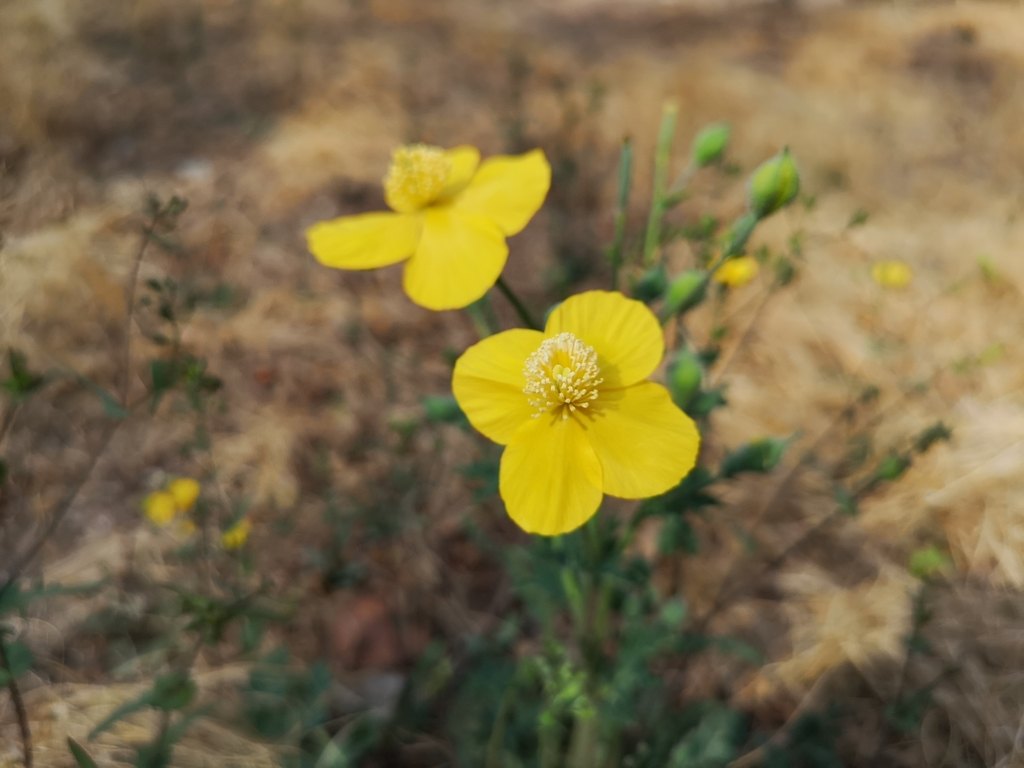
A basal rosette of grey-green, deeply cut leaves sits flat on the ground through winter. In spring the stems rise thirty to seventy centimetres and branch widely, each tip opening a flower three to four centimetres across, its four crumpled petals unfolding as the two sepals fall away the moment the bud splits.
The generic name points at the one feature that separates it from its horned-poppy relatives in Glaucium: a stigma carried on a short stalk and split into two spreading lobes, the twice-forked disc that gives Dicranostigma its Greek name. Cut any part of the plant and it bleeds a milky sap that stains orange.
The Chinese folk name tuchuanghua, roughly the scald-sore flower, records what villagers used it for. Across the loess country of Shaanxi and Gansu the crushed herb was laid on burns, sores and scalp complaints, and that household reputation travelled much further than the plant itself ever has in cultivation.
Science & Biotechnology
Chemical surveys of the genus report benzophenanthridine alkaloids, the same defensive class that colours the sap of greater celandine and the other poppy relatives grouped in tribe Chelidoniae. These compounds give the latex its bite, deterring most chewing insects and explaining why the plant is largely left alone by grazing livestock on shared hillsides.
Where the plant sits in the family tree was argued for decades. Some authors folded Dicranostigma into Glaucium, the horned poppies, since both bleed yellow and grow in dry ground. Molecular work settled it: the forked stigma, the stalked capsule and seed-coat anatomy mark it as a separate genus allied to Chelidonium and Hylomecon rather than a section of Glaucium.
Three species are generally accepted, and this one is the widest ranging. Field records place its flowering peak firmly in April and May, with only stragglers later, so the plant’s whole visible life is compressed into the two months when loess-country grass has barely started to grow and competition for pollinators is thin.
Uses & Benefits
In regional herbals of Shaanxi and Gansu the dried whole plant is listed for external use on burns, scalds, sores and insect stings, usually as a pounded paste or a wash. The use is folk rather than clinical, and the latex is irritant, so preparations stay on the skin and never go near the mouth.
In the garden the value is quiet durability. A drift of it reads as a low silver-green mat studded with yellow cups in mid-spring, happy in gravel scree, on a dry bank, or threaded through the fading foliage of tulips and daffodils, exactly the sort of slot where most perennials look tired.
It asks for nothing once sited. Full sun, sharp drainage and lean soil produce the tightest rosettes and the most flowers, while rich ground and summer rain produce leaves and rot. The sap should be respected with gloves at cutting time, but the plant offers early pollen to spring bees before most perennials have even unfurled. Three other Papaveraceae are catalogued alongside it: Papaver orientale, Corydalis incisa and Papaver croceum.
Growing from Seed
Seed is tiny and comes freely on the stalked capsules, which split at the top and shake out like a pepper pot. Sow in autumn or late winter, either in situ where the plant is to live or in cells, barely covering the seed at two millimetres, and let winter cold do the priming.
Germination is prompt and uneven at cool temperatures, spreading over several weeks, which suits the plant’s strategy in the wild where a slope is scattered rather than carpeted. Do not attempt to move seedlings from open ground; the taproot resents disturbance and a snapped root kills a plant that looked established.
Plants sown in spring will usually flower the following April. Leave a few seedheads to ripen and a colony maintains itself, thickening each year on exactly the stony, unfed ground it likes, and thinning out wherever irrigation, mulch or shading by taller neighbours changes the terms.
Our Take
This is one of the quiet treasures of the Chinese dry hills, and the scarcity of the plant in trade says more about horticultural fashion than about merit. It needs no staking, no dividing, no feeding and no water beyond the sky.
Sow it in autumn on the poorest, fastest-draining spot you have, full sun and sharp drainage, and never transplant it. Leave the seedheads standing after the April show, give it nothing thereafter, and a self-sown drift will take care of itself on that ground for years without a single intervention.
Related Reading
If Yellow Dicranostigma appeals to you, these related plants are worth a look: