


Cynoglossum officinale Seeds | Houndstongue
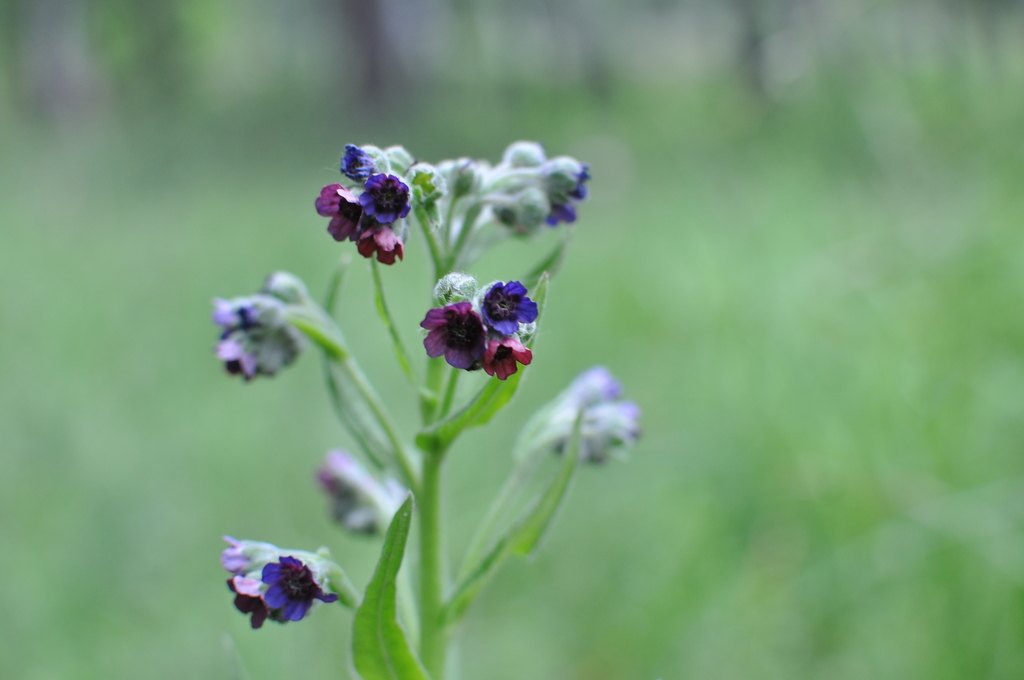
LATIN NAME: Cynoglossum officinale
COMMON NAME: Houndstongue
Plant Profile
Houndstongue is a biennial, occasionally an annual, forming a flat rosette of greyish, softly hairy leaves in its first year and a flowering stem 40 to 80 cm tall in its second. The leaves are lanceolate to oblong, and the basal ones are large, soft and dull. The whole plant has a smell that has been compared, unkindly and accurately, to mice.
The flowers are reddish-purple, funnel-shaped, 6 to 8 mm across, borne in clusters that curl at the tip like a scorpion’s tail, which is characteristic of the family. They open from May to September and are worked by bees, though the plant can also set seed without them.
The name is the whole of the plant’s medieval reputation. Cynoglossum is Greek for dog’s tongue, and the leaf was thought to resemble one; it was given, consequently, as a remedy for dog bites. That is the logic of the doctrine of signatures in one sentence, and the plant has been carrying the name for two thousand years.
Science & Biotechnology
The seed is the reason the plant is a problem. Each flower produces four nutlets covered in barbed spines, and they attach to wool, hair, fur and clothing with the efficiency of burdock. Sheep carry them into clean pasture, dogs carry them home, and machinery moves them along roads. A plant that cannot throw its seed can still travel a hundred kilometres in a fleece.
It also contains pyrrolizidine alkaloids, the group of compounds that damage the liver in cattle and horses. The damage is cumulative rather than acute, which makes it worse: stock eat a little in hay over a winter, show no sign, and are poisoned by the total. It is a notifiable noxious weed in British Columbia for exactly that reason.
Its reputation in medicine is a curiosity rather than a resource. The 1725 Dictionaire oeconomique recommended it, distilled with rosemary and elder, in a bath for madness, along with a live pigeon applied to the shaved head. The 1830s French used it as an emollient and a diuretic. None of it survives contact with the alkaloid chemistry. Its Boraginaceae company here includes Cynoglossum amabile, Myosotis sylvatica and Anchusa capensis.
Uses & Benefits
There are no ornamental uses worth the trouble, and it is not a plant to put in a garden. The one thing it does well is grow on disturbed ground, in dry shade, on sand dunes and waste land, and cover it in the first year while something slower establishes.
Where it is native it is a plant of hedges, verges and rough grass, and it has a certain quiet presence in a wild patch: grey foliage, dark purple flowers, and a seed head that is genuinely handsome in a dry sort of way. Some people keep it for the flowers, and they are not wrong, only unwise.
Its real value is as a warning. Houndstongue is a case study in how a plant with no commercial use and no ornamental distinction becomes a pasture problem through one adaptation, in this case a burr, and how long it takes to undo that once it is established.
Growing from Seed
It is easy from seed and needs no help. Sow in autumn or early spring, 5 mm deep, at 15 to 20 °C; germination is fast and the rosette establishes in a single season. It flowers in the second year and dies after setting seed, so a population is maintained entirely by the seed bank, which can persist for years.
If you are growing it deliberately, keep it in a pot or a contained bed and cut the stems before the nutlets ripen. That is the whole of the control advice, and it works: remove the seed, and the plant is an annual or biennial that disappears. Let one plant set seed and you have a colony.
Do not compost the flowering stems. Bag them, and burn or send them to green waste. If the burrs get into a fleece or a dog’s coat, brush them out over a hard surface rather than in the field, because every one of them is a new plant.
Our Take
This is not a plant to recommend, and it would be dishonest to dress it up as one. It is a weed of pasture and roadside, it poisons stock slowly, and the flowers are pretty in the way that a thistle is pretty, which is not enough.
Grow it only if you are interested in the family, or in the history of the doctrine of signatures, and then grow it in a pot and cut the seed heads. The rest of the time, pull it, bag it, and be glad it is not in the hay.
Related Reading
More species in the same orbit as Houndstongue: