


Consolida regalis Seeds | Forking Larkspur
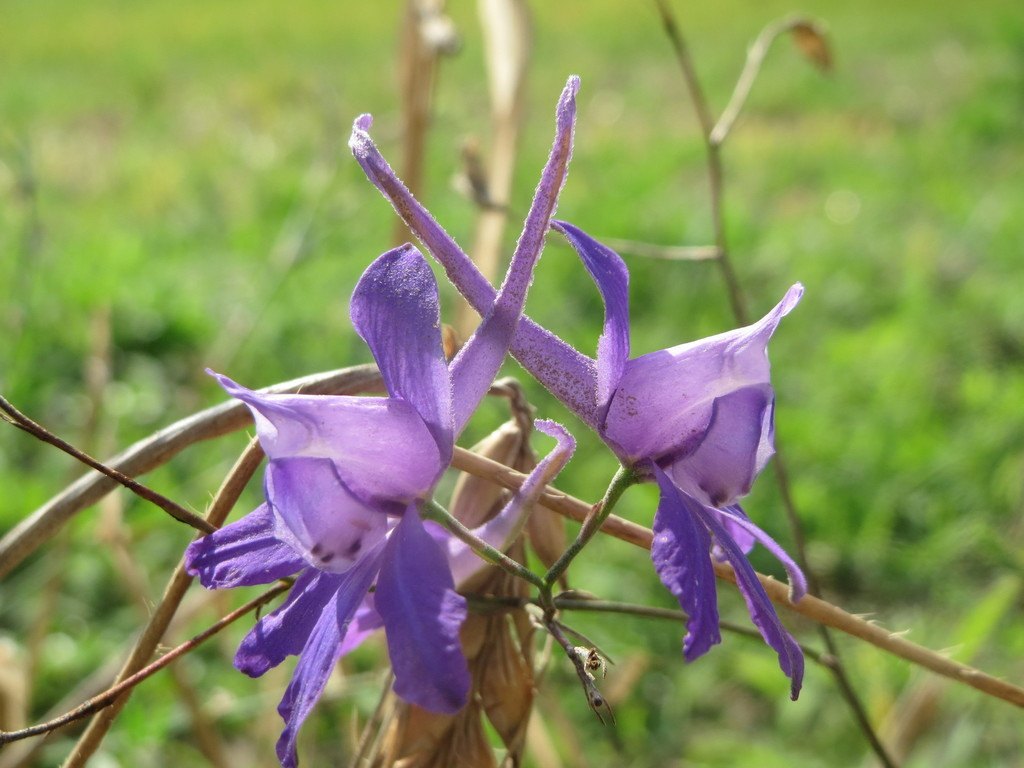
LATIN NAME: Consolida regalis
COMMON NAME: Forking Larkspur
Plant Profile
Forking larkspur, rocket larkspur, field larkspur: three names for a plant that most people meet as a packet of seed in a meadow mixture. It is native across Europe from Spain to Scandinavia and east into Turkey, Georgia and western Siberia, and it is an annual, which distinguishes it at once from the perennial delphiniums it resembles.
The stem is erect, hairy, 30 to 80 cm tall and branched near the top, with alternately arranged leaves cut into fine segments. The inflorescence carries five to eight hermaphrodite flowers, dark blue or purple, with five sepals rather than petals doing the visual work. The upper sepal runs back into a spur 15 to 18 mm long, and there are eight to ten stamens inside.
Its habitat is narrow and specific: sandy or chalky soils from sea level to 1,200 m, in dry weedy places, roadside ditches and cereal fields. It has become rare in central and southern Europe, and the reason is not mysterious. Herbicides and intensive cultivation removed it from the one place it grew in quantity.
Science & Biotechnology
The root goes down 50 cm, which is how an annual of this size survives a dry June on chalk. It also explains why the plant hates a pot: a taproot that long has nowhere to go in 9 cm of compost, and a transplanted seedling sulks for a month and then flowers at 15 cm.
The seeds contain up to 1.4 percent alkaloids, and the list isolated from the species runs to a dozen compounds: delcosine, delsoline, lycoctonine, gigactonine, hetisinone, paniculine, regaline and others. They are diterpenoid alkaloids of the same family as aconitine, and they interfere with nerve signalling by holding open sodium channels. All parts of the plant are poisonous in quantity; the seed is the most dangerous part.
Pollination is done by Hymenoptera and Lepidoptera, and the spur is the filter. Nectar sits at the far end of an 18 mm tube, so only visitors with a tongue long enough can reach it, and short-tongued insects are excluded without being actively repelled. The flower is a lock with a key cut for a few species. Near kin on the list are Consolida ajacis, Adonis amurensis and Trollius chinensis, all Ranunculaceae.
Uses & Benefits
In the garden it belongs in a meadow strip or a cutting bed, not a formal border. It ranks among the few annuals that gives true blue in June from a March sowing, and it does it on chalk and sand with no feeding. In a rich bed it grows soft, tall and flops open in the middle.
As a cut flower it is better than its reputation. The stems are wiry, the colour holds for five or six days, and the flower opens progressively up the spike so a single stem stays useful for a week. Cut when a third of the flowers are open, and sear the stem ends because the sap is thin and the stems collapse otherwise.
The toxicology is not a footnote. A garden with children or livestock should treat the seed heads as it would treat a foxglove, and the dried stems should not go on a compost heap that gets spread on a vegetable bed. It is a plant to admire and to leave alone.
Growing from Seed
Sow direct in September or October, or in March and April, where the plants are to flower. It resents transplanting because of the taproot, so modules are a compromise and root trainers are better. Cover the seed: unlike most annuals, this one germinates more evenly in the dark, and a light dusting of compost helps.
At 15 to 18 °C germination takes two to three weeks and is uneven, with the first seedlings a week ahead of the rest. Thin in stages to 20 cm, keeping the strongest and discarding the rest rather than trying to move them. A thinned row of larkspur at 20 cm will hold itself up; a crowded one will not.
Support with twiggy sticks early, before the stems need them, and the plants will grow through the support and hide it. Deadhead the first flush to get a second, or leave the plants to set seed and they will come back for years from a standing seed bank, which is the closest thing to a perennial this annual offers.
Our Take
It is worth growing for the blue alone, which is deeper and cooler than most delphiniums and comes from seed in a single season. In a garden that has gone over to annuals and gravel, it ranks among the plants that makes the whole idea look deliberate rather than neglected.
Its decline in the field is a small measure of what changed in arable farming after 1950. The plant did not lose a fight with nature; it lost its habitat to a sprayer, and the roadside ditch is now the last place it grows in any numbers. Growing it in a garden is a modest act of keeping.
Related Reading
Continue exploring with these related plants: