


Chasmanthium latifolium Seeds | Northern Sea Oats
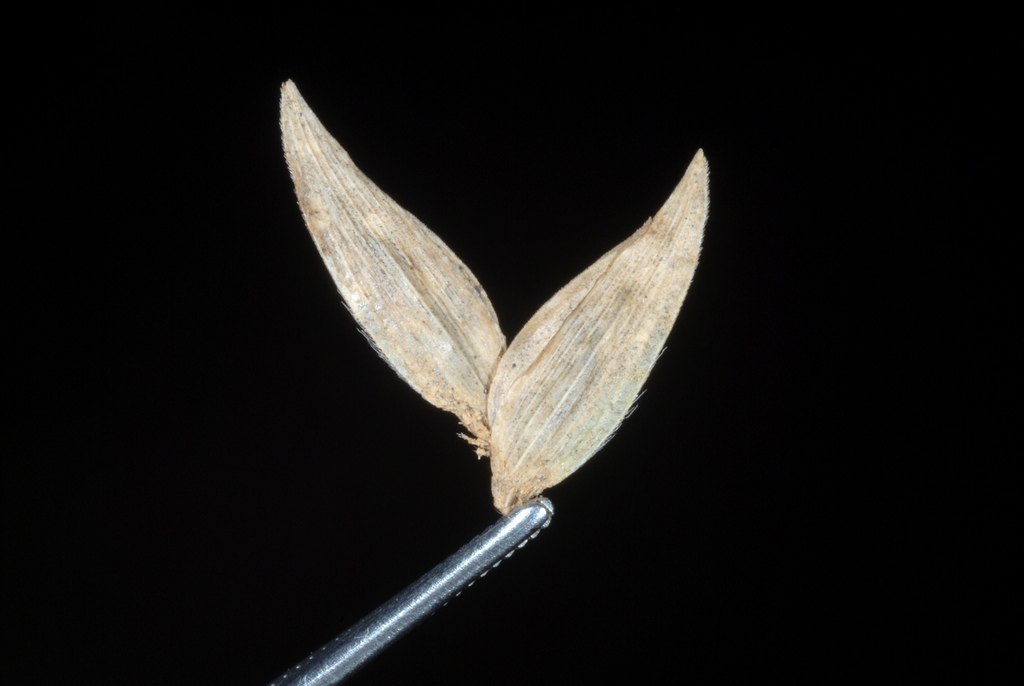
LATIN NAME: Chasmanthium latifolium
COMMON NAME: Northern Sea Oats
Plant Profile
Northern sea oats is a cool-season, rhizomatous perennial grass, about a metre tall, with broad bamboo-like leaves and an open, nodding panicle of flattened spikelets. It grows in woods and along rivers from the central and eastern United States down into northeastern Mexico, north to Manitoba, and it is listed as threatened in Pennsylvania and Michigan at the edge of that range.
The spikelets are the reason it is grown. They hang from thread-like pedicels, 2 cm long and laterally compressed, green in July and bronze by September, and they move in the slightest air. They hold on the plant through winter, which is more than most ornamental grasses manage in a wet climate.
The name sea oats is a mistake with a history. The true sea oat is Uniola paniculata, the dune grass of the southern Atlantic coast, and this plant was first described as Uniola latifolia by Andre Michaux in 1803. Harris Yates moved it to Chasmanthium in 1966.
Science & Biotechnology
The genus name is Greek: chasme, a gaping, and anthemum, a flower, for the open glumes. The specific epithet means broad-leaved, which is accurate. It is one of a small group of woodland grasses in a family dominated by prairie and savanna species, and its physiology follows from that.
It keeps a positive carbon balance in deep shade, fixing carbon at light levels far below what open-ground grasses need and well below their own saturation point. That is why it grows under trees where lawn dies, and why it looks better in shade than in sun, where the foliage bleaches and the plant flops.
It is also salt-tolerant, with shoot growth unaffected up to an electrical conductivity of 10 dS/m, and root growth actually increasing above 5 dS/m. Growth stops at 13 °C and is optimal at 25 °C. It is fire-adapted at low frequency: it increases after one fire and declines under repeated burning. The other Poaceae in the catalogue are Calamagrostis epigejos, Pennisetum setaceum and Melinis nerviglumis.
Uses & Benefits
This is the grass to plant under a tree, on the north side of a hedge, or in the dry strip between a wall and a path where nothing else will hold. It greens in March, weeks before the warm-season grasses, and it is still standing in January. Few plants give twelve months of structure for so little trouble.
The cut stems are excellent in arrangements, fresh or dried, and they last for months in water. For a winter container they are better than anything sold as a dried bunch, because they are already bronze and they do not shatter when they dry.
It is a larval host for the northern pearly-eye and for the caterpillars of the pepper and salt skipper and two roadside skippers, and birds and small mammals eat the seed. That is a real argument for growing it at the edge of a wilder area, where the self-sowing that is a nuisance in a border becomes a resource.
Growing from Seed
Sow fresh seed in autumn, on the surface, at 18 to 21 °C; light helps and so does a cold spell. Germination is slow and uneven, three to six weeks, and the first-year plants are grassy tufts rather than specimens. Sow in a pot and plant out the following spring rather than sowing where it is to stay.
It will grow in sun or shade, in acid or neutral soil, in wet ground or dry, which is the source of its reputation. The one thing it will not take is deep, dry shade under evergreens combined with competition from tree roots; even this grass has limits, and that is where they are.
Expect it to spread. Short rhizomes creep, and the seed germinates freely wherever it lands, so a clump becomes a colony in three years and a thicket in five. Sink a root barrier if it is next to a gravel path, and cut the panicles before they shatter if you do not want it in the lawn. The seed germinates in the gaps between paving stones, which is charming for two years and a job for the next ten.
Our Take
For dry shade it has no serious rival, and the winter presence alone justifies the space. The caveat is that it is a coloniser, not a clump, and gardeners who plant it in a mixed border usually spend the next five years pulling it out of the astilbes. Put it somewhere it can run.
Cut it to the ground in late winter rather than autumn, because the bleached stems and the empty spikelets are the best thing in the garden in December. It is a plant that rewards neglect and punishes fussing, which is a combination worth having, provided you choose the ground with your eyes open. Give it the dry shade nobody else wants and it will look deliberate.
Related Reading
Gardeners who grow Northern Sea Oats often pair it with these related subjects: