


Persicaria capitata Seeds | Pinkhead Smartweed
LATIN NAME: Persicaria capitata
COMMON NAME: Pinkhead Smartweed
Plant Profile
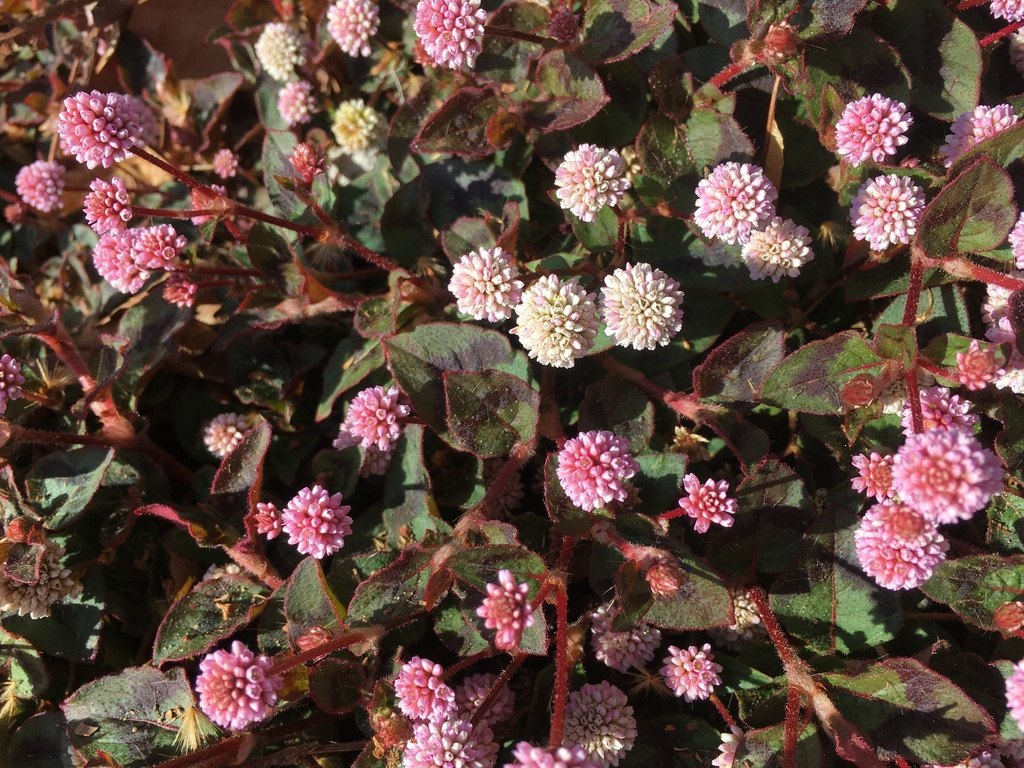
Pinkhead smartweed is a prostrate herb that spreads across the ground rather than rising from it, rooting where its stems touch soil and forming a low mat of leaves in a matter of weeks. The common names multiply, from pink knotweed to pink bubble persicaria, and they all describe the same small, dense, drumstick-shaped head of pink flowers.
The leaves are one to six centimetres long and up to three wide, and they carry the feature that sells the plant: pink to red bands or blotches across the blade, often in a chevron pattern. Short scattered hairs cover the surface, giving the foliage a slightly rough, matte finish in contrast to the glossy leaves of many groundcovers.
The inflorescence is compact, five to ten millimetres long and five to seven millimetres across, a tight cluster of tiny flowers on a short stalk. It is not a flower to inspect individually; the effect is a scattering of pink buttons across the mat, produced over a long season and fading to a papery brown that holds into winter.
It is native to Asia, from China through South Asia to Indochina, and has naturalised in Australia, South Africa and scattered locations in the Americas. Between 2008 and 2013 it was recorded as an invasive plant in Ireland, in Counties Fermanagh, Kilkenny, Wexford and Mayo, a spread that follows garden escapes rather than any natural migration.
Science & Biotechnology
Its family gives it a diagnostic structure worth knowing: the ochrea, a sheath of fused stipules that wraps the stem at each node. In Persicaria the sheath is cylindrical and often fringed with hairs, and it is the first thing a botanist looks at when separating the knotweeds from lookalikes in other genera.
The prostrate habit is a strategy as much as a shape. Stems that run along the ground escape mowing and trampling, root at every node, and exploit the narrow strip between paving and wall where competition is minimal. It is the behaviour of a plant adapted to disturbed edges, and it explains both the garden usefulness and the escape record.
The leaf blotching is anthocyanin pigment laid down in a chevron pattern, a trait that varies between populations and is exaggerated in some cultivated selections. In the wild it may serve as camouflage or as a UV screen; in the garden it is simply the reason the plant is grown, and it holds best in good light. The Polygonaceae thread continues with Persicaria hydropiper, Fallopia convolvulus and Persicaria orientalis.
Uses & Benefits
In Chinese practice the plant has a long record in the treatment of urinary disorders, including urinary calculi and urinary tract infections. That is a traditional use with a plausible rationale in a family rich in astringent compounds, but it is not a prescription, and anyone with a stone or an infection needs a doctor rather than a garden.
As a groundcover it is genuinely useful: it knits a slope, tolerates part shade, spills over a wall, and covers the awkward strip between path and lawn where nothing else will grow. In a container it trails handsomely, and the pink heads against the blotched leaves make a good pairing with silver or bronze foliage.
Its flowers are small but numerous, and the long season makes the plant a steady resource for short-tongued bees, hoverflies and small wasps that work the tiny florets. It is not a native plant in most of the world, which is exactly why its escape record deserves more attention than its nectar value.
Growing from Seed
Seed is small and easy: sow on the surface of a moist mix in spring, press in without covering, and keep warm and bright. Germination is quick and uneven over a couple of weeks, and the seedlings grow away fast once they have true leaves, so do not sow more than you need.
Transplant when the plants are large enough to handle, and set them out after the last frost, spacing thirty centimetres apart for a carpet or closer in a container. They tolerate most soils but perform best in moist, well-drained ground with some sun; deep shade produces a thin, leggy mat.
Propagation from cuttings is even easier than seed: any stem section with a node roots in water or damp compost within days. That same ease is the warning. Cut stems back after flowering to keep the mat tight, and never dump prunings on a bank or compost heap near wild ground, because each fragment is a potential new colony.
Our Take
Pinkhead smartweed is a good garden plant with a bad habit. On a dry slope or in a pot it is tidy, colourful and forgiving; in a mild, damp climate with wild ground nearby it walks away from the garden and does not come back.
Grow it where its spread can be watched, keep the prunings in the bin, and check the local invasive-species list before planting. A carpet of blotched leaves and pink buttons is a fine thing to own, provided the ownership stops at the garden gate.
Related Reading
Readers interested in Pinkhead Smartweed frequently explore these as well: