


Nepeta × faassenii Seeds | Garden Catmint
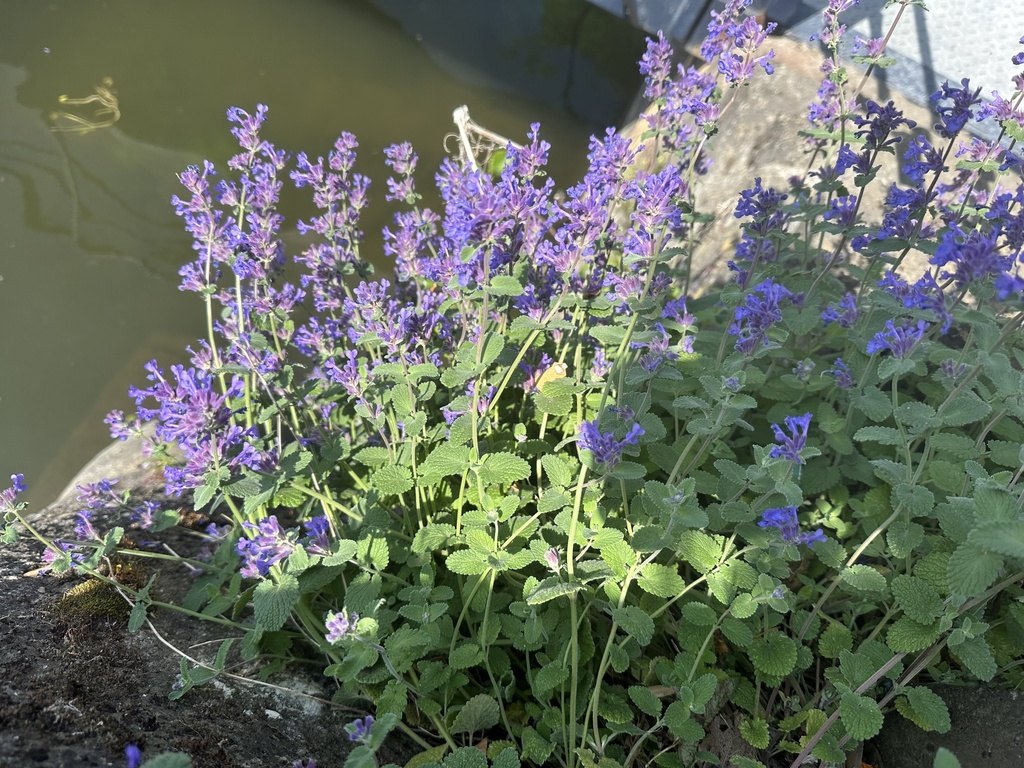
LATIN NAME: Nepeta × faassenii
COMMON NAME: Garden Catmint
Plant Profile
Garden catmint is an herbaceous perennial of 30 to 60 cm, spreading to 90 cm, with square stems and opposite leaves. The leaves are oval, grey-green, quilted with deep veins, and softly hairy; rub one and the whole plant announces itself. It is a smell between mint and lemon balm, with an undertone that puts some people off.
It is a hybrid of garden origin and has no natural range at all. The parents are Nepeta racemosa, from the Caucasus and northern Iran, and Nepeta nepetella, from the mountains of south-west Europe. The cross was raised at the Faassen nursery in Tegelen, in the Netherlands, and named for it by Bergmans, with the name later validated by Stearn.
‘Walker’s Low’ is the cultivar most often planted, and its name is routinely misread as a claim about height. It refers to a garden in Ireland where the plant was selected; the cultivar reaches 60 to 75 cm and is one of the taller ones. For more of the Lamiaceae, the list offers Nepeta tenuifolia, Elsholtzia stauntoni and Salvia pratensis.
Science & Biotechnology
The flower is a classic Lamiaceae two-lipped trumpet, soft lavender, with the stamens tucked under the upper lip and the nectar at the base of a tube whose length is matched to the tongue of a bee. Flowering runs from May to September, and the plant keeps producing because it does not commit to a single flush: cut it over after the first peak and it will build a second on new growth.
The hybrid is close to sterile, and that is the most useful thing about it. Nepeta racemosa and N. nepetella have diverged enough that meiosis in the hybrid produces gametes with unbalanced chromosome sets, and most ovules abort before seed fills. The consequence in the garden is that catmint stays where it is planted, while the related catnip seeds into every gravel path within reach.
The scent is chemistry with a job. Catnip’s active compound is nepetalactone, an iridoid that repels insects and happens to bind to olfactory receptors in cats. Garden catmint carries far less of it, so cats walk past it on the way to a catnip plant, and why deer leave the leaves alone.
Uses & Benefits
Its use is as a soft edge: along a path, along the front of a border, spilling over gravel, or in a pot where the grey foliage can be seen against stone. The colour is a cool lavender that reads well beside almost anything, and in July it lowers the temperature of a hot border by a degree or two of the eye.
The pairing with roses is old and still good, and the reason is structural: catmint hides the bare ankles of a rose, flowers at the same time, and does not compete hard for water. The claim that it keeps aphids off roses has been repeated far more often than it has been tested.
It is drought-tolerant once established, but short-lived on wet, heavy soil, where the crown rots in winter. A plant in the right place opens in the middle after three or four years; lift it in spring, break out the dead centre, and replant the outside pieces.
Growing from Seed
Seed is the wrong route, and it is worth saying plainly. A sterile hybrid sets almost no viable seed, and any that does come up will be a recombination that resembles neither parent reliably. The plant in the trade is raised from cuttings, taken in June from non-flowering shoots, or by division in spring. If a packet of catmint seed is offered, read the botanical name: it is usually Nepeta cataria or N. racemosa, not this hybrid.
If you do sow, treat it as an experiment. Surface sow on a gritty mix, because the seed needs light, keep at 18 to 20 °C, and expect germination in two to four weeks and a row of plants that differ in leaf, height and flowering time. Some will be worth keeping. Most will be greener and floppier than the parent, because the hybrid’s tidy habit is a product of the cross.
Plant out in full sun, in soil that drains, 40 cm apart, and mulch with gravel rather than compost. Cut back in early spring, not autumn: the stems are hollow and hold water, and a plant cut in October often dies back to the crown by February. A hard cut in March, to 10 cm, gives a longer first flush.
Our Take
It ranks among the few plants that earns a place in every garden, because it works in a border, in a pot, on a bank and along a path, and it asks for nothing but sun and drainage. The grey foliage carries the plant when the flowers rest, and the flowers carry it when the foliage is at its dullest, which between them is most of the year.
The single caveat is the one nobody puts on the label: it will not reproduce itself, and a garden that relies on self-sowing to fill gaps will find catmint does not play that game. Buy it once, divide it every fourth year, and it will outlast the roses.
Related Reading
More species in the same orbit as Garden Catmint: