


Gilia tricolor Seeds | Bird’s Eyes
LATIN NAME: Gilia tricolor
COMMON NAME: Bird’s Eyes
Plant Profile
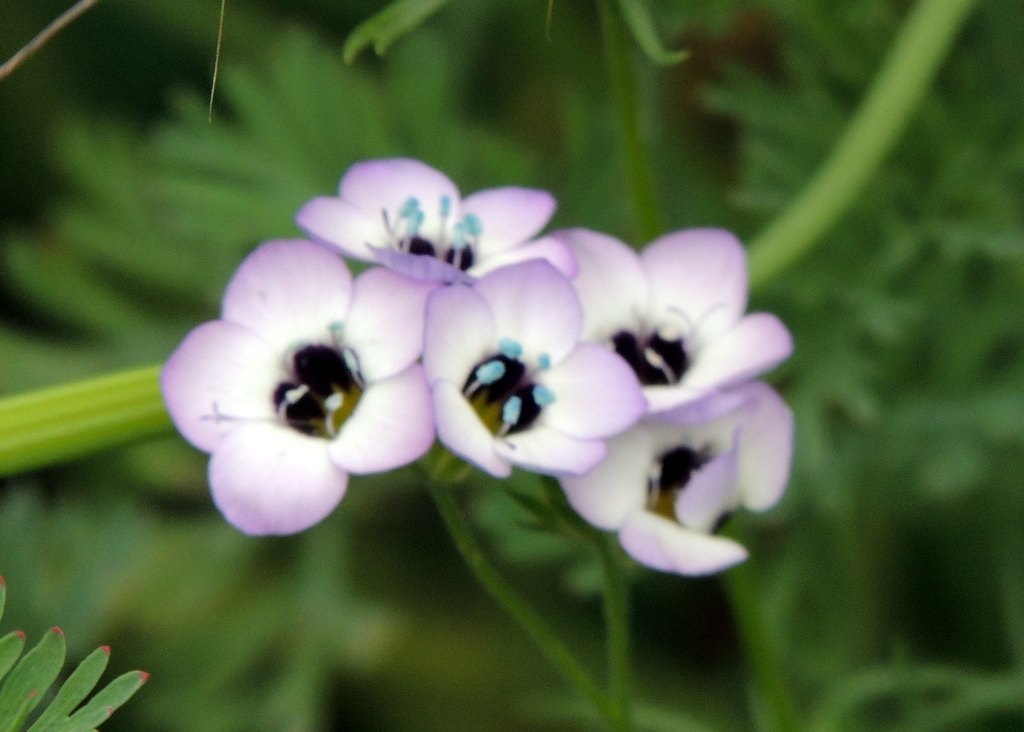
Gilia tricolor is a California annual with a name that explains itself. The five fused petals are lilac to blue-violet at the tip, purple-spotted in the middle, and yellow in the throat, and tricolor is a fair description of a single flower seen close up.
Plants are slender and open, twenty to forty centimetres, with finely divided leaves and a habit that leans on its neighbours rather than standing alone. The common name bird’s-eyes comes from the dark spots, which do resemble a small eye set in a pale surround.
It is native to the Central Valley, the foothills of the Sierra Nevada and the Coast Ranges, in open grassy plains and slopes below about six hundred metres. That is a Mediterranean climate with a short wet winter and a long dry summer, and the plant’s whole life is timed to fit inside the wet part.
Two subspecies are accepted: the nominate, which is the familiar garden form, and subsp. diffusa, a more southern and inland plant of looser habit. They differ in leaf division and flower size, and intermediates turn up where the two ranges meet. The genus commemorates Filippo Luigi Gilii, an Italian priest and naturalist who directed the Vatican observatory.
Science & Biotechnology
The flower’s three colour zones are a nectar guide, and a very direct one. A bee approaching sees the yellow throat as a target, follows the purple spots inward, and lands where the reward is. The lilac outer colour is the long-distance signal that brings the insect in at all.
Polemoniaceae is a family with an unusually well documented relationship between flower form and pollinator. Length of tube, width of throat and colour all shift between species in ways that track bees, flies or hummingbirds, and Gilia is one of the genera where that pattern was first worked out.
The plant is a winter annual in its own climate: seed germinates with the first autumn rains, the rosette overwinters, and flowering runs from February to May. Field records peak hard in April, with March close behind and almost nothing after June.
Uses & Benefits
For a meadow or a seeded annual border it ranks among the cheapest effects available. Six weeks from sowing to first flower is fast even by annual standards, and a square metre sown thickly will read as a sheet of lilac in late spring before the plant collapses in the heat. A packet of a few hundred seeds plants three or four square metres at the density the species prefers.
It is also a useful filler among spring bulbs, where the finely cut foliage hides the yellowing leaves of daffodils without competing with them. The plants are shallow-rooted and light on their feet, and they leave the ground free by midsummer.
Garden escape is documented: records exist from western Washington and southwestern British Columbia, well outside the native range, and the plant appears in wildflower seed mixes sold across North America. It is not considered invasive anywhere it has arrived, but it does move, and it appears further north with every mild winter. Related entries here include Gilia capitata, Maurandya barclayana and Penstemon hartwegii.
Growing from Seed
Sow direct where the plants are to flower, in autumn where winters are mild and in early spring where they are not. The seed is small, so mix it with sand to broadcast evenly, rake it in lightly and water once. It needs darkness rather than light, so a thin covering helps.
Transplanting is a mistake. The plant makes a taproot early and resents disturbance, so modules produce stunted plants that flower late and poorly. If you must raise them under cover, use deep cells and move them while they are small.
Thin the seedlings to fifteen centimetres apart and keep them watered until they are established, using a fine rose because a hose will bury them, then leave them. They will self-sow if a few plants are allowed to set seed and the ground is not mulched, and a colony will persist for years without any further sowing.
Our Take
Bird’s-eyes is a plant for people who want a lot of colour for very little money, and who are willing to let it go when the heat arrives. It is not a plant for a tidy border, and it looks wrong in one: the habit is sprawling and the flowering is over quickly.
Sow it into a meadow strip, a gravel garden or the front of a dry bed, stand back, and let it do what it does. The one thing worth doing is kneeling down to look at a single flower, because the three colours and the spotted throat are the entire point and they are invisible from standing height.
Related Reading
Gardeners who grow Bird’s Eyes often pair it with these related subjects: