


Ursinia anthemoides Seeds | Ursinia
LATIN NAME: Ursinia anthemoides
COMMON NAME: Ursinia
Plant Profile
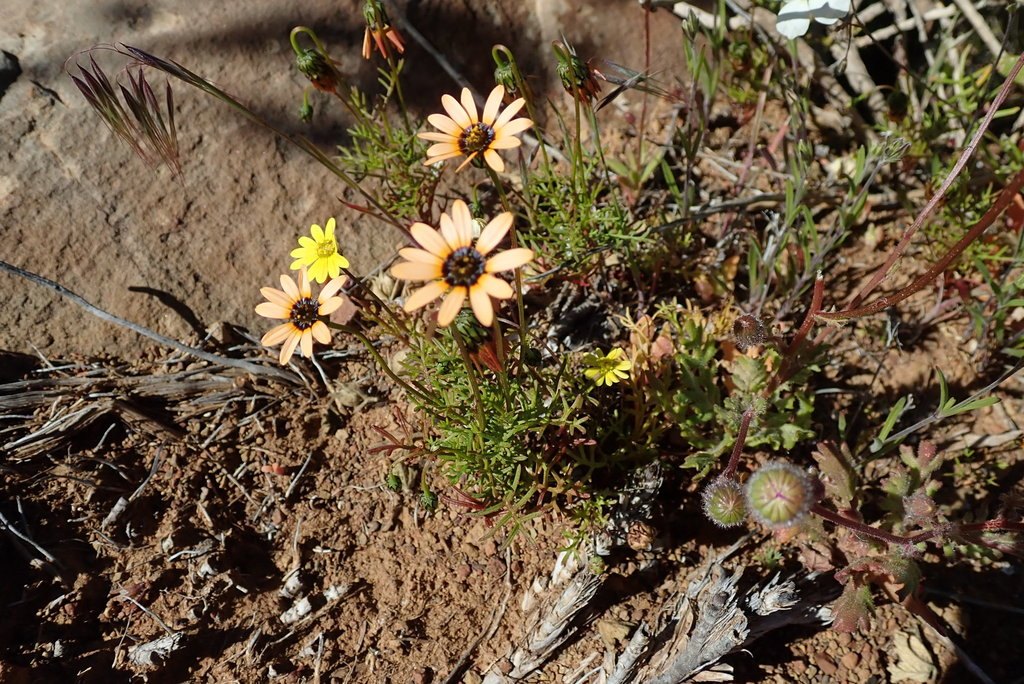
Solar fire is a name from the seed catalogues, and for once it is accurate. Ursinia anthemoides is an annual of the South African Cape, twenty to forty centimetres tall, with finely divided leaves and daisy heads in a range that runs from pale yellow through gold to a deep orange with a dark ring at the centre.
The foliage is thread-like and slightly grey, and it disappears against the soil until the plant flowers, at which point the heads appear to float. That is the same trick the better-known Cape daisies use, and it makes the plant useful at the front of a border where a solid mass of leaf would be too heavy.
Two subspecies are recognised, the nominate and subsp. versicolor, separated on the colour of the ray florets and the markings at their base. The second is the more variable of the two and the one most often sold, so packets labelled simply as Ursinia produce flowers that do not match each other.
It was described by Linnaeus in the tenth edition of Systema Naturae in 1759, which places it among the earliest Cape annuals to receive a binomial. The genus commemorates Johann Heinrich Ursinus, a German botanical author of the seventeenth century about whom very little else is remembered.
Science & Biotechnology
The seed is built for wind, and built twice over. Each fruit carries a pappus of membranous scales at the top and a covering of fine hairs on the body, so it is both a parachute and a sail. A head that has dried will release its seed over weeks, and a plant in a dry garden will place seed metres away without any help.
The daisy head closes at dusk and on dull days, which is a behaviour rather than a curiosity. Closing protects the pollen from dew and rain and reduces the night-time loss of heat from the disc, and it means that the plant’s flowering day is set by light rather than by temperature.
Asteraceae at its most modular: what looks like one flower is hundreds, with ray florets around the edge doing the advertising and disc florets in the centre doing the seed. The dark ring that many of these heads carry is a ring of sterile or differently coloured florets, and it makes the centre of the flower read as a target. Three other Asteraceae are catalogued alongside it: Achillea ptarmica, Helipterum roseum and Zinnia angustifolia.
Uses & Benefits
In the garden it is a filler for hot, dry, poor ground, and it is at its best in a gravel garden or a seeding meadow where the plants can move. It flowers over a long season in mild climates and gives a single brilliant flush in cold ones, and either is a reasonable return for a packet of seed.
In Western Australia it has naturalised and is listed among the environmental weeds of that state, which is worth knowing before planting it in a Mediterranean climate with sandy soils. It moves in disturbed ground and along tracks rather than into intact vegetation, but it does move.
No food or medicinal use is recorded for it in the European literature, and the plant is not toxic. It ranks among the Cape annuals that entered horticulture purely on appearance, and it has stayed in the trade on the same basis for two hundred and fifty years.
Growing from Seed
Sow in autumn where winters are mild, or in early spring where they are not, at eighteen to twenty degrees. The seed is large enough to handle and should be covered with its own depth of grit. Germination is quick, five to fourteen days, and the seedlings are vigorous from the start.
Plant out at twenty to twenty-five centimetres in full sun and ground that drains within an hour of rain. Rich soil or overhead watering produces a soft plant that flops and flowers for a fortnight; lean conditions produce a compact plant that flowers for three months and sets seed you can save.
Deadhead if you want a tidy plant and leave the last heads if you want it back next year. Seed collected when the pappus is fully expanded and the head has begun to shatter will keep for three or four years in a cool dry jar, and it self-sows readily where the ground is open.
Our Take
Solar fire does one thing, which is to produce an unreasonable amount of orange from a small amount of dry ground, and it does it without any of the coddling that annuals of that colour usually demand. There is no subtlety in it and no need for any.
The closing of the flowers at dusk is the detail that turns a bedding plant into something worth watching, and it costs nothing. Plant a row along a path you use in the evening and the patch will go out, one head at a time, as the light fails.
Related Reading
Readers interested in Ursinia frequently explore these as well: