


Duchesnea indica Seeds | Mock Strawberry
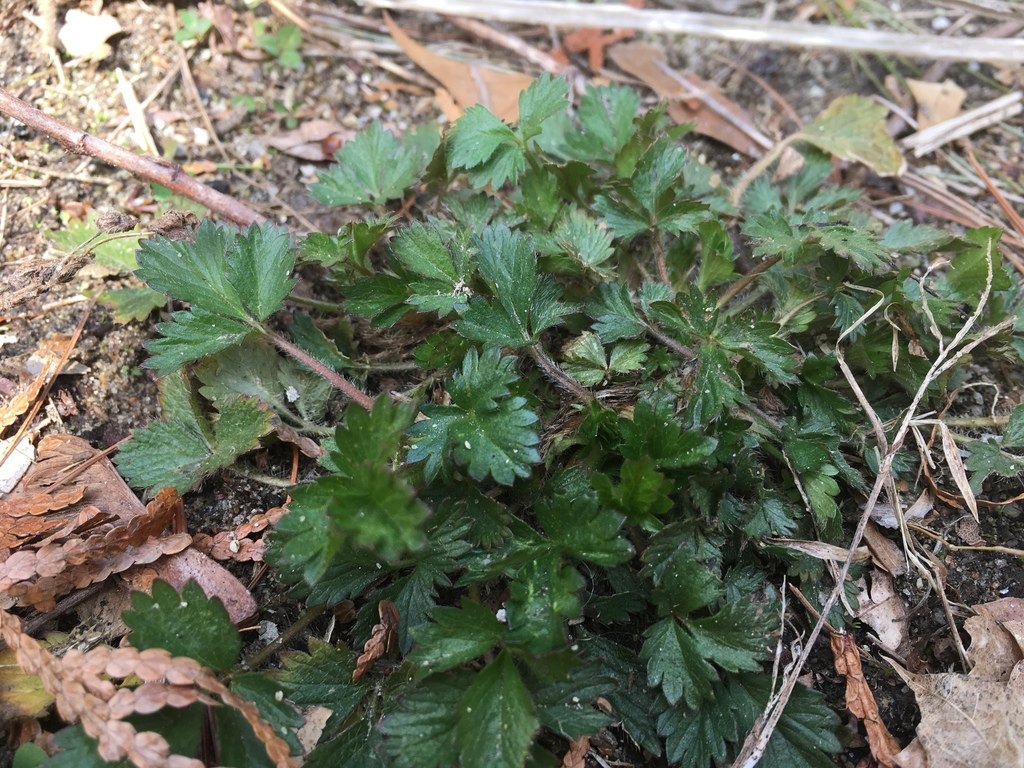
LATIN NAME: Duchesnea indica
COMMON NAME: Mock Strawberry
Plant Profile
Mock strawberry, Indian strawberry, false strawberry, and snakeberry in North America: the common names all circle the same disappointment. It is native from West Asia through India to East Asia and Southeast Asia, and it has naturalised in Europe, North America and parts of South America. In the United States and Canada it is most often noticed as a weed in thin lawns.
The separation from a true strawberry takes two seconds once you know it. Fragaria flowers are white or faintly pink; mock strawberry flowers are yellow, and they sit on single axillary stalks rather than in a cluster. The fruit is red and glossy but carries its achenes on the surface of a dry, spongy receptacle, and it points upward rather than drooping.
The genus is unsettled. Chloroplast sequence data place Duchesnea inside Potentilla, and most authorities now use Potentilla indica. The older name persists in horticulture and in the weed literature, so both appear on the same page of a seed list without comment.
Science & Biotechnology
Each yellow petal carries a nectar guide near its base that absorbs ultraviolet light more strongly than the rest of the petal. To a bee the flower has a dark centre and a bright rim; to us it is uniformly yellow. The guide is a landing signal, and it is invisible in the wavelength range our eyes use, which is the point: the flower is advertising to a different audience.
A white-fruited form, f. albocaput, with white receptacles and cream achenes, has been recorded only in Argentina and Japan. Two records on opposite sides of the world for a single mutation is an odd distribution, and the usual explanation is a chance long-distance introduction rather than parallel evolution. It is rare enough that most botanists will never see it.
Where it invades, it changes the soil fauna and not only the plant cover. Studies in North America found reduced abundance of springtails and ants beneath dense mats of mock strawberry, which matters because both groups drive decomposition and seed movement in the litter layer. A ground cover that suppresses them is altering the system, not just occupying it. The same family turns up again in Prunus dulcis, Prunus cerasifera and Prunus domestica.
Uses & Benefits
The fruit is edible and almost entirely without flavour: watery, faintly sweet, with none of the acidity that makes a strawberry worth eating. It is not poisonous, which is the only claim that can be made for it. Children eat them and are unimpressed, and that is the correct response.
In northeastern India the plant has a longer record of use. In the Khasi and Jaintia Hills of Meghalaya, roots of Potentilla species are chewed with betel nut, and P. indica is used the same way. A survey in Assam between 2018 and 2020 documented traditional healers using it for asthma, and it appears in Chinese materia medica for clearing heat and cooling blood.
As a ground cover it has real value in dry shade, where it forms a mat of trifoliate evergreen leaves and roots at every node. It suppresses weeds by density rather than by chemistry, and it tolerates root competition from shrubs better than most things you could plant under them. The cost is that it does not stop at the boundary you had in mind.
Growing from Seed
Seed is small and the germination is erratic. Surface sow on firmed compost, press in without covering, keep at 18 to 20 °C and expect the first seedlings in three weeks with stragglers for another three. Light improves germination, and a thin vermiculite dusting is better than compost, which can crust and hold the seed under a sealed layer.
There is a faster route. A runner node pressed into damp soil roots within a week, and a single plant will give you a dozen plantlets in a season. Lift them in early autumn with a plug of soil, cut the stolon behind them, and pot on. This is how the plant spreads in a garden, and using its own method is quicker and more reliable than seed.
Contain it from the start. Sink a barrier 15 cm deep along any edge you care about, or plant it where tarmac and wall provide the boundary for you. Divide established clumps in spring if the centre thins. It sets seed freely and the seedlings appear in gravel, in lawn, and in the joints of paving, so a plant left to itself becomes a colony.
Our Take
It is not a fruit crop and should not be sold as one. As a weed-suppressing mat under shrubs in dry shade it earns its place, and as a plant for a child to pick and then reject it has a certain educational value. Those are modest virtues, honestly stated.
When it appears in a lawn, it is a diagnosis rather than a problem. Mock strawberry competes poorly with dense turf and establishes where the grass is thin, the soil compacted and the mower is set low. Fix the turf and it retreats. Spray it and it comes back, because the conditions that let it in have not changed.
Related Reading
Gardeners who grow Mock Strawberry often pair it with these related subjects: