


Chrysanthemum lavandulifolium Seeds | Lavender Chrysanthemum
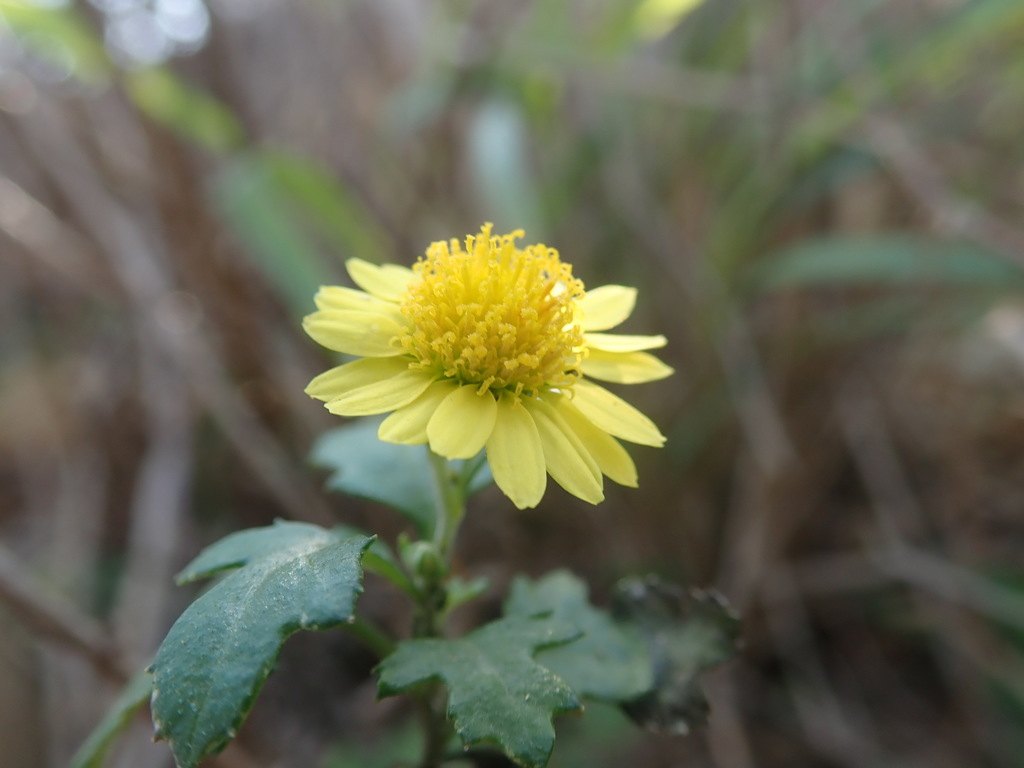
LATIN NAME: Chrysanthemum lavandulifolium
COMMON NAME: Lavender Chrysanthemum
Plant Profile
This is a wild chrysanthemum from China, Korea and Japan, 60 cm to 1.5 m tall, with erect branched stems covered in white down and a short rhizome under the crown. The leaves are 5 to 7 cm long and 4 to 6 cm wide, broad in the blade with a base that narrows suddenly, lobed like a chrysanthemum leaf and arranged alternately up the stem.
There are only a few stem leaves, which is part of why the plant looks so open: a long green stem with foliage near the base and then a cloud of flower heads at the top. The heads are yellow, 14 to 15 mm across, in a flat-topped corymb, with three or four soft oblong bracts beneath and a hemispherical involucre.
The ray florets are yellow or white, the disc florets bisexual with obtuse, irregular anther bases, and the achenes are angled and indehiscent with no pappus, or one so small it is not worth the name. It has 18 chromosomes at the diploid stage, which is a small number for the genus and part of why it is studied. The same family turns up again in Chrysanthemum dwarf, Chrysanthemum paludosum and Tanacetum coccineum.
Science & Biotechnology
It was first described in 1872 by Ernst von Trautvetter as Pyrethrum lavandulifolium, with the name credited to Friedrich von Fischer. In 1909 Tomitaro Makino moved it into Chrysanthemum while describing Chrysanthemum boreale, which he had listed as a variety of C. indicum in 1902, and noted that boreale came very near to lavandulifolium. The two are now treated as one species.
That history matters because it places the plant in the C. indicum complex, the group from which the garden chrysanthemum was bred. It is a wild relative of a crop that has been cultivated for two thousand years, and as such it is used in breeding for hardiness, for flowering time and for resistance to the diseases that plague the garden forms.
Its small diploid genome makes it a model for that work: 18 chromosomes is a manageable number, and the plant is being sequenced and mapped as a reference for the genus. Much of what is known about how chrysanthemums respond to cold and to salt comes from work on this species rather than on its showy descendants.
Uses & Benefits
In the garden it is an autumn plant, flowering in October when most herbaceous things are finished, with a mass of small yellow daisies on tall stems. It is not a cut flower in the ordinary sense, but a few stems in a jug last a fortnight and smell faintly of the genus, which is not a smell everyone likes.
It is also a plant for the back of a border, where the height and the airy habit can be seen against a hedge, and for a wilder area where it can seed about. The yellow is clean and the flowers are small enough to read as a texture rather than as individual blooms.
The dried flower heads have a history in Chinese medicine, as do most chrysanthemums, and the plant is grown for that in its native range. That is not a recommendation, only a note on why a wild species from Hubei is in cultivation at all.
Growing from Seed
Sow in late winter or early spring, on the surface, at 15 to 18 °C; the seed needs light and germinates in two to three weeks. Do not cover it, and keep the tray humid but not wet. The seedlings are thin and quick to damp off, so ventilate as soon as they are up.
Prick out into individual pots and grow them on cool and bright. Plant out in spring, 40 cm apart, in full sun and any reasonable soil. The plants establish fast and will reach a metre in their first season; they flower in the first autumn, which is unusual for a perennial raised from seed.
Cut the stems to the ground in late autumn once flowering is over, and lift and divide the clumps every third year, in spring, replanting the vigorous outer pieces. The centre dies out in the way that chrysanthemum centres always do, and division is the only thing that keeps a clump young.
Our Take
It is a plant for people who like the idea of a chrysanthemum more than the thing itself: no staking, no disbudding, no digging up in winter, and a metre of yellow in October from a packet of seed. The wild species does everything the garden forms do except look like a show bloom.
The drawback is that it is a wild plant and behaves like one: it runs at the root, it seeds, and it will not stay in the tidy clump the catalogue implies. Give it a place at the back where it can spread, and it earns its keep in the last month of the year.
Related Reading
If Lavender Chrysanthemum appeals to you, these related plants are worth a look: