


Primula vialii Seeds | Vial’s Primrose
LATIN NAME: Primula vialii
COMMON NAME: Vial’s Primrose
Plant Profile
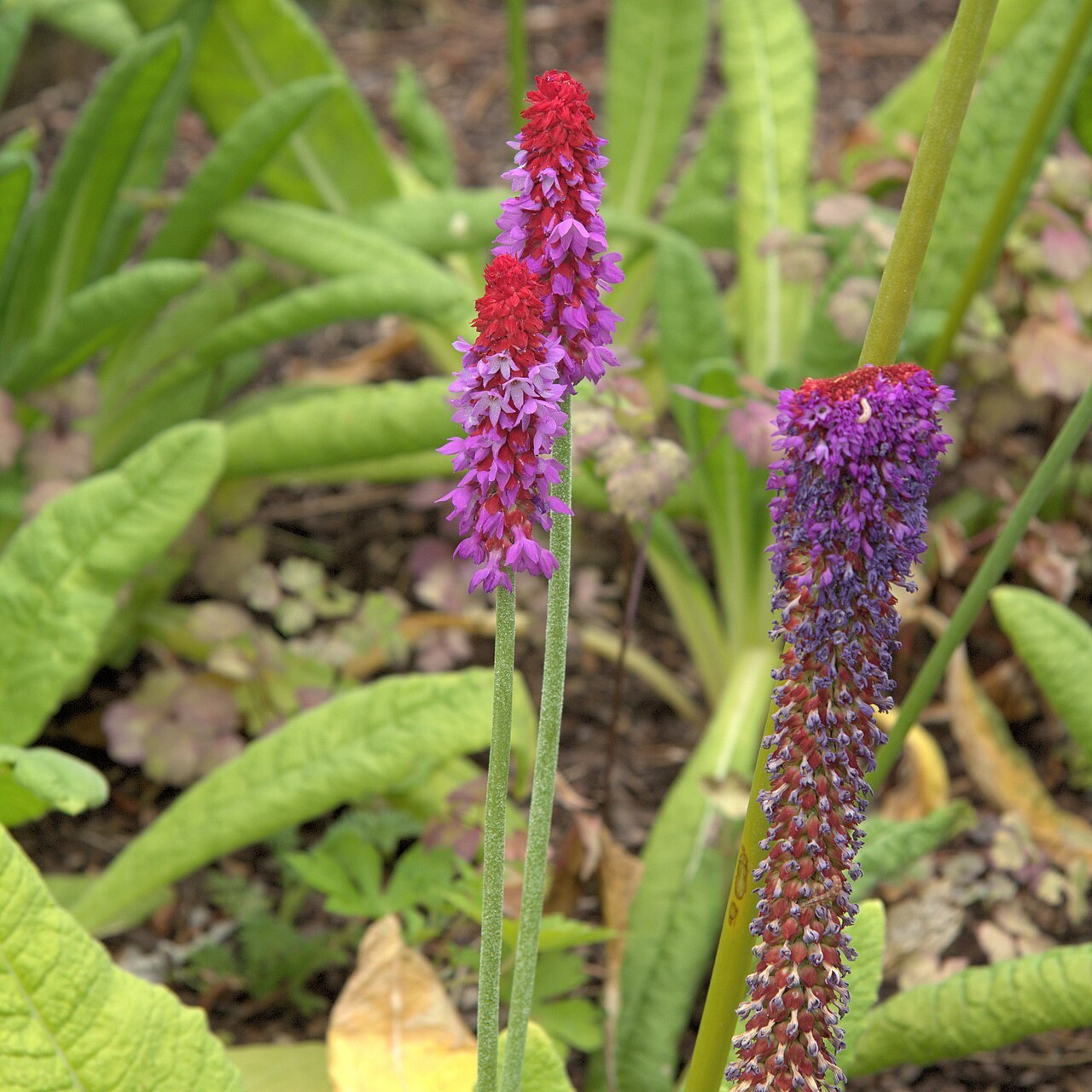
Primula vialii is the primula that looks least like a primula. It sends up a narrow spike that starts green, flushes red at the tip as the buds swell, and then opens pink or violet flowers from the base upwards over two or three weeks, so the same spike carries three colours at once.
Plants reach about forty centimetres, with a basal rosette of soft, pale green leaves and erect hollow stalks. The inflorescence is dense and cylindrical rather than tiered, and a well-grown clump in a wet bed reads as a row of small pink-tipped pokers. The leaves are the softest in the genus and bruise at a touch, so a plant that has had a dry spell looks tired long after it has been watered.
The specific epithet honours Paul Vial, a French missionary and linguist who worked among the Yi people of Yunnan between 1880 and 1917 and whose collections and writings reached European botanists. The plant was described from his material by Franchet, working from Delavay’s gatherings.
Its range is small and specific: wet meadows and stream sides in the high valleys of southwest Sichuan and northern and northwestern Yunnan, generally above two thousand metres. Outside that landscape it exists only in gardens, and it has never spread from them. Three more Primulaceae sit in the same catalogue: Primula vulgaris, Primula veris and Primula alpicola.
Science & Biotechnology
The two-colour effect is not a trick of lighting but a sequence. The calyx and the unopened corolla are deep red, so the upper part of the spike looks like a red cone; as each flower opens, the pink corolla pushes out and the red recedes upward. The green base is the already-finished part of the spike.
This bottom-up opening is characteristic of the candelabra group, and it spreads the flowering period along a single stem rather than concentrating it. A spike stays decorative for three weeks, and the pollinating insects work upward, following the fresh flowers rather than revisiting spent ones.
The species sits in the same genus as the drumstick primulas but in a different section, closer to the tall wet-meadow species of western China. Its leaves are softer, its stems more succulent, and its water demand higher, all of which follow from the seepage slopes it inhabits.
Uses & Benefits
There is nothing else quite like it in a damp border: the combination of green, red and pink on one stem is unlike any other hardy perennial, and it arrives in June when the first rush of spring is over and the border is between waves. It associates well with hostas, astilbes and the taller candelabra primulas, which want exactly the same wet ground.
Records are sparse, under a hundred and fifty in total, scattered through June and August, which reflects a plant known almost entirely from cultivation and from a handful of Chinese localities. Its garden population is far larger than its wild one, a reversal that is worth noticing.
The white form, Alison Holland, was found by an eighty-five-year-old amateur gardener, John Holland, in his own upland garden in northern England, and named for his wife. It holds an Award of Garden Merit, as does the species, and it ranks among the few cultivars of a primula that is genuinely worth seeking out.
Growing from Seed
Sow as soon as the seed is ripe, on the surface of a moist peaty mix, and keep the tray cool and humid rather than warm. Light is needed for germination, and the seed is short-lived, so a packet kept over winter will germinate at half the rate of one sown fresh.
Seedlings are slow and prone to damping off. Ventilate the frame, water from below, and prick out at the first true leaf into a mix of leaf mould, peat and sharp sand. Grow them on in shade for the first season and plant out in early autumn.
The plant wants ground that never dries: a stream edge, a seepage slope, or a bed improved with compost and mulched every year. Division every third spring keeps the clumps vigorous, since old crowns hollow out and flower less, and a light self-sowing will fill any gap if the ground stays damp. The one condition it will not forgive is a crown standing in water through winter, when the plant is not growing and cannot shed it.
Our Take
Vial’s primrose fails in dry shade and succeeds in wet light, and almost every disappointment with it comes down to that single distinction. Give it moving water below and open sky above and it is straightforward; give it a dry border and it will vanish in two seasons.
Grow it in a group of five or seven so the spikes read as a colony rather than as specimens. Cut the stems as the seed sets if you do not want seedlings everywhere, and leave the last few spikes standing, because the red tips hold into August after the pink has gone.
Related Reading
Readers interested in Vial’s Primrose frequently explore these as well: