


Crossandra Seeds | Firecracker Flower
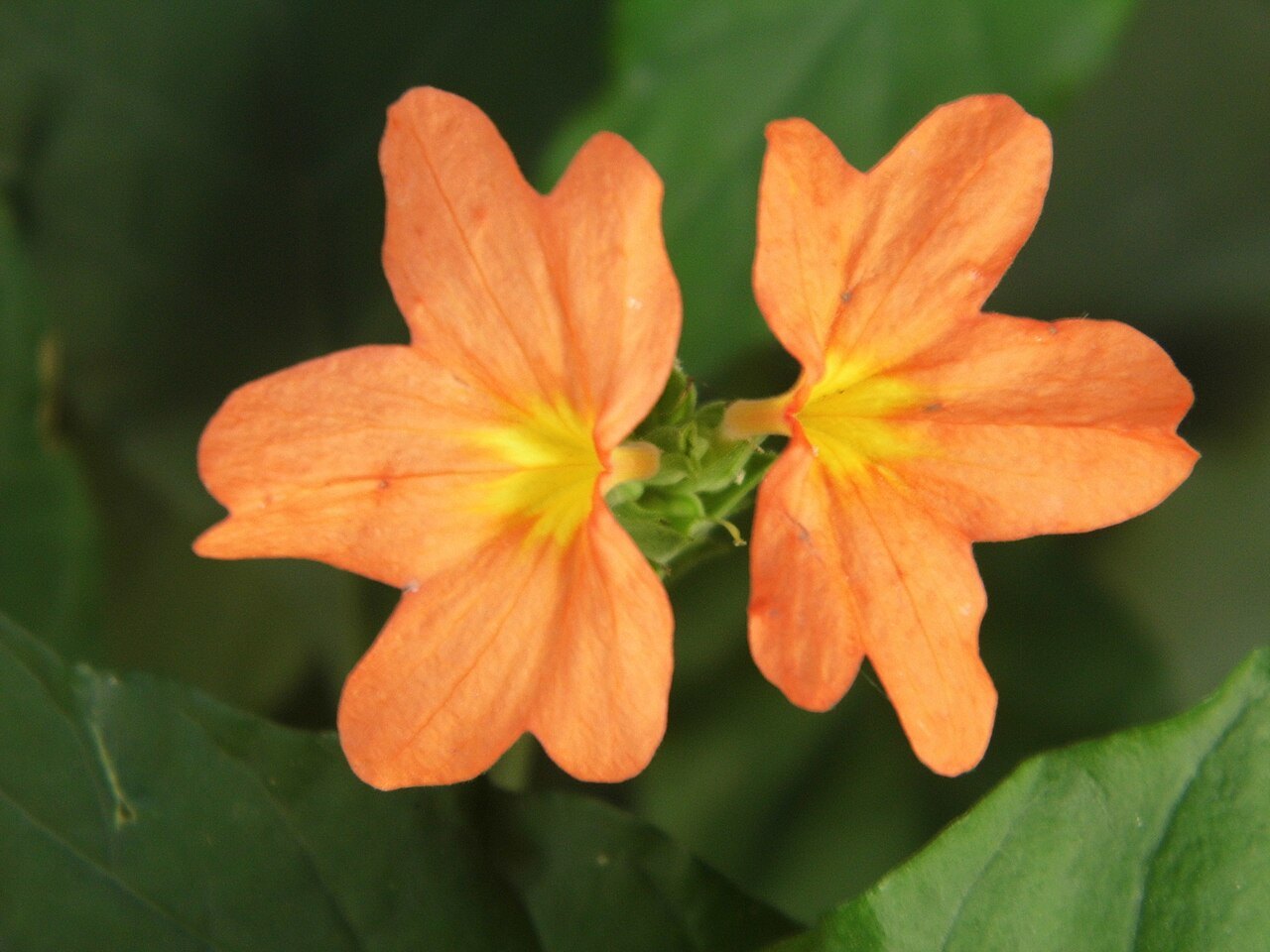
LATIN NAME: Crossandra
COMMON NAME: Firecracker Flower
Plant Profile
Crossandra is a genus of about fifty species of evergreen shrubs and subshrubs in the Acanthaceae, native to tropical Africa, Arabia, India and Sri Lanka. One species, Crossandra infundibuliformis, is grown around the world as a flowering pot plant and a cut flower, and it is the only one most gardeners will ever see.
The name describes the anthers, from the Greek krossos, a fringe or tassel, and aner, a man, which refers to the fringed stamens. The flowers are produced in a four-sided spike, and they open one at a time from the base upwards, so a single stem carries flowers and buds together. That is why the stems last so long in a vase.
The petals overlap like the scales of a fan, and the whole flower is asymmetric, with a narrow tube and a wide, five-lobed limb. The colour is a clear orange in the common species, and there are yellow and salmon forms in the trade. The leaves are glossy, dark green and slightly wavy at the margin. They are also brittle, and they snap at the least pressure.
Crossandra infundibuliformis means funnel-shaped, which refers to the corolla tube. It was described by Linnaeus from Indian material and moved to Crossandra by Nees von Esenbeck in 1832. Nees was one of the great students of the acanthus family, and his work still shapes how it is arranged. The species is variable across its range. The same family turns up again in Hypoestes phyllostachya, Thunbergia alata and Ruellia.
Science & Biotechnology
The family is defined by the way the fruit opens: a capsule that splits explosively along the septum, throwing seed some distance from the parent. The mechanism is a spring of woody tissue that builds tension as the fruit dries. Crossandra has it, and so does Ruellia and Justicia. The sound is audible on a quiet afternoon.
Many acanthaceous plants carry cystoliths, crystals of calcium carbonate on hair-like stalks inside the epidermal cells, which give the leaves a slightly rough feel and may deter herbivores. They are visible under a hand lens and they are a useful identification character. Crossandra has them in abundance, as do most of its relatives.
Pollination in the genus is by long-tongued bees and by butterflies, and the flower shape is built to deposit pollen on the head or the back of the visitor. The anthers are held under the upper lip, and the stigma touches the insect after it has passed. It is a precise arrangement and it works.
Uses & Benefits
Crossandra is grown as a cut flower in the tropics, where the stems are sold in markets and used in temple offerings and in wedding garlands. The flowers last for days without water and they hold their colour. In India the plant is also grown around houses for the same reason. The trade is local rather than international.
In temperate countries it is a glasshouse and house plant, valued for flowering in winter when little else does. It wants warmth, humidity and bright filtered light, and it resents cold water and cold nights. A minimum of fifteen degrees is needed to keep it growing. Below that it sulks and drops its buds.
There is no food use, and the medicinal uses recorded in India are local and unverified. The plant is grown for ornament, and in the right climate it ranks among the most generous winter flowers available. That is a narrow brief, and it fills it better than most plants fill a broad one.
Growing from Seed
Sow fresh seed in spring at twenty-two to twenty-five degrees, on the surface of a fine, moist mix, and keep it under glass or in a propagator. Germination is quick in fresh seed and unreliable in old. The seedlings are slow for the first month and then suddenly vigorous. Do not discard a pot that looks empty.
Pot on into a free-draining, humus-rich mix, and keep the plants warm and humid but never wet at the root. Water with water at room temperature, because cold water spots the leaves and checks growth. Feed lightly through the growing season. A monthly dose is enough, and more is actively harmful.
Pinch the young plants to make them bushy, and remove faded flowers to keep the spike producing. The plants become leggy with age and are best replaced from cuttings every two or three years. Cuttings root easily in warmth and high humidity. That is the whole of the propagation method, and it takes three weeks.
Our Take
Here is a plant that does one thing well and asks for a warm room in return. The flowers are geometric, the colour is uncompromising, and the season is the darkest quarter of the year. That is a good bargain. It is also, in the right hands, almost easy, which is not the same as easy.
Grow it if you have a warm window and a taste for orange. If you do not, there are other plants, and none of them will flower in January with quite that confidence. That confidence is the whole of its charm. And it is real.
Related Reading
Gardeners who grow Firecracker Flower often pair it with these related subjects: