


Cyclamen persicum Seeds | Florist’s Cyclamen
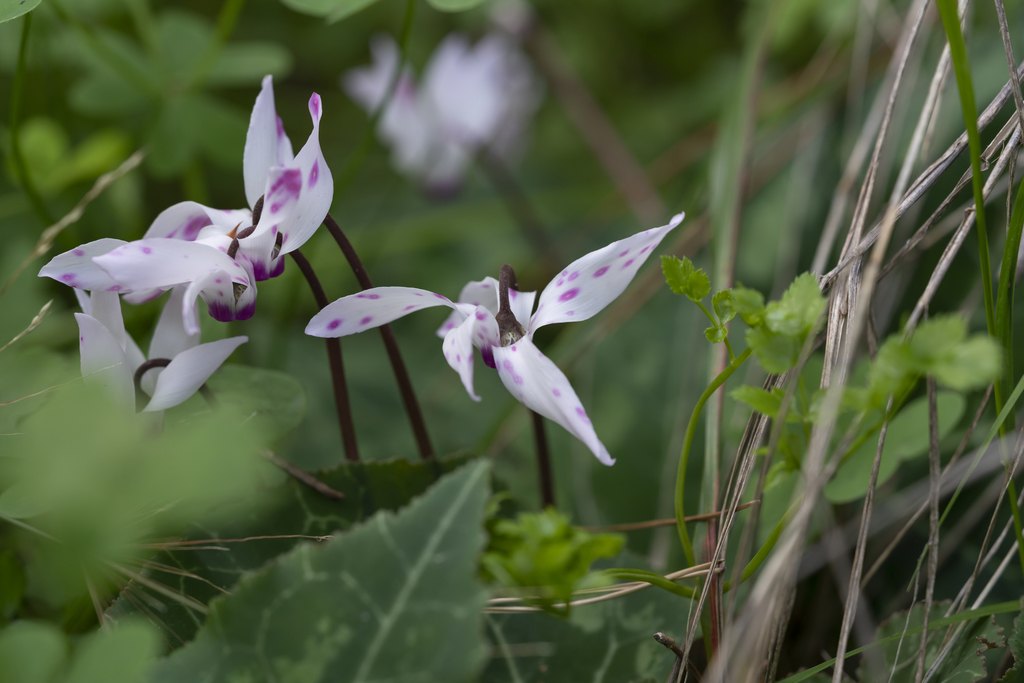
LATIN NAME: Cyclamen persicum
COMMON NAME: Florist’s Cyclamen
Plant Profile
Cyclamen persicum grows on rocky hillsides and in open woodland from south-central Turkey through Syria, Lebanon and Israel to Jordan, and on the Greek islands of Rhodes and Crete, at altitudes up to 1,200 m. It is a plant of Mediterranean climate, with hot dry summers and cool wet winters, and it grows from a flattened tuber that sits partly above the soil surface, anchored by roots that emerge from the top and sides rather than from the base.
The leaves are heart-shaped, 5 to 10 cm long, dark green and marbled with silver in a pattern that varies from plant to plant. The flowers are held above the leaves on bare stems, each with five petals that sweep backwards and upwards, 3 to 5 cm long, in white, pink, red or purple, usually with a magenta nose at the mouth. The petals are reflexed, which is the feature that distinguishes the species from most of its relatives.
In spite of the name, which means from Persia, the plant is not Persian; the name was given by the botanist who first described it from cultivated material and assumed an eastern origin. The florist’s cyclamen sold in winter is derived from this species, selected over 150 years for larger flowers, more compact habit and a wider colour range.
Science & Biotechnology
The genus Cyclamen has about 23 species, centred on the Mediterranean and extending east to Iran, and it sits in the Primulaceae, the primrose family, despite looking nothing like a primrose. The reflexed petals of C. persicum are an adaptation to its pollinators: the flower is visited by small bees and hoverflies that land on the nose and push into the inverted cone formed by the petals, contacting the anthers and stigma in sequence.
The florist’s cyclamen is a complex hybrid, usually called the Persicum Group, derived from C. persicum and possibly from other species in the eastern Mediterranean. Modern F1 cultivars, such as the Halios and Latinia series, are the result of hybridisation between inbred lines and are uniform in habit, flower size and flowering time, which is what the pot plant trade requires.
Breeding has also changed the plant’s physiology. Wild C. persicum needs a cool winter to initiate flowers, while selected cultivars will flower at 15 to 18 °C with no cold treatment, so they can be scheduled for sale in December. The cost of that convenience is a plant that is less tolerant of heat and more prone to rot than its wild ancestor.
Uses & Benefits
This is a winter pot plant for a cool room, a conservatory or a cold windowsill. It flowers from November to March, which is when colour is scarcest and when few other plants will bloom in a chilly porch, and a single plant in full flower will give three months of colour for the price of a bunch of cut flowers.
In mild climates it can be grown outdoors in a sheltered, well-drained spot, in the root run of a tree or in a raised bed against a warm wall, where it will naturalise and seed itself. In cold climates it is a house plant, and it ranks among the few that prefers a cool room to a warm one.
The tuber is poisonous. It contains saponins, particularly cyclamin, that cause severe irritation of the mouth and gut if eaten, and the plant should be kept away from pets and small children. Handling the tuber can cause contact dermatitis in sensitive people. The other Primulaceae in the catalogue are Primula veris, Primula elatior and Primula malacoides.
Growing from Seed
Sow in late summer or early autumn, at 18 to 20 °C, and cover the seed with 5 mm of compost, because cyclamen seed germinates in the dark. Germination is slow and uneven, 30 to 60 days, and the seedlings appear as small tubers with a single cotyledon pulled out of the soil by the elongating stem.
Prick out the seedlings when the first true leaf has opened, setting the small tuber on the surface of the compost and covering it only lightly. Grow on at 15 to 18 °C in bright, indirect light. The plant takes 12 to 15 months from sowing to flowering, so a sowing this autumn gives plants for next winter.
Water from below, and never let water sit in the crown, which is the commonest cause of collapse. After flowering, reduce watering as the leaves yellow and let the tuber rest in dry compost for the summer, in a cool shaded place. Start it into growth again in late summer by watering and moving it into brighter light. Repot every second year, setting the tuber half above the surface.
Our Take
Cyclamen is the best-value winter flower you can buy, and the one most often killed by kindness. It wants cool air, bright light and a careful hand with the watering can; what it usually gets is a warm living room, a dark corner and a saucer of standing water. Given the right conditions it will flower for four months and live for years.
Buy plants with plenty of unopened buds rather than plants in full flower, and check the tuber for softness before you pay. Keep it in an unheated room, water from below, and let it rest in summer. Do that and it becomes a permanent piece of furniture, returning every November with more flowers than the year before.
Related Reading
If Florist’s Cyclamen appeals to you, these related plants are worth a look: