


Dipsacus fullonum Seeds | Wild Teasel
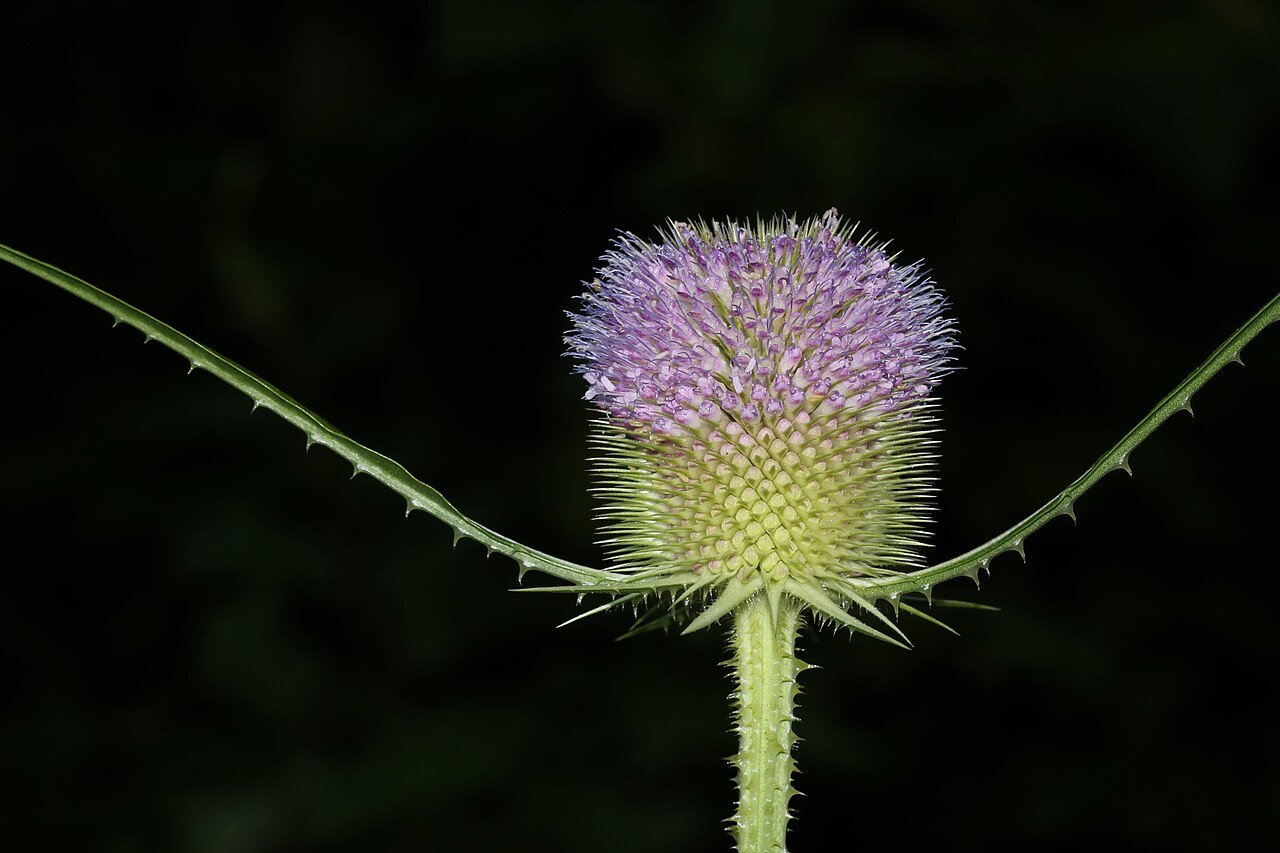
LATIN NAME: Dipsacus fullonum
COMMON NAME: Wild Teasel
Plant Profile
Dipsacus fullonum is a biennial of the honeysuckle family, native to Eurasia and North Africa, and introduced to the Americas, southern Africa, Australia and New Zealand. It grows 1.5 to 2 m tall in its second year, with prickly stems, a rosette of wrinkled leaves in the first year, and a stout, egg-shaped flower head covered in stiff bristles.
The flower head is the plant’s defining feature: a cone of tiny purple flowers arranged in a spiral, which open in a band that moves up the head over several weeks, and it is ringed by long, curved bracts that arch upwards like a cage. In winter the head dries to a brown skeleton that stands through frost, so gardeners grow it for winter structure. A single head carries several hundred flowers and opens over a month.
The leaves are paired and their bases fuse around the stem into a cup that holds rainwater. That cup carries one of the oldest questions in plant biology: is it a trap for insects, a source of water for the plant, or simply a consequence of the leaf arrangement? Nobody has settled it. Fellow Caprifoliaceae members here: Dipsacus japonica, Scabiosa atropurpurea and Scabiosa stellata.
Science & Biotechnology
The leaf cups have drawn scientific attention for more than a century. Charles Darwin suggested the plant might digest insects that fell in, and later work found enzymes in the water and larger seedlings where insect food was added. That supports at least partial carnivory, though the case is not closed.
The mechanism stays passive: insects fall in and drown, and the plant absorbs nutrients from the decaying liquid through the leaf tissue. True carnivory would mean enzymes of its own and a specialised trap, and this plant has neither. The boundary case has a name, protocarnivory, and teasel sits on it.
The flower head is a capitulum, a dense cluster of hundreds of small flowers, and the spiral arrangement follows the Fibonacci sequence, with the number of spirals in each direction typically 34 and 55. That pattern is the same one seen in sunflowers and pine cones, and it produces the most efficient packing of florets on the head.
Uses & Benefits
For five hundred years teasel was a tool. The dried flower heads were mounted on a frame and used to raise the nap on woollen cloth, a process called fulling, and the cultivated variety D. fullonum var. sativus was grown in England and France specifically for that purpose. The stiff, hooked bristles are exactly the right shape to tease the fibres apart without tearing them.
The trade collapsed in the twentieth century when metal cards replaced the plant, but the tool survives in the name and in the phrase fuller’s teasel. Gardeners now grow it for winter structure, for dried arrangements and for goldfinches, which work the heads through the winter and leave them ragged. The heads are still sold in bunches for flower arrangers.
Insects value it too: bees and butterflies work the flowers in midsummer, and birds and small mammals drink from the leaf cups. North America lists it as invasive in several states, where it colonises disturbed ground and pasture and crowds out the native sward.
Growing from Seed
Sow in late spring or early summer at 15 to 20 °C, covering the seed lightly; germination takes 14 to 30 days. A biennial, it makes a rosette the first year and a flower stem the next, then dies after setting seed.
Transplant the rosettes in autumn or early spring, 45 cm apart, in full sun or light shade. The plant tolerates poor, dry soil and needs no feeding; rich soil produces tall growth that needs staking, and the stems are prickly enough that staking is unpleasant work.
Leave the heads on the plant through winter for the birds and for structure, then cut them in early spring before the seed sheds if you do not want it everywhere. The plant self-sows freely, and in a mild climate it will establish a permanent colony along a hedge or a fence line within a few years.
Our Take
Teasel carries a history, and that counts for something in a garden. It also stands among the best plants for winter structure, and among the best for goldfinches, which hang from the heads in January and pick them clean before the weather breaks.
Grow it at the back of a border or along a fence, wear gloves when handling it, and cut the heads before they seed if you do not want it to spread. Usefulness has kept it in gardens for centuries, and it still earns its corner.
Related Reading
More species in the same orbit as Wild Teasel: