


Scabiosa caucasica Seeds | Caucasian Scabious
LATIN NAME: Scabiosa caucasica
COMMON NAME: Caucasian Scabious
Plant Profile
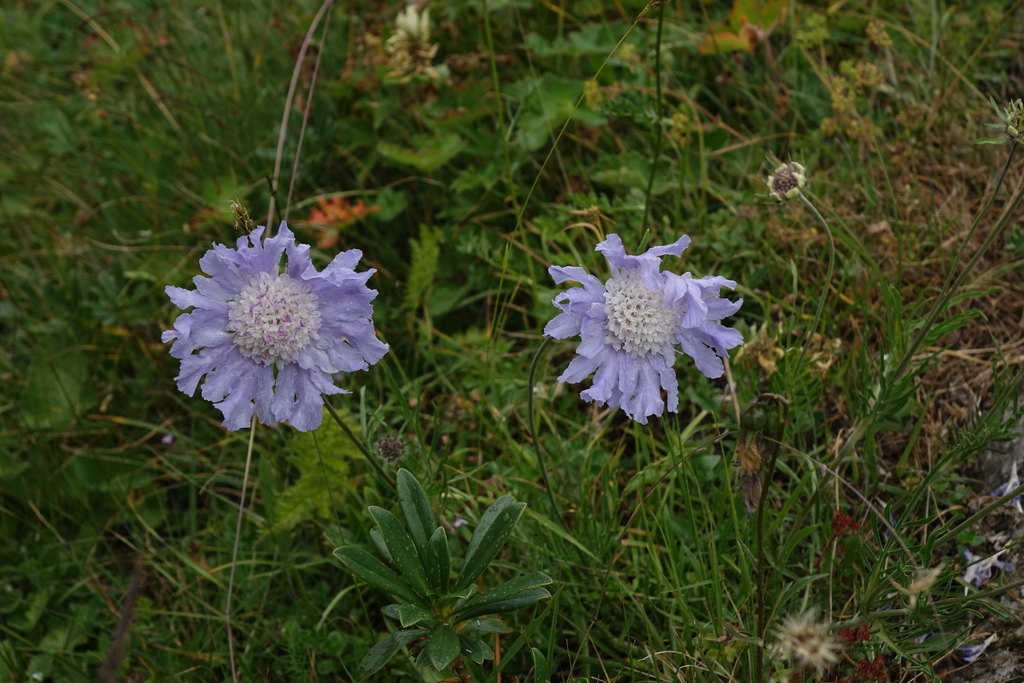
The Caucasian scabious is a clump-forming perennial of about 60 cm, with grey-green, divided leaves and erect, hairy stems. The flower heads are 4 to 8 cm across, pale blue or lavender, carried from late summer well into autumn, and they look exactly like what they are named for: a cushion of florets bristling with pins.
It is native to the Caucasus, north-eastern Turkey and northern Iran, mountain country with sharp drainage and cold winters, which explains a constitution that resents winter wet far more than winter cold. In the garden it behaves like a plant from a scree even though it is sold as a border perennial.
The name changed in 1985. After a study of the family in 1983 split the old scabious genus, this species was placed in Lomelosia by Greuter, and later work on fruits, pollen and then DNA confirmed the move. The trade still sells it as Scabiosa caucasica, and both names buy the same plant.
Science & Biotechnology
The pincushion is not a flower but an inflorescence, a head of dozens of small florets. The outer ring is flattened and petal-like, doing the advertising; the inner dome carries the fertile florets, and the “pins” are their styles, protruding to catch pollen from passing insects. It is the same engineering as a sunflower, on a blue head the size of a fist.
That structure is why the plant is so good with pollinators: a single head offers a landing platform, dozens of nectar rewards and an easy route between them. Bees work it methodically, and butterflies, which prefer a flat landing surface to a deep tube, use it heavily through August and September.
The family itself moved too. The old Dipsacaceae, the teasel family, has been folded into Caprifoliaceae, the honeysuckles, on molecular evidence. A plant can therefore be a honeysuckle relative with a daisy’s habit, which is a reminder that flower shape is a poor guide to relationship.
Uses & Benefits
Its use is the middle of the border, where the pale blue cools hot yellows and reds and the long stems put the flowers above its own foliage. It flowers from July to the first frosts, and few hardy perennials match that duration with that quality of colour, so it survived the move out of the Caucasus.
It is a good cut flower: stiff stems, a firm head, and a vase life of a week or more if cut when the outer florets are open but the centre is still tight. Cut it hard and the plant responds with more stems, which makes deadheading and cutting the same job.
Two cultivars have the Royal Horticultural Society’s Award of Garden Merit: ‘Clive Greaves’, large and lavender-blue, and ‘Miss Willmott’, white with tall stems. Both are old, both are still the best of their colours, and seed of the species will give you plants close to either, in colours that drift from white through pink to blue. Three other Caprifoliaceae are catalogued alongside it: Scabiosa stellata, Scabiosa atropurpurea and Dipsacus fullonum.
Growing from Seed
Sow in late winter or early spring at 15 to 18 °C, barely covering the seed. Germination takes two to three weeks and is uneven, so leave the tray a month. The seedlings are unremarkable; grow them cool and bright, prick out into modules, and plant out after the last frost, 40 cm apart.
Give it full sun and sharp drainage, and improve heavy ground with grit rather than compost, working it into the top 30 cm where the crown will sit; a plant that rots in a wet winter was almost always planted in clay. On light soil it needs nothing but a cut-back in spring and the removal of flower stems when they tire.
It is hardy with drainage and short-lived without it. Plants last four or five years, open in the centre, and are best replaced from cuttings of basal shoots in spring, which root easily in a gritty mix under a propagator. Division is possible but the woody crown breaks awkwardly, and cuttings give you cleaner plants.
Our Take
It ranks among the few perennials that justifies itself on flowering time alone, and the colour and the pollinators are a bonus on top of four months of blue. A blue flower in October is worth two in June, because June has plenty.
Plant it where the drainage is, cut it for the house without guilt, and do not lose sleep over the name. The botanists have settled on Lomelosia; the catalogues will catch up in a decade or two, and the pincushion will be the same either way. Grit and lime matter more than richness.
Related Reading
Readers interested in Caucasian Scabious frequently explore these as well: