


Sempervivum Seeds | Houseleek
LATIN NAME: Sempervivum
COMMON NAME: Houseleek
Plant Profile
Sempervivum is a genus of about forty species of rosette-forming succulents in the Crassulaceae, native to the mountains of Europe, the Balkans, Turkey and the Caucasus. They grow on rock, in scree and on walls, and one of them, Sempervivum tectorum, has been planted on roofs for so long that its original range is uncertain.
The name means always alive, from semper and vivus, and it is a fair description of a plant that keeps green leaves through the hardest winter. The English common name, houseleek, records the roof habit, and leek because the leaves of some species were eaten. They are not leeks and they are not particularly good eating.
Each plant is a rosette of fleshy, pointed leaves arranged in a tight spiral, and the spiral is a Fibonacci pattern that can be counted. The leaves are often hairy or fringed, and many have a red or purple flush at the tip in cold weather. The rosette is the whole plant until it flowers.
Sempervivum tectorum is the type species and the one with the longest history. It was grown on European roofs against lightning, and the belief was recorded by Charlemagne and repeated by herbalists for a thousand years. The plant does not repel lightning, but it does survive on a roof. That is a more useful trick than most magic. It sits among Sedum lineare, Echeveria peacockii and Sedum, all Crassulaceae.
Science & Biotechnology
The genus uses crassulacean acid metabolism, opening its stomata at night and fixing carbon in the dark, which is how it survives heat and drought on bare rock. The same pathway is found across the family, and it has evolved independently many times. It ranks among the great adaptations of dry-country plants. Sempervivum is a textbook example of it.
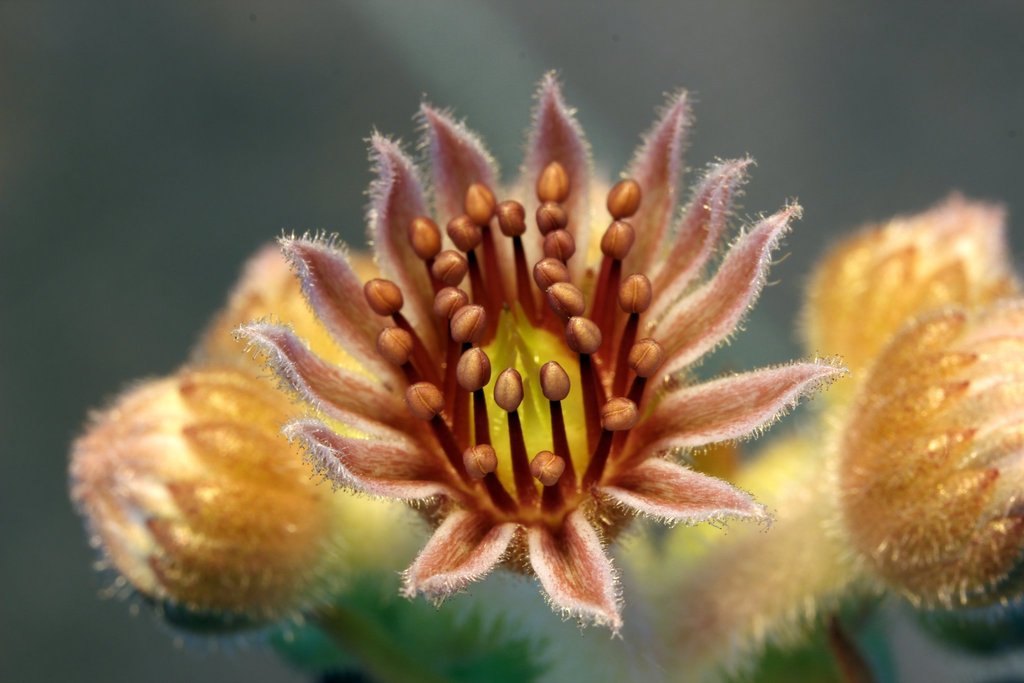
The plants are monocarpic: each rosette flowers once, sends up a tall stem of star-shaped pink or yellow flowers, and dies. The death is not a failure, because the rosette has already made offsets on stolons around it. A colony is a chain of clones, each one replacing the last. Some colonies in the Alps are centuries old in that sense.
The offsets are the main means of spread, and seed is a secondary route. The flowers are visited by bees and by hoverflies, and the seed is small and dust-like. In cultivation the offsets are so easy that seed is rarely used except by breeders looking for new leaf colours. That is where most of the named cultivars come from.
Uses & Benefits
The plants are grown in rock gardens, in troughs, on walls and in green roofs, where their geometry and their tolerance of drought are the whole point. They are also grown in pots on windowsills, where they need almost nothing. A collection of named forms is a common enthusiasm. There are hundreds of them, and the names are chaos.
In folk medicine the leaves were applied to burns, wounds and sore eyes, and the plant was grown near the door for that reason as much as for the roof. The juice is astringent and cooling, and it has no proven antibiotic action. It is a comfort rather than a cure. That is a distinction worth preserving.
There is no food use of any importance, though the leaves have been eaten in salads in hard times. They are mucilaginous and bland, and there are better things to eat. The plant is grown for its form, and its form is enough. A trough of sempervivums in January is a better sight than most gardens.
Growing from Seed
Sow the dust-fine seed on the surface of a gritty mix in spring, and do not cover it. Germination is slow and uneven, and the seedlings are tiny for months. Most people propagate from offsets instead, which is faster and gives an identical plant. The two methods answer different questions, and both are worth knowing.
Plant offsets in spring or early autumn in a mix of grit, sand and a little loam, and water them once. They root within weeks and they need no encouragement. Set them on their side, not buried, because a rosette that sits in wet compost will rot at the base. That is the single rule that matters.
The plants want full sun and sharp drainage, and they tolerate drought and cold far better than wet. In a pot, use a gritty mix and water only when the compost has dried. Remove dead rosettes after flowering, and the colony will close over the gap in a season. Slugs and vine weevil are the only real pests.
Our Take
Sempervivum is a plant that has been grown for a thousand years for reasons that were wrong, and it has survived the reasons. It is still worth growing, for the geometry and for the way a colony fills a stone. That is a better reason than lightning. The old reason did no harm, and the new one is sound.
Plant a few in a trough and leave them alone. In three years you will have a hundred, and you will have to decide what to do about that. Most people give them away, which is how the plant has travelled. It is a good way to travel.
Related Reading
More species in the same orbit as Houseleek: