


Salsola tragus Seeds | Russian Thistle
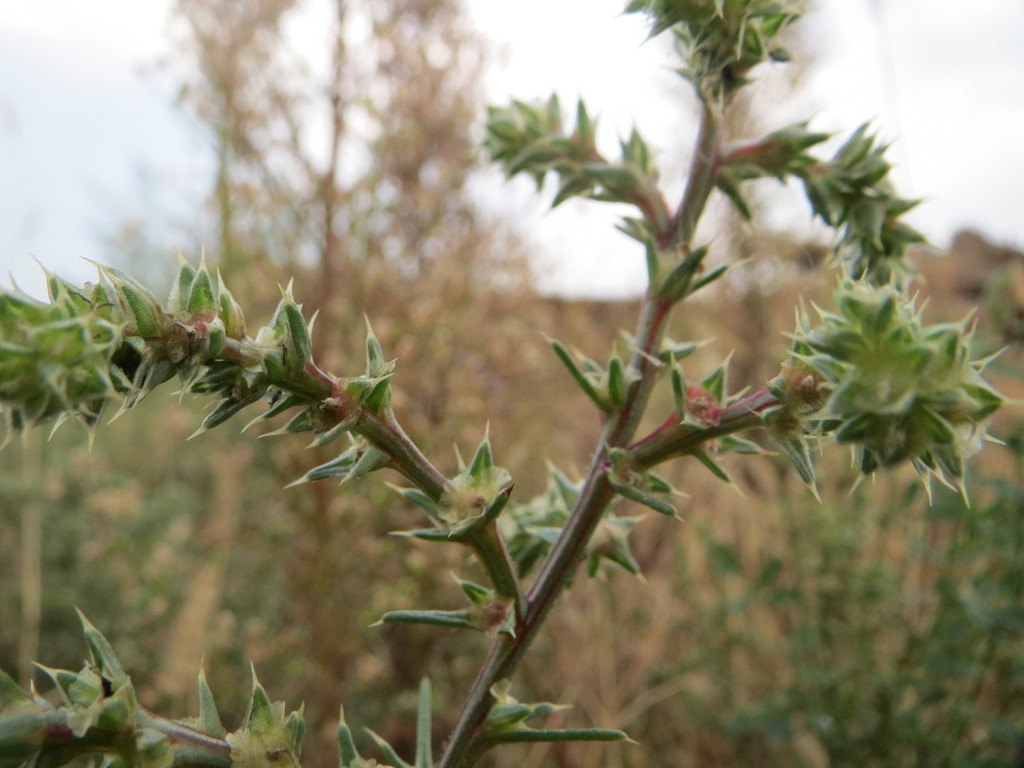
LATIN NAME: Salsola tragus
COMMON NAME: Russian Thistle
Plant Profile
Salsola tragus is a plant of the Eurasian steppe, native from the Mediterranean through central Asia to Siberia, and it is now one of the most widespread plants in North America, where it arrived in the 1870s in flax seed brought by Ukrainian farmers to South Dakota. Within twenty years it had crossed the continent, and it is now the plant most people mean when they say tumbleweed.
It is an annual, 30 cm to 1 m tall, that begins as a soft green seedling with fleshy, needle-like leaves and ends the season as a stiff, spherical, woody ball. The stems are striped with red and green, the leaves are tipped with a sharp spine, and the whole plant is armed well enough to draw blood through a glove.
The flowers are tiny, green and inconspicuous, hidden in the leaf axils, and they are pollinated by wind. Each plant can produce 200,000 seeds, and the seed is short-lived but germinates within hours of wetting, so the plant appears in a desert after a single storm and disappears just as quickly. Other Amaranthaceae on the list: Atriplex hortensis, Iresine and Atriplex semibaccata.
Science & Biotechnology
The tumbleweed habit is a dispersal strategy: at the end of the season the stem base weakens and breaks at ground level, and the whole plant rolls with the wind, shedding seed as it goes. A single ball can travel several kilometres in a strong wind, and it can cross a highway in seconds, so tumbleweeds cause accidents in the American West every autumn.
Salsola is a genus of about 60 species in the Amaranthaceae, and it ranks among the few plants that uses C4 photosynthesis in a halophytic setting, which allows it to grow on saline soil under high light and heat. The combination of C4 and salt tolerance is rare, and it is the reason the plant is so competitive in dry, alkaline ground.
The plant was long known as Salsola iberica or S. kali in North America, and the taxonomy has been confused for a century. Molecular work has shown that the North American populations are a single species, S. tragus, with a small number of introductions rather than the multiple species that were once described.
Uses & Benefits
It has almost no garden use, and it is included here because it ranks among the most recognisable plants in the world and because understanding it explains a great deal about how weeds work. It is not sold, not sown and not wanted, except by a few growers who use the dried skeletons in winter arrangements.
Young plants are edible, and they were eaten in times of scarcity in eastern Europe and central Asia, boiled like spinach, though the leaves are salty and the spines make them unpleasant. The plant accumulates salt in its tissue, which is one reason it thrives on the alkaline soils of the American West.
It is a serious agricultural weed, reducing yields in wheat and sorghum, harbouring insects and interfering with harvesting machinery. It is also a fire hazard, since the dry ball burns fast and hot, and it piles up against fences and buildings in wind, which is how it blocks roads and traps livestock.
Growing from Seed
No one sows it deliberately, and this section exists to explain how it establishes so that you can prevent it. The seed germinates within 24 hours of wetting, at temperatures from 5 to 30 °C, and it needs only a film of moisture, not a soaking.
It colonises bare, disturbed ground: overgrazed pasture, roadside verges, building sites, and the edges of fields where the soil has been scraped. The way to prevent it is to keep the ground covered, since the seed needs light and a bare surface to establish.
If it appears, pull it young, before the spines harden and before the seed sets. Once the plant breaks off and starts to roll, it is too late; the seed is already on the ground and the ball is doing its job. A single plant left to roll can seed a whole field margin.
Our Take
Tumbleweed is a plant worth knowing about even though nobody grows it. It is a case study in how a plant from one steppe can take over another, and it is a reminder that the traits we admire in garden plants, vigour, drought tolerance and seed production, are the same traits that make a weed. If you garden in a dry climate, keep your bare ground covered and pull it young. If you do not, it will find you anyway, and it will bring the wind with it.
Related Reading
Gardeners who grow Russian Thistle often pair it with these related subjects: