


Persicaria orientalis Seeds | Oriental Prince’s Feather
LATIN NAME: Persicaria orientalis
COMMON NAME: Oriental Prince’s Feather
Plant Profile
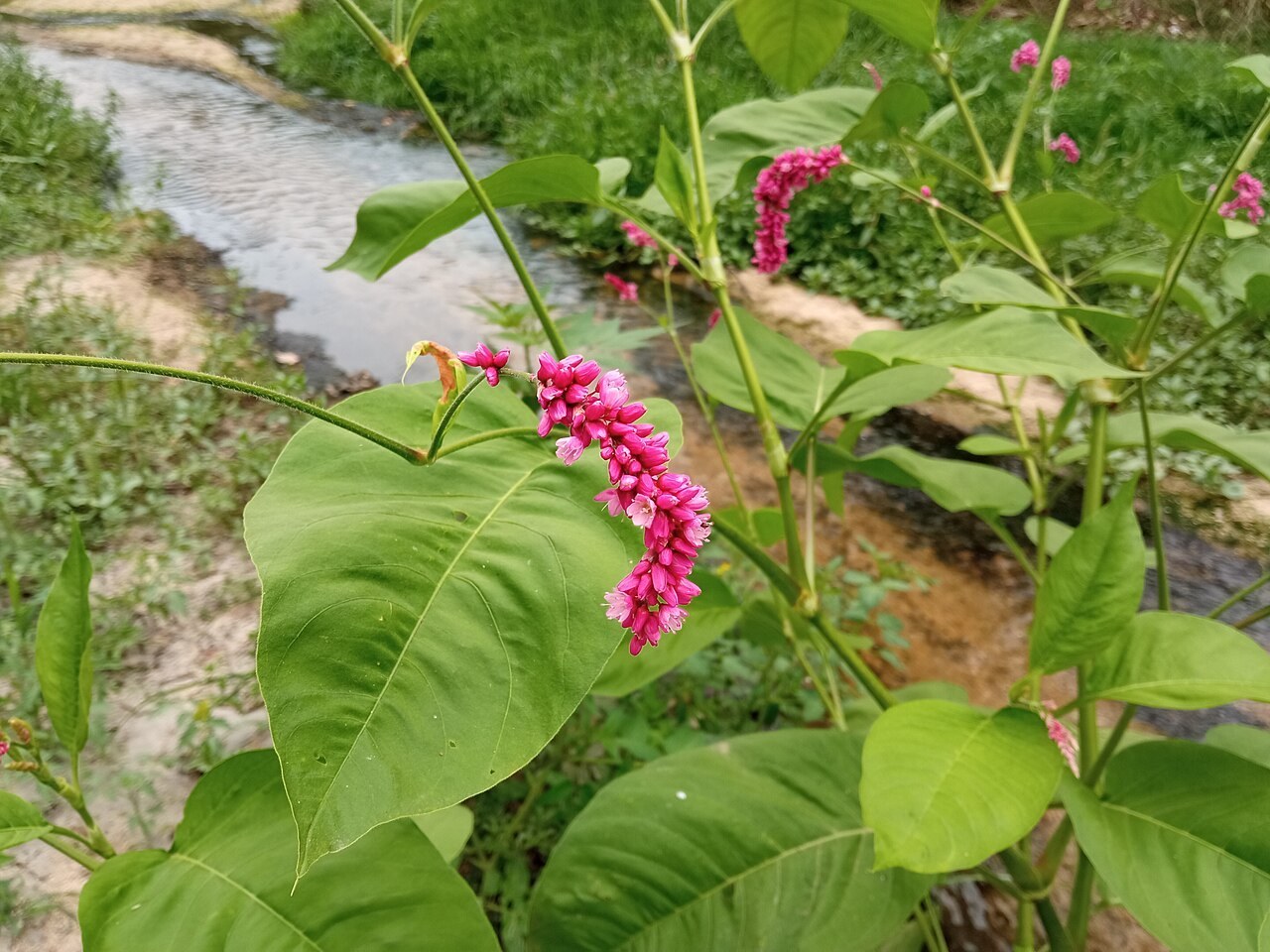
Persicaria orientalis is a tall annual of the knotweed family, native from the Russian Far East through China, Indochina and Malesia to Australia, and widely naturalised beyond that range. It grows 1 to 2 m in a season on hollow, jointed stems, with broad, pointed leaves and long, drooping spikes of small pink flowers.
The flower spikes are the reason it is grown. Each is 10 to 15 cm long, dense with tiny five-lobed flowers, and hangs from the top of the stem like a tassel or a feathered head, which is the origin of the old English name prince’s feather. The colour runs from pale pink to a deep rose, and the spikes keep coming from midsummer until frost.
It has been grown in China for at least two thousand years, and it appears in the Book of Songs as you long, the wandering dragon, a name that describes the trailing flower spikes. It was described by Linnaeus in 1753 as Polygonum orientale and moved to Persicaria by Édouard Spach in 1841, and both names are still in use.
Science & Biotechnology
Persicaria is a genus of about 150 species, separated from Polygonum on the basis of flower and fruit structure, and it includes several agricultural weeds as well as this ornamental. The family Polygonaceae is characterised by ochreate stipules, sheaths that wrap around the stem at the base of each leaf, which are visible on this species as a thin membrane at each joint.
The drooping habit of the spike is a weight response: the flowers are borne on one side of the stem, and as they open the spike becomes top-heavy and bends over. That asymmetry is what gives the plant its distinctive silhouette, and it is under simple genetic control.
The plant is a rapid coloniser of disturbed ground, producing thousands of seeds per stem, and the seed can remain viable in the soil for years. That is why it appears after flooding or cultivation, and why it is so hard to eradicate once it is established in a damp ditch.
Uses & Benefits
It is a plant for the back of a border, a fence line, or a wild garden where its height and its self-sowing habit are assets. The drooping spikes catch the light and move in wind, and the plant looks best in a loose planting rather than a formal bed.
It is a useful cut flower, though the stems are hollow and need a deep vase; the spikes last a week and dry well if hung upside down. In China the plant has been used medicinally, the stems and leaves taken for rheumatic pain and for skin complaints, and the seed used as a purgative.
The plant is not edible in any quantity, and it self-sows with enthusiasm. In a mild climate it will appear in the same place every year, and in a wet one it can become a nuisance along ditches and in damp corners, so it is listed as an invasive species in parts of North America. Fellow Polygonaceae members here: Persicaria hydropiper, Fallopia convolvulus and Persicaria capitata.
Growing from Seed
Six to eight weeks before the last frost, sow them indoors at 18 to 21 °C and cover the seed with a pinch of compost. The seed is up inside a fortnight. The seed is large and germinates reliably, and the seedlings grow fast.
Move them into 9 cm pots and hold them at 15 °C. Plant out after the last frost, 60 cm apart, in full sun or light shade. The plant tolerates poor, damp soil and needs no feeding; rich soil produces tall growth that falls over.
Flowering begins about fourteen weeks from sowing and continues until frost. If you do not want self-sowing, cut the spikes before the seed turns brown, because a single plant can produce enough seed to colonise a garden. In a cold climate the plant is an annual and must be resown; in a mild one it returns without help. The seed is hard-coated and germinates better after a soak in warm water for twelve hours, and it needs light to germinate, so scatter it on the surface and press it in rather than burying it.
Our Take
Prince’s feather is a plant with a long history and a slightly disreputable present, since it has become a weed in several countries. In a garden it is handsome and easy, and the drooping spikes are unlike anything else in a late-summer border.
Grow it at the back, where its height can be seen, and cut the heads before they set if you do not want it everywhere. It is a plant that rewards a little discipline with a great deal of colour.
Related Reading
If Oriental Prince’s Feather appeals to you, these related plants are worth a look: