


Convolvulus tricolor Seeds | Dwarf Morning Glory
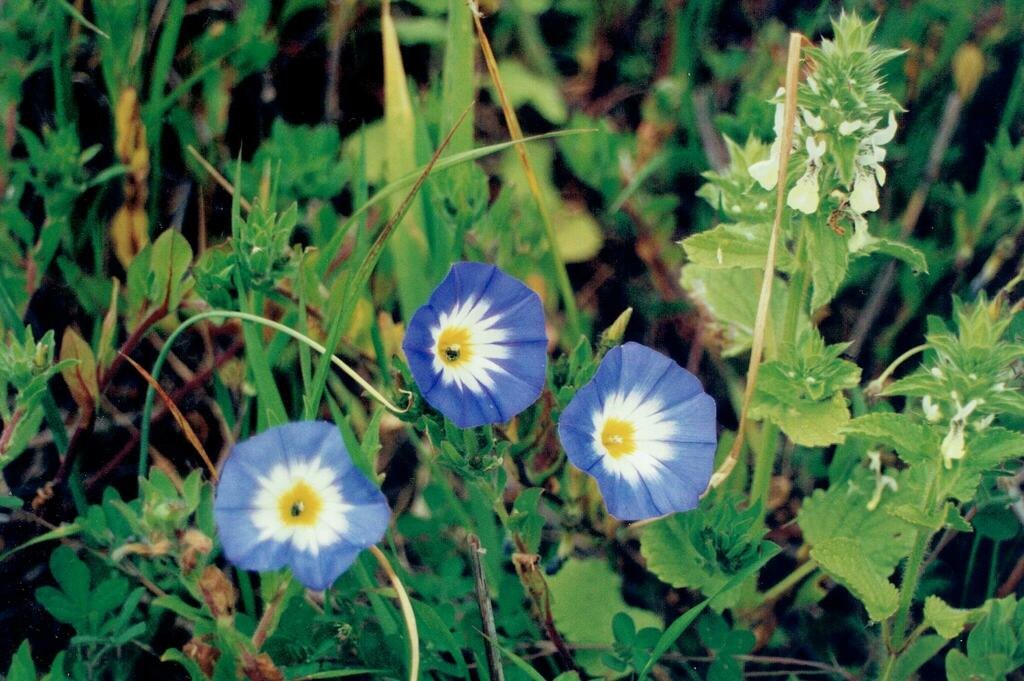
LATIN NAME: Convolvulus tricolor
COMMON NAME: Dwarf Morning Glory
Plant Profile
The dwarf morning-glory is a short, bushy annual with solitary, long-stalked flowers, and the first thing to say about it is that it does not twine. It is a convolvulus by family, a bindweed by genus, and a 30 to 40 cm mound by habit, which is the opposite of everything the name suggests to most gardeners.
The flower is a funnel about 3 cm across, in three colours at once: deep blue at the rim, a white band below, and a yellow eye. It opens in the morning and closes by afternoon, one day per flower, and the French common name belle de jour records exactly that schedule.
It is native to the Mediterranean Basin, especially the south, common on cultivated land, dry open ground, sandy places and roadsides. In Spain it is found in the Balearic Islands and Andalusia, and the wild plant is the ancestor of everything sold in packets.
Science & Biotechnology
The genus carries a taxonomic burden. This species has been described more than once under different names, and the synonyms include Convolvulus minor and C. maroccanus; four subspecies are now recognised, and one of them, subsp. hortensis, is the cultivated form, distinguished from the wild plant by its larger flowers and its willingness to stay in a garden bed.
Subsp. pentapetaloides, from the Balearic Islands, is separated from the type by small flowers of only 7 to 10 mm and by a calyx and capsule with few or no hairs. A gardener does not need to care, but it is a reminder that the seed packet version is a selected and enlarged descendant of a modest wildflower.
The family is easy to recognise once seen: funnel-shaped corolla pleated in bud, so it opens like an umbrella, and a fused tube with the stamens hidden inside. The same architecture runs from this little annual to the morning glories of tropical hedges, and the pleating is the fingerprint. Allied plants on the list: Convolvulus prostratus, Ipomoea nil and Ipomoea quamoclit.
Uses & Benefits
Its use is as an edging and bedding annual, in a pot, at the front of a border, or trailing over a low wall. The species and the cultivar ‘Blue Ensign’, a deep blue with the white and yellow throat, have both received the Royal Horticultural Society’s Award of Garden Merit, which is a fair measure of how reliable it is.
Because it does not climb, it can go where morning glories cannot: a shallow pot, a window box, the front twelve inches of a bed. The flowers open in the morning and are over by mid-afternoon, but a plant carries many buds, and the display renews daily from June to September.
It is drought-tolerant once established and prefers poorish, well-drained soil, in which it stays compact; a gravel edge over a hot wall is the classic site, and the reason Victorian gardeners grew it in quantity. In rich wet ground it grows larger, flowers less, and lies open after rain. It is also a good bee plant: the funnel gives access to most sizes of insect, and the flower is open during their working hours.
Growing from Seed
The seed is large for an annual of this size, with a hard coat. Soak it overnight, or nick it, and sow in spring at 18 to 21 °C, 5 mm deep. Germination takes one to two weeks and is quick and even, and the seedlings are up and growing before most other annuals have decided to start.
Sow in modules rather than open trays if you start under cover, because the roots are brittle and resent disturbance; plant out after the last frost, 25 cm apart, in full sun. Direct sowing after frost works equally well and skips the transplanting problem altogether.
Pinch the young plants once to encourage branching, water until established, and then leave them to it. Deadheading is optional since the flowers fall clean, but a light trim in late July will restart the display for September. Collect seed from the dry capsules in autumn and it will come true.
Our Take
It is one of the best annuals for people who want a morning glory without the scaffolding, and the blue is a real blue, which is rarer in annuals than catalogues imply. Three months of flower for a packet of seed is a fair trade anywhere.
Give it sun and drainage, sow it warm, and resist the urge to feed it. The plant that flowers itself to death in gravel is the one the catalogue photographed; the one in the compost-rich border will be a leafy disappointment with the same name.
Related Reading
Readers interested in Dwarf Morning Glory frequently explore these as well: