


Aubrieta deltoidea Seeds | Rock Cress
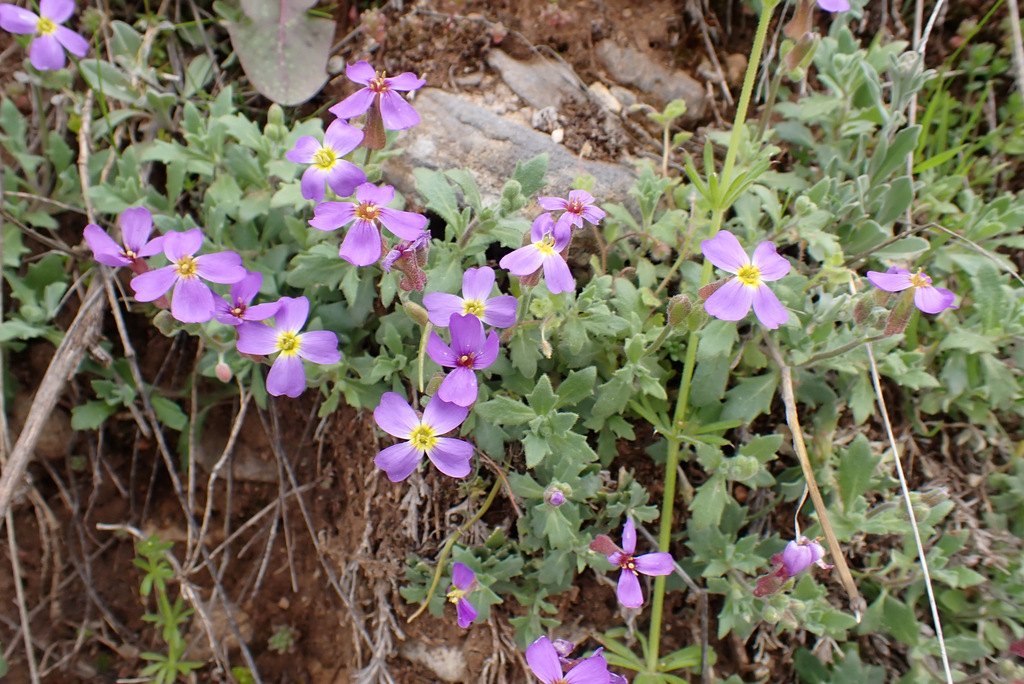
LATIN NAME: Aubrieta deltoidea
COMMON NAME: Rock Cress
Plant Profile
Aubrieta deltoidea comes from the rocky hills of southeastern Europe and the eastern Mediterranean, from Greece and the Balkans through western Turkey, where it grows in thin soil in cracks and on ledges that dry out completely in summer. That origin explains the plant’s two requirements: sharp drainage and full sun.
It is a low, mat-forming perennial, 10 cm high and 60 cm or more across, with small grey-green leaves that are spoon-shaped to oval, some of them lobed or toothed. The flowers are four-petalled, 1.5 to 2 cm across, in purple, violet, pink and white, held in loose heads that open in early spring and last four to six weeks. In full flower the plant disappears under its own bloom, and the foliage is not visible again until the flowers fade.
The fruit is an inflated, hairy silique up to 2 cm long, and it ripens seed freely. The garden plants sold as aubrieta are mostly hybrids between this species and Aubrieta cultorum, with a wider colour range and a more compact habit than the wild plant, and they are usually propagated by cuttings rather than seed.
Science & Biotechnology
Aubrieta is a member of the Brassicaceae, the mustard family, and it shows the family’s characteristic four-petalled flower arranged in a cross, which gives the family its older name, Cruciferae. The fruit is a silique, a two-valved capsule with a central partition, and in this species it is inflated and covered with branched hairs, a feature used to distinguish species in the genus.
The genus has about 15 species, centred on the eastern Mediterranean and Turkey, and it is one of a group of cushion-forming Brassicaceae that have evolved in the same way: dense low growth, early flowering, and a deep taproot that lets them survive summer drought in a few centimetres of soil. The same strategy appears in Arabis, Draba and Alyssum, so they are grown together in rock gardens.
Hardiness varies more than the labels suggest. The species is rated to USDA zone 4 in many references, but plants in wet winter soil die at much milder temperatures than that, because the crown rots before it freezes. Drainage matters more than the thermometer, and a plant in sharp gravel will survive a winter that kills one in clay.
Uses & Benefits
This is the classic plant for a wall, a rock garden, a bank, the edge of a path or a trough, where it can hang over an edge and flower in full sun. It is also good between paving stones and in the gravel at the front of a border, where its early flowers fill the gap between bulbs and the first perennials.
The flowering period is short but early, and it coincides with the moment when most of the garden is still bare. A sheet of purple aubrieta in March, hanging over a wall, is worth more than a border of summer flowers that nobody sees because they are on holiday in August.
It is not scented, not edible and has no medicinal use, which is unusual among the cabbage family, many of whose members are vegetables or medicines. It is a garden plant pure and simple, and it has been grown in European gardens since the early eighteenth century. It sits among Aubrieta cultorum, Iberis umbellata and Diplotaxis erucoides, all Brassicaceae.
Growing from Seed
Sow in late winter or early spring, on the surface at 15 to 18 °C, and press the seed down without covering it, since it needs light. Seedlings show inside three weeks. The seed is fine and the seedlings are small, so prick them out carefully into a gritty compost.
Grow on in a cool, bright frame or a cold greenhouse, and plant out in early autumn rather than spring; an autumn planting gives the roots time to establish before the first summer, which is when the plant is most likely to die. Space plants 30 to 40 cm apart, in full sun, in soil that drains within an hour of rain.
The main maintenance job is a hard trim immediately after flowering. Cut the whole cushion back by half with shears, without cutting into the old wood, which does not regenerate. That trim keeps the plant tight and stops it opening in the middle, and it is the difference between a plant that lives five years and one that lives fifteen. Take cuttings in early summer from non-flowering shoots if you want to keep a particular colour.
Our Take
Aubrieta is easy if you give it what it wants and impossible if you do not, and what it wants is drainage. On a wall, a bank or a gravel bed it ranks among the most rewarding plants in the garden; in clay soil it rots in the first wet winter, and no amount of grit in the planting hole will save it if the surrounding ground holds water.
Grow it where it can hang, cut it back hard in May, and take cuttings every few years so that you have replacements when a plant inevitably dies. The reward is a sheet of colour in the coldest, greyest week of the year, which is when you will appreciate it most.
Related Reading
Continue exploring with these related plants: