


Clarkia elegans Seeds | Elegant Clarkia
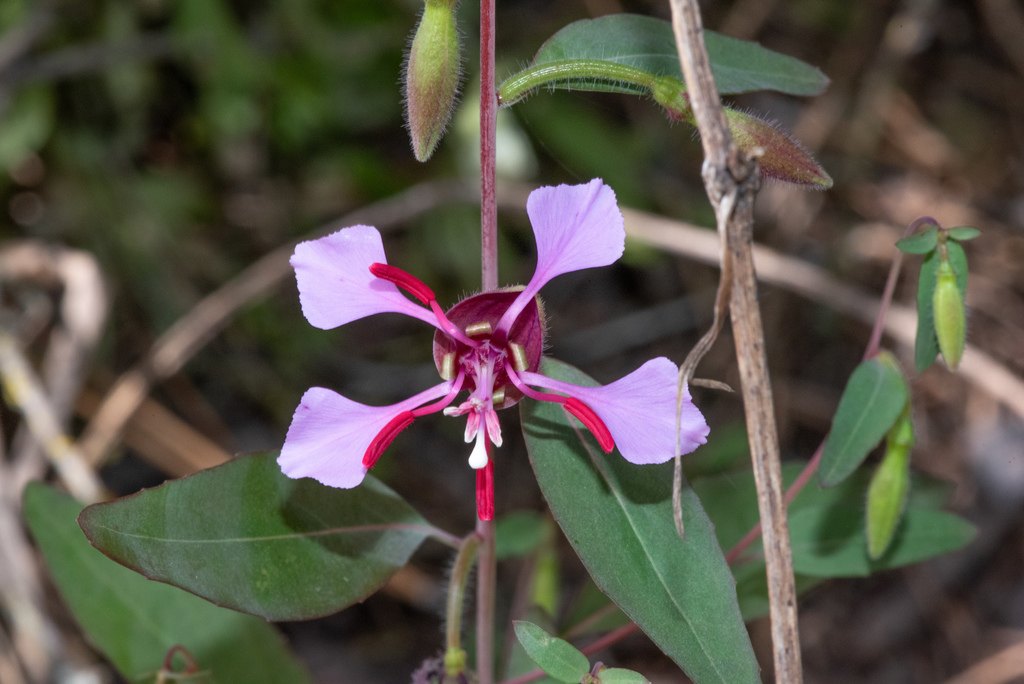
LATIN NAME: Clarkia elegans
COMMON NAME: Elegant Clarkia
Plant Profile
Elegant clarkia is an annual wildflower from California, and it looks like it: a spindly, hairless stem with a red flush, few leaves, and a loose raceme of four-petalled flowers in pink, rose and purple. It grows to about 90 cm in the wild and rather less in a garden, where it is usually finished by August and often by July.
The petals are 1 to 2.5 cm long, paddle-shaped and diamond-cut at the tip, and they sit in a cup of fused, hairy sepals. Eight stamens surround the style, and the outer four carry large red anthers. The stigma protrudes well beyond them, which is what makes the flower easy to recognise in a mixed meadow seed mix.
The name on the packet is out of date. The plant was described as Clarkia elegans and has been Clarkia unguiculata since the middle of the last century, but the trade still sells the old name because it is the one in the catalogues. It commemorates William Clark of the Lewis and Clark expedition, who collected plants on the way west.
Science & Biotechnology
It is pollinated by a small specialist bee, Hesperapis regularis, which lives in the same California habitats and works little else. The flower is also self-fertile, and a plant isolated from pollinators will still set seed. That combination is why the species survives in small roadside fragments where its bee may be absent for years at a time.
The seed is held in a small indehiscent fruit, a capsule that does not split, so the seeds stay inside until the whole structure breaks down. That is unusual in the evening primrose family, most of which open their capsules with four valves and shed seed as soon as it is ripe and dry.
It is a plant of dry air and dry soil, and it will not flower in humidity. California’s oak woodlands give it a wet winter and a rainless summer, and the plant finishes before the drought begins. Grown in a wet climate it makes lush growth, mildews, and flowers badly or not at all, which is the usual reason people give up on it.
Uses & Benefits
It is a meadow annual, sown in autumn with other California natives and left to sort itself out. The colour range is narrow and good: rose, salmon, lavender-pink, rarely white. It mixes well with yellow and blue, and badly with orange, which is worth knowing before you buy a mixed packet and hope for the best.
The seed is edible. It can be eaten raw or ground into a powder, and it was used that way by the peoples of its native range. The quantity from a garden patch is small, since each fruit holds only a few seeds, so it is a curiosity rather than a crop and not worth growing for the kitchen.
It is not a cut flower in the ordinary sense; the stems are wiry and the petals drop within a day. What it does well is fill a gap. Sown in autumn it flowers in late spring, after the bulbs and before the annuals, in exactly the fortnight when a border looks tired and empty. Its Onagraceae company here includes Clarkia amoena, Oenothera speciosa and Oenothera lindheimeri.
Growing from Seed
Sow in autumn where the plants are to flower, or in spring if you must, in poor sandy soil in full sun. The seed needs light, so press it in and do not cover it. Germination takes about two weeks at 15 to 18 °C, and autumn sowing gives much stronger plants than spring sowing ever does.
Do not enrich the ground. Rich soil produces a tall, soft plant that falls over in the first wind and flowers sparsely. A gravel mulch, a sunny slope and no feeding at all give the short, stiff habit the plant has in the wild, which is the habit that looks right in a meadow and wrong in a border.
Water while establishing, then stop. Once flowering starts, irrigation shortens the season and encourages mildew. Let the plants set seed and shake it where you want it; the species self-sows reliably in dry ground and not at all in wet ground. Pull the spent stems in August.
Our Take
It is a plant for people who have given up on it once already. The first attempt usually fails in a rich border in a wet summer, and the second succeeds on a dry bank with no attention at all. The difference is drainage and moving air, not skill or luck.
Where it works, it ranks among the prettiest things in the garden for three weeks and then it is over. That is the deal with annuals from a Mediterranean climate, and it is worth taking. Sow it thickly, expect losses, and let the survivors seed into the gravel.
Related Reading
Gardeners who grow Elegant Clarkia often pair it with these related subjects: