


Calceolaria crenatiflora Seeds | Pocketbook Plant
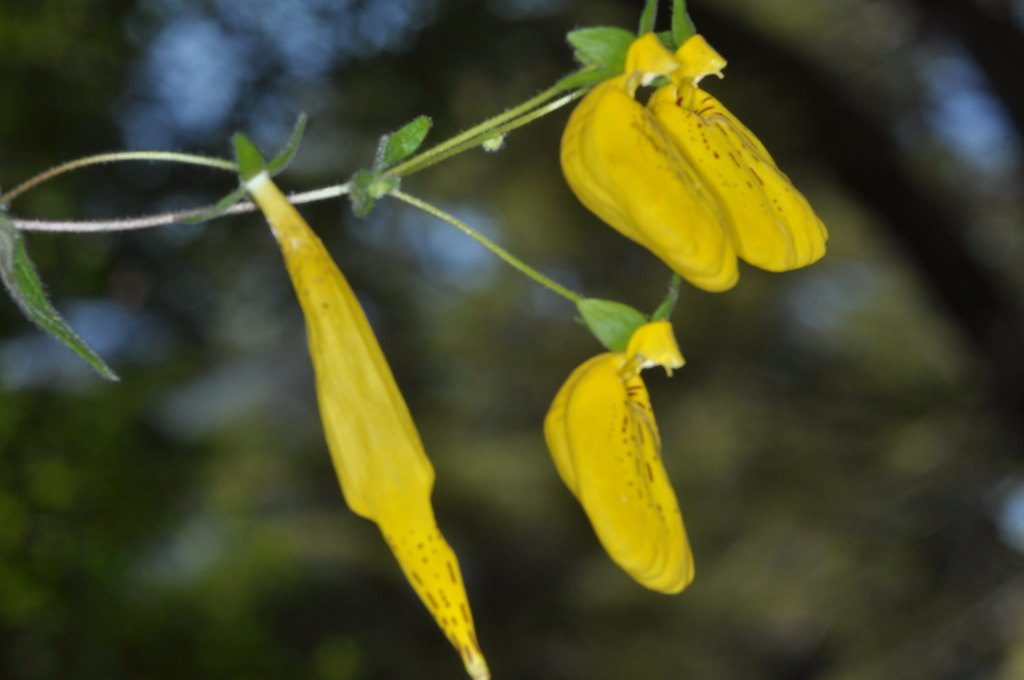
LATIN NAME: Calceolaria crenatiflora
COMMON NAME: Pocketbook Plant
Plant Profile
Calceolaria crenatiflora grows in central and southern Chile and across the Andes into southern Argentina, in damp shaded ground and on cool rocky slopes. It is a soft perennial, often grown as an annual, making a rosette of pale green, scalloped leaves 15 to 25 cm long and a head of flowers held above them on slender stems.
The flower is the reason anyone grows it. Each one is a small purse or slipper, a swollen yellow pouch 2 to 3 cm long with a small opening at the front, often spotted or blotched with red-brown, and the two lips are pressed together so that the whole thing looks like a mouth that has been stitched shut. No other common flower has that shape, and children recognise it before adults do.
The species name refers to the crenate, or scalloped, leaf margins. It is one of the parents, with C. corymbosa and C. cana, of the Calceolaria Herbeohybrida Group, the florist’s calceolarias sold in winter, which are larger-flowered and more compact than the wild plant but keep the pouch. The Royal Horticultural Society has given the species an Award of Garden Merit as a warm-temperate greenhouse ornamental, which is a precise way of saying it is not a garden plant in most of Europe. Close allies on the list: Penstemon digitalis, Veronica polita and Maurandya barclayana.
Science & Biotechnology
Calceolaria is one of the classic cases of oil-reward pollination. The flowers offer no nectar. Instead, a pair of glandular hairs inside the lip secretes a fatty oil, and female bees of the genera Centris and Chalepogenus collect it with specialised front-leg brushes, mix it with pollen and use it to line and provision their nests. The pouch shape is a fit to the bee’s body: it pushes into the flower, contacts the anthers, and leaves with pollen on its back.
The system is old and specific. It ties Calceolaria to a small group of oil-collecting bees in South America, and it explains why the plant is not a generalist’s flower and why it does not set seed in a European greenhouse without hand pollination. The oil is not a food reward in the way nectar is; it is a nest material, which makes the relationship unusually specialised.
The genus has about 350 species, centred on the Andes, and is one of the few plant groups whose flowers have evolved a reward that most pollinators cannot use. That narrowness is also its vulnerability: where the oil bees are absent, the plants persist as ornamentals but not as populations.
Uses & Benefits
This is a winter pot plant for a cool, bright room, a conservatory or a cold greenhouse. It flowers from late winter into spring, at the moment when colour is scarcest and when a windowsill is the only growing space most people have. It is not a plant for a warm living room: above about 18 °C it collapses, and dry air makes the leaves crisp at the edges within days.
In its native range it is a plant of damp shade, and that is the condition to imitate. Stand the pot on a saucer of damp gravel, keep the compost moist but never sodden, and give it light without direct sun. A north-facing windowsill in a cool room suits it better than a south-facing one.
It is also grown for show benches, where the spotted forms are judged on the evenness of the spotting and the fullness of the head. The plant is not edible, and the leaves contain calceolarin and other diterpenes that make it unpalatable to anything with sense.
Growing from Seed
Sow in late summer for winter and spring flowering, on the surface of a fine, moist seed compost, at 15 to 18 °C. The seed is dust-fine and needs light, so do not cover it; water from below or mist gently, and cover the tray with glass to hold humidity. The seedlings are up in a fortnight to three weeks.
Prick out when the seedlings are large enough to handle, into a compost with added leaf mould and grit for drainage. Grow on at 10 to 15 °C in good light, and keep the plants cool; a warm greenhouse in autumn produces soft growth that rots at the neck in winter.
Pot on as the roots fill, and water with care: the rosette is prone to botrytis if water sits in the crown, so water the compost and not the plant. A liquid feed every two weeks from bud stage keeps the flowers coming. After flowering the plant usually goes over and is discarded; it can be kept for a second year, but the rosette becomes woody and the flowering is poorer.
Our Take
Calceolaria is a plant with a narrow window. In a cool conservatory or a chilly spare room it ranks among the most curious and rewarding winter pots you can grow. In a modern centrally heated house it is dead in a fortnight, and no amount of care will change that. The plant is not difficult; the room is wrong.
If you have the right room, grow it and show it to children, who will understand the flower immediately. If you do not, admire it in a botanic garden and grow a cyclamen instead, which asks for the same conditions and forgives more.
Related Reading
More species in the same orbit as Pocketbook Plant: