


Nemesia strumosa Seeds | Nemesia
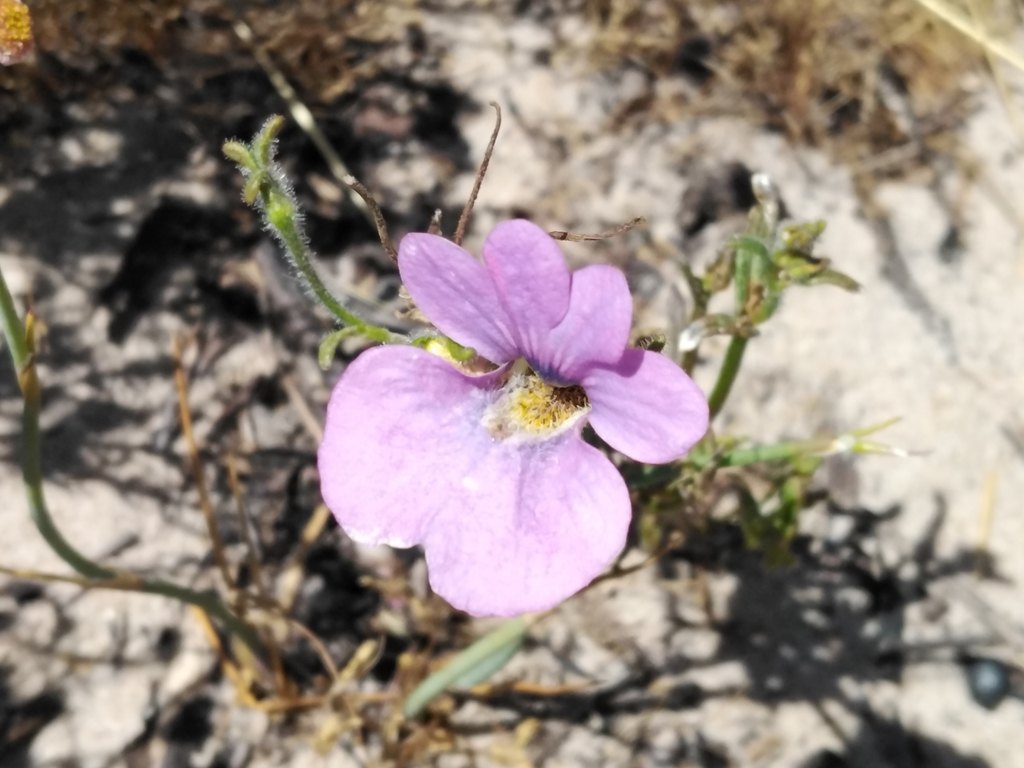
LATIN NAME: Nemesia strumosa
COMMON NAME: Nemesia
Plant Profile
Nemesia strumosa comes from the winter-rainfall country of the Western Cape and Namaqualand, where it germinates with the first autumn rains, flowers through the cool wet winter and sets seed before the dry summer arrives. That rhythm explains everything about it in a garden: it wants cool air, bright light and water while it grows, and it dies politely when the heat comes.
It grows 20 to 30 cm high in a bushy tuft, with narrow, slightly toothed leaves and flowers in loose terminal heads. Each flower is a small open-faced snapdragon, 1.5 to 2 cm across, with a two-lipped corolla, a yellow throat and a rounded pouch or spur at the back. The wild plant is orange and yellow; garden strains add white, cream, pink, blue, violet and bicolours, often with a contrasting lower lip and a yellow eye.
The species was described by Bentham in 1836 and reached European gardens at the end of the nineteenth century. Almost everything sold now is a hybrid with Nemesia versicolor, which brings the blue and the compact habit, and the Ball strains raised in California in the 1990s brought the colour range that made the plant a container staple. The family connection runs to Nemesia versicolor, Verbascum phoeniceum and Diascia.
Science & Biotechnology
Nemesia sits in the Scrophulariaceae, the figwort family, alongside snapdragons and Nemesia’s near relatives, and it shows the family’s characteristic two-lipped flower with a closed throat. The pouch at the back of the flower is not a nectar spur in the way a larkspur’s is; it is a swelling of the lower lip that presses against a visiting bee and deposits pollen on its back.
The genus has a base chromosome number of x = 9, and the garden hybrids are a mess of different ploidy levels, which is one reason seed strains vary so much and why a packet of mixed nemesia gives plants of three different sizes. Modern F1 strains have stabilised the habit, at the cost of the variability that made the old mixtures interesting.
Breeding has concentrated on two things: holding the colour in heat and keeping the plant compact without growth regulators. Neither has fully succeeded. The flowers still fade in strong sun, and the compact habit still collapses into a floppy mound by midsummer in warm climates, which is the plant telling you it is finished.
Uses & Benefits
Nemesia is a gap-filler. It flowers eight to ten weeks from sowing, which is faster than almost any other annual, and it will bloom in the cool weeks of early spring when pansies are still sulking and lobelia has not started. Use it at the front of a border, in containers, in the pockets between spring bulbs, and in the cool shade of a north wall where it will last into June.
In mild climates it has a second life in autumn. Sow in late summer, plant out in September, and it will flower until the first hard frost, which in a Mediterranean or Californian garden means December. In a cold-winter garden that autumn sowing is not possible outdoors, but a late-summer sowing under glass will give plants for a cool conservatory in November.
Some strains are scented, a sweet vanilla-ish smell strongest in the evening, and the scent is one of the reasons the plant is sold as much for containers as for beds. It is not edible and has no medicinal use; it is a garden plant, and a good one.
Growing from Seed
Sow indoors eight to ten weeks before the last frost, on the surface and only just covered, at 15 to 18 °C. The seed needs light and cool conditions; a warm propagator will give a poor and uneven germination. Expect 7 to 14 days.
Keep the seedlings cool and bright, around 15 °C, or they stretch into weak stems that never recover. Prick out into small pots and grow on at 12 to 15 °C. Harden off carefully, since the plants have been raised in cool conditions and a sudden move to a warm greenhouse does more harm than the cold outside.
Plant out after the last frost, 20 to 25 cm apart, in full sun or light shade. Water regularly for the first three weeks; after that the plants are surprisingly drought-tolerant for something so soft. Deadhead to keep flowers coming, and when flowering stops in heat, cut the plants back by half and water. In cool autumn weather they will often push a second flush from the base.
Our Take
Nemesia is a plant that rewards timing more than skill. Sown at the right moment it ranks among the fastest and most generous annuals you can grow; sown three weeks late it flowers in the first heat and is over before you have noticed it. In a climate with cool springs it is indispensable; in one where May arrives at 30 °C, grow it for autumn instead.
The colour range is the attraction, particularly the blues and the bicolours, which are rare among annuals that flower this early. The habit is the weakness. Plants flop, the centre opens up, and by July you are looking at a tangle of stems. Cut them back hard at that point rather than pulling them out, and give them a month; the second flush is usually better than the first.
Related Reading
Readers interested in Nemesia frequently explore these as well: