


Osteospermum ecklonis Seeds | Cape Marguerite
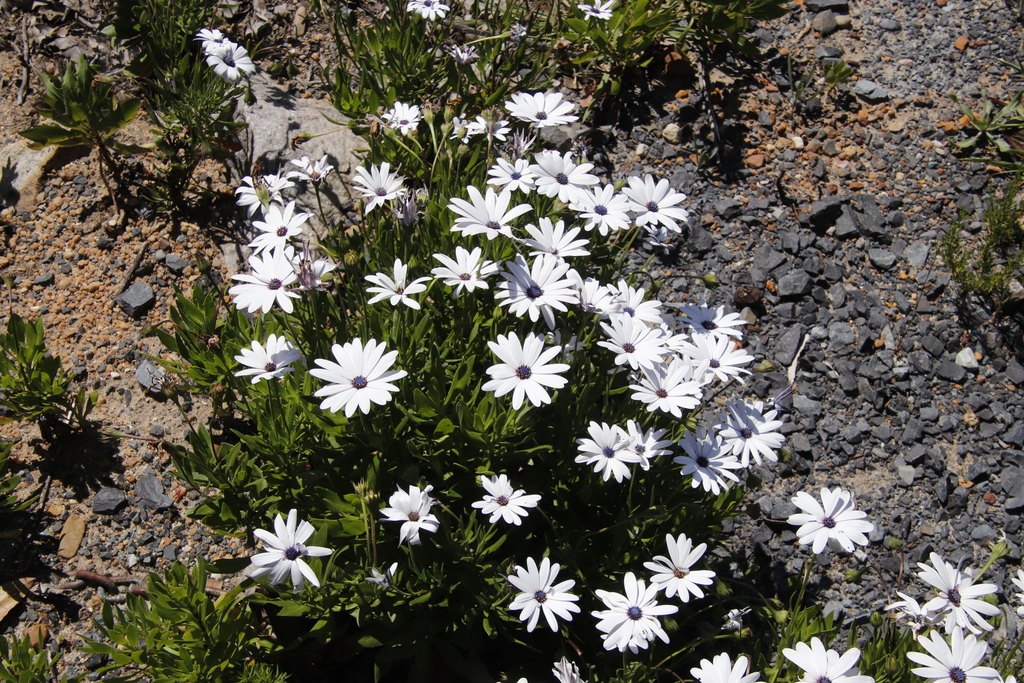
LATIN NAME: Osteospermum ecklonis
COMMON NAME: Cape Marguerite
Plant Profile
The Cape marguerite is an evergreen, shrubby perennial from the Eastern Cape, grown almost everywhere as a bedding plant. It reaches about a metre where it is happy, with flower heads 5 to 8 cm across: white ray florets above, washed with reddish blue underneath, around a disc that is dark blue or purple. The effect is a white daisy with a dark eye and a blue shadow.
Leaves are stalkless, elliptical, slightly succulent and covered in glandular hairs, up to 25 cm long on strong shoots and much smaller on the flowering stems. The margins are entire or toothed. The whole plant smells faintly resinous when handled, which is the first clue that the foliage is defended rather than merely decorative.
The name on the label is out of date. The species has been moved into Dimorphotheca, so the accepted name is Dimorphotheca ecklonis, and the horticultural trade has not caught up. It commemorates Christian Friedrich Ecklon, a Danish collector who worked the Cape flora in the 1820s and whose name is attached to a good many plants. The other Asteraceae in the catalogue are Madia sativa, Doronicum orientale and Aster alpinus.
Science & Biotechnology
The plant contains hydrocyanic acid, which makes it poisonous to cattle, rabbits and rodents. Gardeners rarely notice, because the leaves are bitter and nothing grazes them twice, but clippings should not go into a rabbit hutch or into a compost heap that livestock can reach. The same compound is why the plant is left alone by most herbivores.
The two-tone ray florets are the interesting part. The pigment is held on the upper surface, so the head reads white from above and blue-grey from below, and the colour shifts with the angle of the sun. The plant is strongly phototropic, so it has been used as a UV indicator in laboratory work on radiation.
It is also a workable model organism: fast, flowering all year under glass, and easy to propagate from both seed and cutting. That combination is why it turns up in research on flowering time and on photoperiod. In the field it has spread well beyond its small native range, and it is listed as invasive in Victoria and Western Australia.
Uses & Benefits
In cool gardens it is a spring bedding plant, bought in flower and set out after the last frost. In Mediterranean climates it is a winter-flowering shrub that carries the border through the wet months, when little else is open. Either way it wants sun and sharp drainage, and it sulks in wet clay through the whole of a wet winter.
It is a container plant before it is a border plant. The habit is upright and self-supporting, the flowers sit above the foliage where they can be seen, and a single plant fills a 30 cm pot by midsummer. Mixed with nemesia or a silver-leaved helichrysum it looks deliberate rather than municipal, which is a distinction worth making.
It is not a cut flower, whatever the label suggests. The stems droop within hours and no amount of conditioning fixes it, because the peduncle has no woody support to hold the head upright. Cut it for a table if you like, but expect to change the water twice a day and to lose the lot by evening.
Growing from Seed
Sow in spring at about 18 °C, on the surface or barely covered, and expect ten to twenty-one days. Germination is uneven and the seedlings are slow for the first fortnight, which tempts people to throw the tray out too early. Fresh seed is much better than old; viability falls away quickly in a warm drawer.
Cuttings are quicker and truer. Take softwood tips in late spring or semi-ripe wood in late summer, root them in gritty compost at 18 °C, and overwinter the plants just frost-free. Named cultivars, including the dark-centred ones, have to be done this way, because seed will not reproduce them.
Plant out 15 to 25 cm apart in poor to moderately fertile, sandy soil in full sun. Rich soil and shade produce soft growth that flowers little and rots at the crown in winter. Deadhead to keep the heads coming, and cut the plant back by a third after the spring flush to stop it from becoming leggy and bare at the base.
Our Take
It earns its place in the six weeks when nothing else is out, and it does so without fuss. The problem is the gap after midsummer, when the plant is leggy, the flowers are small and the leaves look tired. Cut it back hard, water it, and it will usually give a second, smaller flush in autumn.
Check the weed status before planting if you garden in Australia, Portugal or any Mediterranean island. A plant that is banned from sale in one state and still on the bench in the next is worth a moment’s thought, and the answer is usually to keep it in a pot and deadhead it properly.
Related Reading
Readers interested in Cape Marguerite frequently explore these as well: