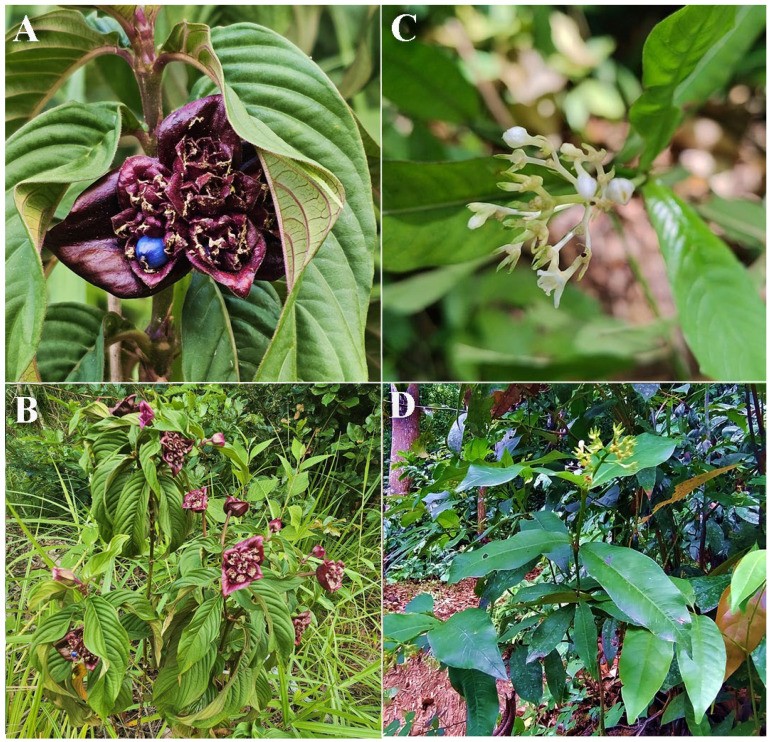
LATIN NAME: PALICOUREA COLORATA
COMMON NAME: Palicourea, Psychotria colorata
The Palicourea colorata, or palicourea, is a striking evergreen shrub of the warm forests, and its large, oval, bright-green leaves and its clusters of the small, red or orange flowers, followed by the small, dark berries, have made it a plant of the understory and the warm gardens across the tropical and the subtropical regions. It grows as an evergreen shrub of the coffee family, reaching up to four metres or more, with the smooth, greenish-brown bark and the branching stems bearing opposite, large, oval, bright-green, thin-textured leaves, and bearing, in the warm months, the clusters of the small, tubular, red or orange flowers at the ends of the branches, followed by the small, round, dark berries which contain the seeds. It is a species of the flowering shrub, native to the warm forests of the tropical regions of the Americas, while it has been cultivated in the warm gardens and the greenhouses, and it is known as the palicourea or the Psychotria colorata.
Scientific Research & Plant Biotechnology
The palicourea has a real and distinguished place in research. It has been studied in the botany and the plant systematics, since the Palicourea colorata is a member of the coffee family and a relative of the other palicoureas, the psychotrias and the coffee, and the researchers have examined its classification, its relationships and its distribution, while the study of the tropical shrubs has drawn attention in the international botanical press. The plant has also been studied in the ecology and the tropical forest science, since the palicourea is an understory shrub of the warm forests and a food source for the hummingbirds and the birds which visit its flowers and eat its berries, and the researchers have examined its role in the forest ecosystems and its pollination, while the study of the tropical understory plants has been of continuing interest. The species has also been studied in the horticulture, since it is a striking evergreen shrub for the warm garden and the greenhouse, and its cultivation and its value in the landscape have been examined, while the large, bright-green leaves and the red or orange flowers of the palicourea have been of interest to the botanists and the warm-garden enthusiasts. For a shrub of such colour, the Palicourea colorata has a rich and distinguished record of research.
Ecological & Economic Value & Wide Applications
To grow the Palicourea from seed, the palicourea is an evergreen shrub of the warm forests, bearing the large, oval, bright-green leaves and the clusters of the small, red or orange flowers, followed by the small, dark berries. Its tubular, red or orange flowers are a magnet for the hummingbirds and the other pollinators, and its lush, evergreen foliage gives a fine presence in the warm garden and the understory, while its colourful flowers give a striking effect in the shaded garden. Its economic value is real: the palicourea is prized as a striking evergreen shrub for the warm garden and the greenhouse, and its value has drawn attention in the international horticultural press, while the colourful flowers and the lush foliage have made it a plant of interest to the warm-garden enthusiasts and the plant collectors, and the shrub is a fine addition to the warm garden, the greenhouse and the shaded border. To raise the palicourea, sow the seeds in pots of moist, open compost in a warm, shaded place, keep them gently watered, and grow the little shrubs on in the warmth.
sow the seeds in pots of moist, open compost in a warm, shaded place, keep the young palicourea gently watered, and grow the little shrubs on in the warmth.
Palicourea colorata (Formerly Psychotria colorata): A Tropical Shrub of Medicinal Wisdom and Ecological Grace
During a research trip to the Amazon basin a few years ago, I wandered off the main trail and stumbled upon a cluster of small, vibrant shrubs growing along the banks of a slow-moving stream. Their leaves were glossy, deep green, and arranged in opposite pairs, and clusters of tiny, pale pink flowers peeked out from the foliage—subtle, but striking in the dappled sunlight of the rainforest. A local guide, who had been teaching me about native plants, noticed my gaze and said, “That’s Palicourea colorata—we call it ‘flor de rosa’ here. Once, it was known as Psychotria colorata, but the botanists reclassified it a few years back. It’s not just pretty; it’s a healer for our people.” That moment stuck with me, and over the weeks that followed, I learned more about this unassuming shrub—its tangled taxonomic history, its deep roots in traditional
medicine, and its quiet role in supporting the rainforest ecosystem. It’s a plant that’s easy to overlook amid the Amazon’s flashier flora, but its value runs far deeper than its delicate appearance.
First, let’s clear up the name confusion: Palicourea colorata and Psychotria colorata are
the exact same plant—just classified under different genera over time. For decades, it was grouped with Psychotria, a large genus in the Rubiaceae family (the same family as coffee and gardenias). But recent botanical studies reclassified it into the Palicourea genus, as it shares key traits with other Palicourea species—like its
flower structure and fruit shape—more closely than with Psychotria. Native to southern tropical America, this evergreen shrub thrives in wet tropical biomes, often growing in the understory of rainforests, along stream banks, or in gallery forests, where it gets plenty of moisture and dappled sunlight. It typically grows 1 to 2 meters tall, with a bushy, compact growth habit, and its leaves are elliptical, thick, and leathery—adapted to retain moisture in the humid rainforest air. The small, tubular flowers bloom in clusters, ranging from pale pink to lavender, and they’re followed by small, round, blue-black berries that hang in clusters, tempting birds and small mammals to disperse their seeds.
The most significant and deeply rooted use of Palicourea colorata is in traditional medicine, a practice passed down through indigenous communities in South America for centuries. During my trip, I sat with an elder from the Kichwa community who showed me how they harvest the leaves and stems of the shrub, drying them in the shade to preserve their medicinal properties. “We use it for many things,” she told me, crushing a handful of dried leaves between her palms to release a faint, earthy aroma. “For fevers, we make a decoction—steep the leaves in hot water, drink it slow. For cuts or insect bites, we crush fresh leaves into a paste and apply it to the skin to stop bleeding and reduce swelling.” This aligns with what I later learned from botanical studies: Palicourea colorata is part of the Palicourea genus, which is known to be a rich source of bioactive compounds like iridoids, flavonoids, and alkaloids—substances that give the plant its anti-inflammatory, antimicrobial, and hemostatic (bleeding-stopping) properties. Indigenous communities also use it to treat digestive issues, hypertension, and even parasitic worms, relying on its natural healing power to address common ailments in regions where modern medicine is scarce.
While traditional medicinal use is its most well-documented role, Palicourea colorata also plays a vital part in the rainforest ecosystem. As a native understory shrub, it contributes to the biodiversity of tropical forests—particularly in gallery forests of the Brazilian Cerrado, where it’s one of the dominant species in the understory. Its flowers are a valuable source of nectar for pollinators like bees, butterflies, and even hummingbirds, which are drawn to their subtle fragrance and pale color. The blue-black berries are a favorite food source for birds, which eat the fruit and disperse the seeds across the forest, helping the shrub colonize new areas. Its dense foliage also provides shelter for small insects and amphibians, offering a safe haven from predators and the harsh midday sun. In this way, Palicourea colorata is a quiet contributor to the balance of the rainforest, supporting the web of life that makes these ecosystems so resilient.
Beyond medicine and ecology, Palicourea colorata has a few practical uses tied to local culture. Some communities use the dried leaves as a natural insect repellent, placing bundles of them in homes to keep mosquitoes and other pests at bay. The stems, which are flexible but sturdy, are sometimes used to weave small baskets or decorative items—though this is less common than its medicinal use. I also noticed that some local artisans use the plant’s leaves to add a subtle green dye to textiles, creating soft, earthy hues that complement traditional fabrics. These uses are simple, but they reflect how deeply the plant is integrated into the daily lives of the communities that live alongside it.
Growing Palicourea colorata is possible in tropical and subtropical regions, but it requires conditions that mimic its natural rainforest habitat—and it’s not a plant for casual gardeners. It thrives in moist, well-drained, humus-rich soil, and it needs partial shade—too much direct sunlight can scorch its leaves, while too much shade can make it leggy and reduce flower production. It prefers high humidity, so in drier climates, misting the leaves regularly or placing a tray of water near the plant can help keep it healthy. Propagation is typically done through seeds or stem cuttings; seeds should be sown in a warm, moist soil mix, while cuttings should be taken from healthy, mature stems and rooted in a well-draining medium. I tried growing a few cuttings in a greenhouse during my trip, and I quickly learned that overwatering is its biggest enemy—soggy soil leads to root rot, which can kill the plant quickly. It’s also relatively resistant to pests and diseases, but aphids and scale insects can occasionally be a problem; a gentle spray of soapy water usually takes care of the issue without harming the plant or its pollinators.
One thing that struck me during my time learning about Palicourea colorata is how little it’s known outside of its native range. Unlike some tropical plants that are prized for their exotic flowers or commercial value, this shrub remains underappreciated, even though it’s a treasure trove of traditional wisdom and ecological value. It’s also worth noting that, like many rainforest plants, its wild populations face threats from habitat destruction—deforestation for agriculture and development is shrinking its natural range, putting both the plant and the traditional knowledge associated with it at risk. Local communities and conservation groups are working to protect it, promoting sustainable harvesting practices and growing it in community gardens to reduce pressure on wild populations.
To me, Palicourea colorata is more than just a plant—it’s a bridge between nature and culture, between traditional wisdom and modern science. It’s a reminder that some of the most valuable plants are the ones that don’t demand attention, but quietly provide for the communities and ecosystems that depend on them. Every time I think of its glossy leaves and pale pink flowers, I remember the elder’s hands crushing dried leaves, the way birds feasted on its berries, and the quiet hum of pollinators around its blooms. It’s a plant that teaches patience, respect, and the importance of preserving the natural world and the knowledge it holds. Whether you encounter it in the Amazon rainforest, a tropical garden, or read about it in a botanical text, Palicourea colorata—once Psychotria colorata—is a plant worth getting to know, for its beauty, its utility, and the stories it carries.



